. 2011 Jun 9;117(23):6319-25.
doi: 10.1182/blood-2010-12-327957. Epub 2011 Apr 14.

Skeletal muscle hemojuvelin is dispensable for systemic iron homeostasis

Affiliations

Skeletal muscle hemojuvelin is dispensable for systemic iron homeostasis

Wenjie Chen et al. Blood. .

Abstract

Hepcidin, a hormone produced mainly by the liver, has been shown to inhibit both intestinal iron absorption and iron release from macrophages. Hemojuvelin, a glycophosphatidyl inositol-linked membrane protein, acts as a bone morphogenetic protein coreceptor to activate hepcidin expression through a SMAD signaling pathway in hepatocytes. In the present study, we show in mice that loss of hemojuvelin specifically in the liver leads to decreased liver hepcidin production and increased tissue and serum iron levels. Although it does not have any known function outside of the liver, hemojuvelin is expressed at very high levels in cardiac and skeletal muscle. To explore possible roles for hemojuvelin in skeletal muscle, we analyzed conditional knockout mice that lack muscle hemojuvelin. The mutant animals had no apparent phenotypic abnormalities. We found that systemic iron homeostasis and liver hepcidin expression were not affected by loss of hemojuvelin in skeletal muscle regardless of dietary iron content. We conclude that, in spite of its expression pattern, hemojuvelin is primarily important in the liver.


Figures
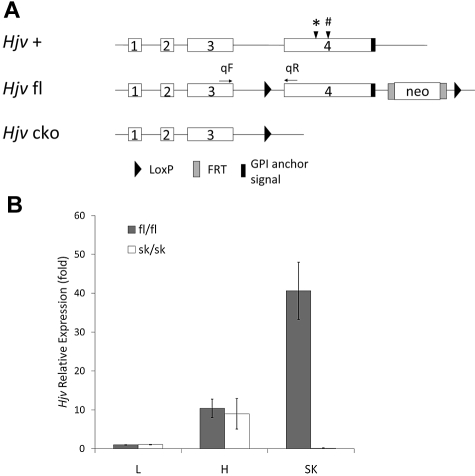
Figure 1
Figure 1
Targeted disruption of the Hjv gene. (A) Schematic representation of the mouse wild-type Hjv genomic sequence (+), LoxP-flanked allele with FRT-flanked Neo sequence (fl), and conditional knock out (cko) alleles. Positions of sequences coding for features of the protein are indicated as follows: (*) indicates the Tmprss6 cleavage site and (#) the Furin cleavage site., (B) Hjv mRNA relative expression in liver (L), heart (H), and skeletal muscle (SK) by quantitative RT-PCR. fl/fl indicates mice with the homozygous fl allele (n = 4); sk/sk, mice with the homozygous cko allele in skeletal muscle (n = 4). Quantitative PCR primers of Hjv were qF, the forward primer in exon 3, and qR, the reverse primer in exon 4. Rpl19 was used as an internal control. The Hjv expression level in liver from Hjv fl/fl mice was assigned as 1. Error bars represent SD.
Figure 2
Figure 2
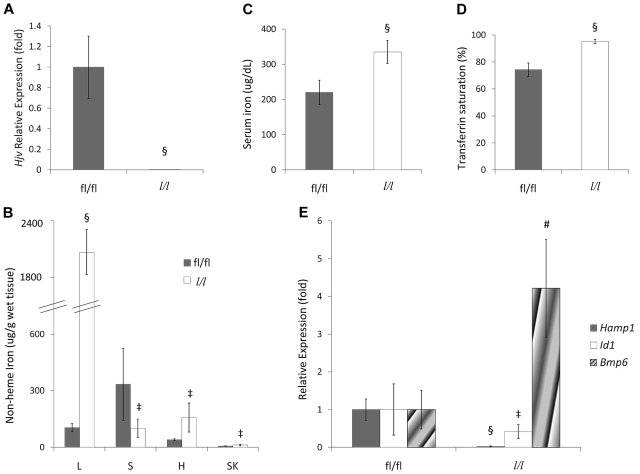
Hjv liver-specific knockout mice exhibit iron-overload phenotypes. (A) Relative Hjv mRNA expression in liver determined by quantitative RT-PCR. fl/fl indicates mice with the homozygous fl allele; l/l, homozygous fl mice expressing the Cre transgene in liver. The Hjv expression level in the livers of fl/fl mice was assigned a value of 1. (B) Serum iron concentration. (C) Serum transferrin saturation. (D) Nonheme tissue iron concentrations (μg/g wet weight) of fl/fl and Hjv liver-specific knockout (l/l) mice. L indicates liver; S, spleen; H, heart; and SK, skeletal muscle. (E) Hepatic Hamp1, Id1, and Bmp6 relative to Rpl19 mRNA expression by quantitative RT-PCR. Results are reported as the -fold change from Hjv fl/fl mice. (A-E) Mean values from analysis of 8-week-old mice (fl/fl mice: 3 male and 2 female, l/l mice: 4 male and 2 female) are graphed. Error bars represent SD. ‡P < .05, #P < .005, and §P < .0005 compared with Hjv fl/fl mice.
Figure 3
Figure 3
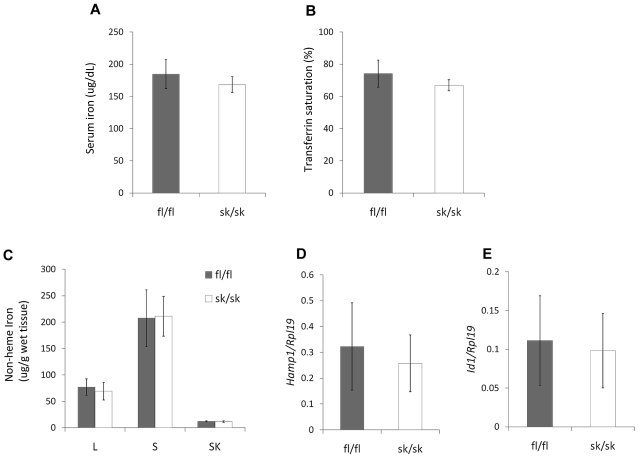
Iron homeostasis is not altered in Hjv skeletal muscle–specific knockout mice. (A) Serum iron concentration. (B) Serum transferrin saturation. (C) Nonheme tissue iron concentrations (μg/g wet weight) of Hjv fl/fl and skeletal muscle–specific knockout (sk/sk) male mice. L indicates liver; S, spleen; and SK, skeletal muscle. (D) Hepatic Hamp1 relative to Rpl19 mRNA expression. (E) Hepatic Id1 relative to Rpl19 mRNA expression. Mean values from analysis of 8-week-old male mice (n = 8 per genotype) are graphed. Error bars represent SD. No statistically significant differences were observed.
Figure 4
Figure 4
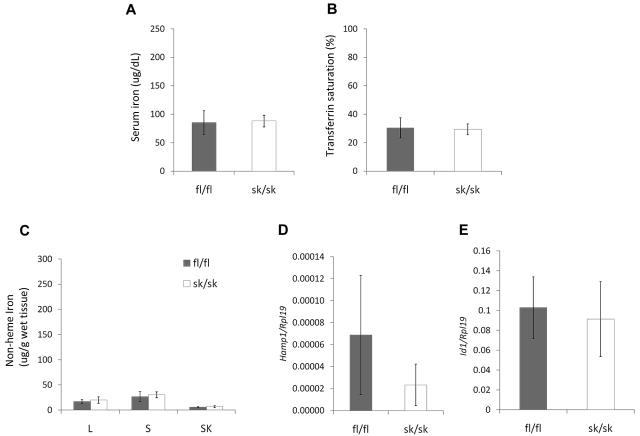
Iron homeostasis in Hjv skeletal muscle–specific knockout mice on iron-deficient diet. (A) Serum iron concentration. (B) Serum transferrin saturation. (C) Nonheme tissue iron concentrations (μg/g wet weight) of Hjv fl/fl and skeletal muscle-specific knockout (sk/sk) female mice. L indicates liver; S, spleen; and SK, skeletal muscle. (D) Hepatic Hamp1 relative to Rpl19 mRNA expression. Note that all values were very low compared with mice on a standard diet. (E) Hepatic Id1 relative to Rpl19 mRNA expression. Mean values from analysis of 8-week-old female mice (n = 8 per genotype) are graphed. Error bars represent SD. No statistically significant differences were observed.
Figure 5
Figure 5
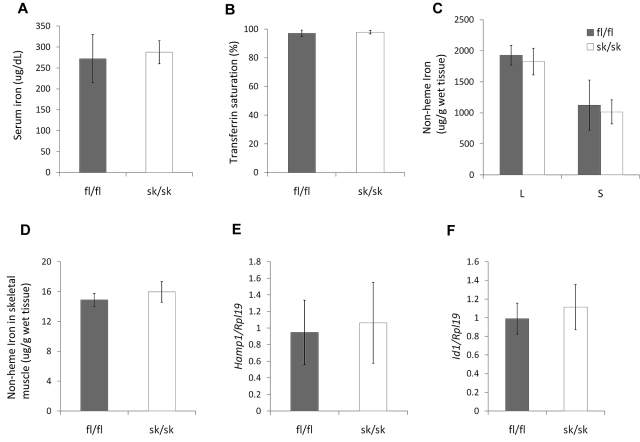
Iron homeostasis in Hjv skeletal muscle–specific knockout mice on iron-rich diet. (A) Serum iron concentration. (B) Serum transferrin saturation. (C) Nonheme tissue iron concentrations (μg/g wet weight) of Hjv fl/fl and skeletal muscle–specific knockout (sk/sk) male mice. L indicates liver; and S, spleen. (D) Nonheme iron concentrations in skeletal muscle. (E) Hepatic Hamp1 relative to Rpl19 mRNA expression. (F) Hepatic Id1 relative to Rpl19 mRNA expression. Mean values from analysis of 8-week-old male mice (n = 4 for fl/fl and n = 6 for sk/sk) are graphed. Error bars represent SD. No statistically significant differences were observed.

References

    1. Roetto A, Papanikolaou G, Politou M, et al. Mutant antimicrobial peptide hepcidin is associated with severe juvenile hemochromatosis. Nat Genet. 2003;33(1):21–22. - PubMed
    1. Nicolas G, Bennoun M, Devaux I, et al. Lack of hepcidin gene expression and severe tissue iron overload in upstream stimulatory factor 2 (USF2) knockout mice. Proc Natl Acad Sci U S A. 2001;98(15):8780–8785. - PMC - PubMed
    1. Weinstein DA, Roy CN, Fleming MD, Loda MF, Wolfsdorf JI, Andrews NC. Inappropriate expression of hepcidin is associated with iron refractory anemia: implications for the anemia of chronic disease. Blood. 2002;100(10):3776–3781. - PubMed
    1. Nicolas G, Bennoun M, Porteu A, et al. Severe iron deficiency anemia in transgenic mice expressing liver hepcidin. Proc Natl Acad Sci U S A. 2002;99(7):4596–4601. - PMC - PubMed
    1. Pigeon C, Ilyin G, Courselaud B, et al. A new mouse liver-specific gene, encoding a protein homologous to human antimicrobial peptide hepcidin, is overexpressed during iron overload. J Biol Chem. 2001;276(11):7811–7819. - PubMed

Publication types