Lower risk in parous women suggests that hormonal factors are important in bladder cancer etiology
- PMID: 21493870
- PMCID: PMC3312020
- DOI: 10.1158/1055-9965.EPI-11-0017
Lower risk in parous women suggests that hormonal factors are important in bladder cancer etiology
Abstract
Background: Urinary bladder cancer is two to four times more common among men than among women, a difference in risk not fully explained by established risk factors. Our objective was to determine whether hormonal and reproductive factors are involved in female bladder cancer.
Methods: We analyzed data from two population-based studies: the Los Angeles-Shanghai Bladder Cancer Study, with 349 female case-control pairs enrolled in Los Angeles and 131 female cases and 138 frequency-matched controls enrolled in Shanghai, and the California Teachers Study (CTS), a cohort of 120,857 women with 196 incident cases of bladder urothelial carcinoma diagnosed between 1995 and 2005. We also conducted a meta-analysis summarizing associations from our primary analyses together with published results.
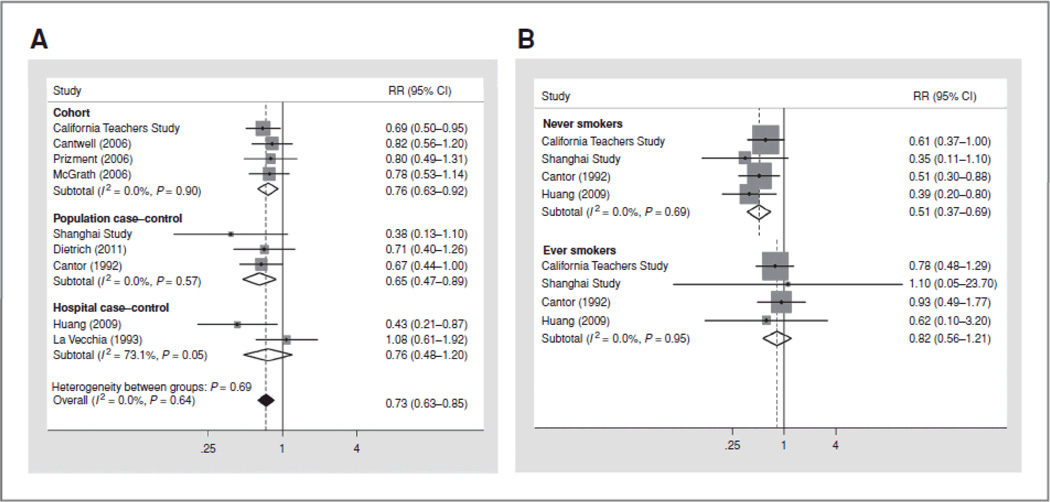
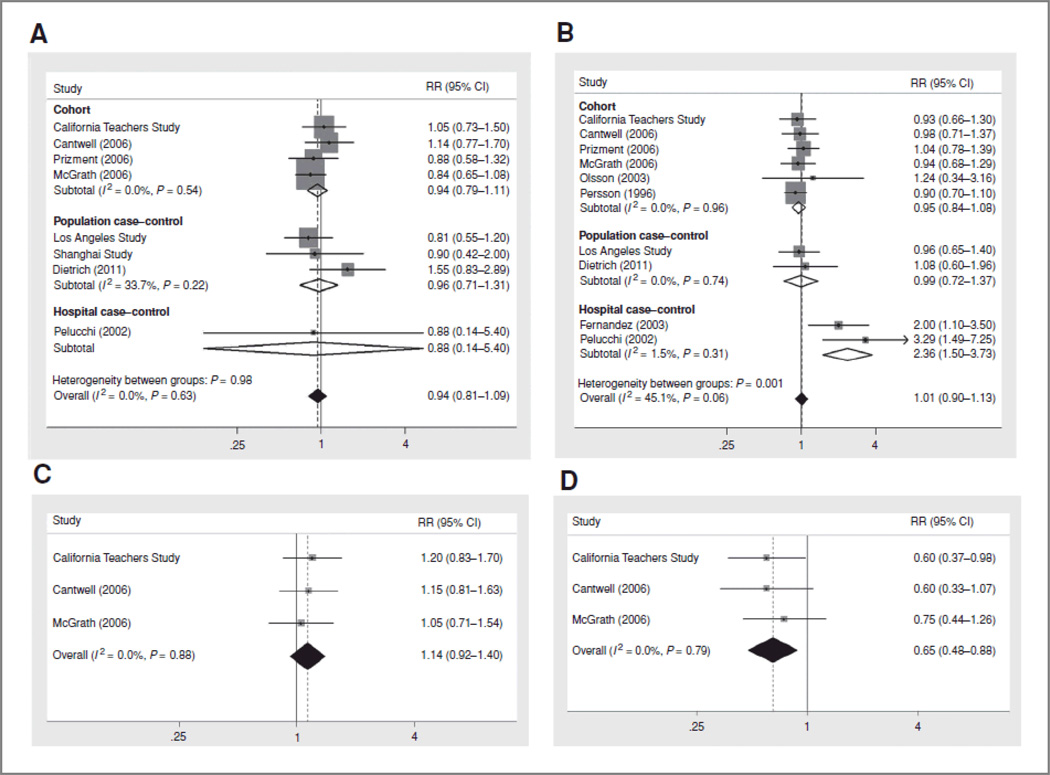
Results: In primary data analyses, parous women experienced at least 30% reduced risk of developing bladder cancer compared with nulliparous women (Shanghai: OR = 0.38, 95% CI: 0.13-1.10; CTS: RR = 0.69, 95% CI: 0.50-0.95) consistent with results of a meta-analysis of nine studies (summary RR = 0.73, 95% CI: 0.63-0.85). The CTS, which queried formulation of menopausal hormone therapy (HT), revealed a protective effect for use of combined estrogen and progestin compared with no HT (RR = 0.60, 95% CI: 0.37-0.98). Meta-analysis of three studies provided a similar effect estimate (summary RR = 0.65, 95% CI: 0.48-0.88).
Conclusions: A consistent pattern of reduced bladder cancer risk was found among parous women and those who used estrogen and progestin for HT.
Impact: These results suggest that more research is warranted to investigate hormonal and reproductive factors as possible contributors to bladder cancer risk.
©2011 AACR.
Figures
References
-
- American Cancer Society. Cancer Facts and Figures 2010. Atlanta: American Cancer Society; 2010.
-
- Murta-Nascimento C, Schmitz-Drager BJ, Zeegers MP, Steineck G, Kogevinas M, Real FX, et al. Epidemiology of urinary bladder cancer: from tumor development to patient’s death. World J Urol. 2007;25:285–295. - PubMed
-
- Report on Carcinogens. Eleventh Edition; U.S. Department of Health and Human Services, Public Health Service, National Toxicology Program. 2005
-
- Castelao JE, Yuan J-M, Skipper PL, Tannenbaum SR, Gago-Dominguez M, Crowder JS, et al. Gender- and smoking-related bladder cancer risk. J Natl Cancer Instit. 2001;93:538–545. - PubMed
-
- Hartge P, Harvey EB, Linehan WM, Silverman DT, Sullivan JW, Hoover RN, et al. Unexplained excess risk of bladder cancer in men. J Natl Cancer Instit. 82. 1990:1636–1640. - PubMed
Publication types
MeSH terms
Substances
Grants and funding
- U55/CCR921930-02/PHS HHS/United States
- CA-77398/CA/NCI NIH HHS/United States
- N01 PC035136/CA/NCI NIH HHS/United States
- N01-PC-35139/PC/NCI NIH HHS/United States
- K05-CA-136967/CA/NCI NIH HHS/United States
- R01 CA114665/CA/NCI NIH HHS/United States
- CA-086871/CA/NCI NIH HHS/United States
- K05 CA136967/CA/NCI NIH HHS/United States
- R01 CA077398/CA/NCI NIH HHS/United States
- P01 CA086871/CA/NCI NIH HHS/United States
- N02 PC015105/PC/NCI NIH HHS/United States
- N01 PC035139/CA/NCI NIH HHS/United States
- N01-PC-35136/PC/NCI NIH HHS/United States
- CA-114665/CA/NCI NIH HHS/United States
LinkOut - more resources
Full Text Sources
Medical
Research Materials