Supporting adolescent orphan girls to stay in school as HIV risk prevention: evidence from a randomized controlled trial in Zimbabwe
- PMID: 21493943
- PMCID: PMC3093274
- DOI: 10.2105/AJPH.2010.300042
Supporting adolescent orphan girls to stay in school as HIV risk prevention: evidence from a randomized controlled trial in Zimbabwe
Abstract
Objectives: Using a randomized controlled trial in rural eastern Zimbabwe, we tested whether comprehensive support to keep orphan adolescent girls in school could reduce HIV risk.
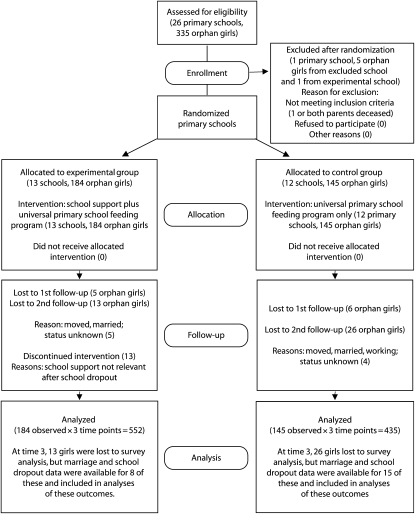
Methods: All orphan girls in grade 6 in 25 primary schools were invited to participate in the study in fall 2007 (n = 329). Primary schools were randomized to condition. All primary schools received a universal daily feeding program; intervention participants received fees, uniforms, and a school-based helper to monitor attendance and resolve problems. We conducted annual surveys and collected additional information on school dropout, marriage, and pregnancy rates. We analyzed data using generalized estimating equations over 3 time points, controlling for school and age at baseline.
Results: The intervention reduced school dropout by 82% and marriage by 63% after 2 years. Compared with control participants, the intervention group reported greater school bonding, better future expectations, more equitable gender attitudes, and more concerns about the consequences of sex.
Conclusions: We found promising evidence that comprehensive school support may reduce HIV risk for orphan girls. Further study, including assessment of dose response, cost benefit, and HIV and herpes simplex virus 2 biomarker measurement, is warranted.
Figures
References
-
- UNICEF State of the world's children, statistical tables, table 4. Available at: http://www.unicef.org/sowc08/docs/sowc08_table_4.pdf. Accessed December 8, 2009
-
- Case A, Paxson C, Ableidinger J. Orphans in Africa: parental death, poverty, and school enrollment. Demography. 2004;41(3):483–508 - PubMed
-
- UNICEF Children on the brink 2004: a joint report of new orphan estimates and a framework for action. 2004. Available at: http://www.unicef.org/publications/files/cob_layout6-013.pdf. Accessed March 3, 2010
-
- Chiao C, Mishra V. Trends in primary and secondary abstinence among Kenyan youth. AIDS Care. 2009;21(7):881–892 - PubMed
-
- Magadi MA, Agwanda AO. Determinants of transitions to first sexual intercourse, marriage, and pregnancy among female adolescents: evidence from South Nyanza, Kenya. J Biosoc Sci. 2009;41(3):409–427 - PubMed
Publication types
MeSH terms
Grants and funding
LinkOut - more resources
Full Text Sources
Medical