


Fast and slow effects of medial olivocochlear efferent activity in humans
- PMID: 21494578
- PMCID: PMC3073004
- DOI: 10.1371/journal.pone.0018725
Fast and slow effects of medial olivocochlear efferent activity in humans
Abstract
Background: The medial olivocochlear (MOC) pathway modulates basilar membrane motion and auditory nerve activity on both a fast (10-100 ms) and a slow (10-100 s) time scale in guinea pigs. The slow MOC modulation of cochlear activity is postulated to aide in protection against acoustic trauma. However in humans, the existence and functional roles of slow MOC effects remain unexplored.
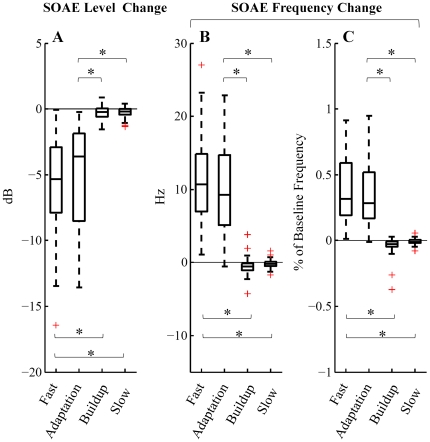
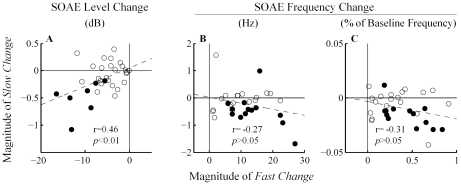
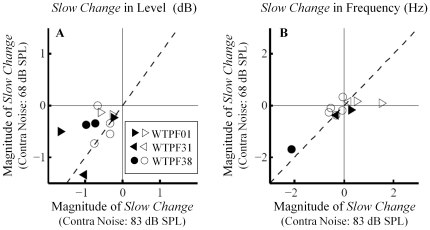
Methodology/principal findings: By employing contralateral noise at moderate to high levels (68 and 83 dB SPL) as an MOC reflex elicitor, and spontaneous otoacoustic emissions (SOAEs) as a non-invasive probe of the cochlea, we demonstrated MOC modulation of human cochlear output both on a fast and a slow time scale, analogous to the fast and slow MOC efferent effects observed on basilar membrane vibration and auditory nerve activity in guinea pigs. The magnitude of slow effects was minimal compared with that of fast effects. Consistent with basilar membrane and auditory nerve activity data, SOAE level was reduced by both fast and slow MOC effects, whereas SOAE frequency was elevated by fast and reduced by slow MOC effects. The magnitudes of fast and slow effects on SOAE level were positively correlated.
Conclusions/significance: Contralateral noise up to 83 dB SPL elicited minimal yet significant changes in both SOAE level and frequency on a slow time scale, consistent with a high threshold or small magnitude of slow MOC effects in humans.
Conflict of interest statement
Figures
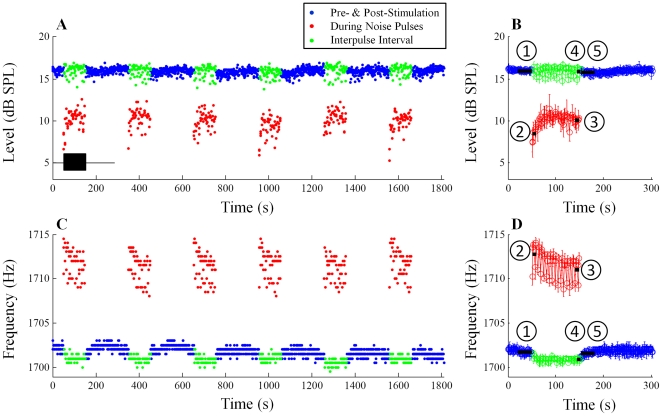
 ) is defined as the median SOAE level/frequency in the 30-s window before noise onset. Similarly, SOAE levels/frequencies during the first two noise pulses (
 ), during the last two noise pulses (
 ), during the last two inter-pulse intervals (
 ) and in the 30-s window after noise offset (
 ) were quantified. Differences from the baseline were defined as fast change (
 -
- ), adaptation change (
 -
- ), buildup change (
 -
- ) and slow change (
 -
- ). Error bars represent one standard deviation.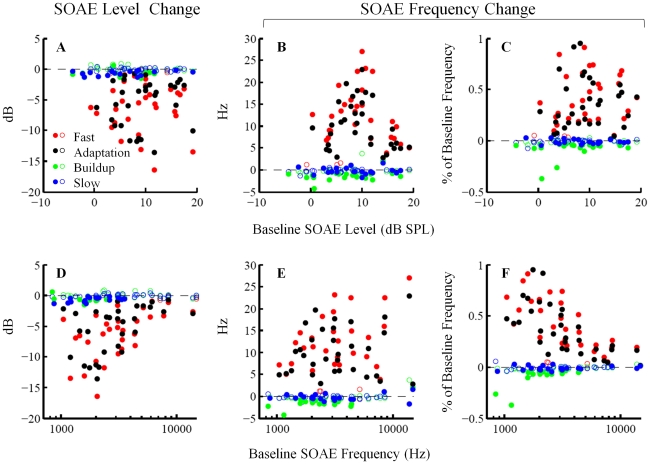
References
-
- Guinan JJ., Jr Olivocochlear efferents: anatomy, physiology, function, and the measurement of efferent effects in humans. Ear Hear. 2006;27:589–607. - PubMed
-
- Robles L, Delano PH. Efferent System. In: Dallos P, Oertel D, editors. The Senses: A Comprehensive Reference. 1 ed. Academic Press; 2008.
-
- Elgoyhen AB, Johnson DS, Boulter J, Vetter DE, Heinemann S. Alpha 9: an acetylcholine receptor with novel pharmacological properties expressed in rat cochlear hair cells. Cell. 1994;79:705–715. - PubMed
Publication types
MeSH terms
Grants and funding
LinkOut - more resources
Full Text Sources
Miscellaneous
