


Optimization of the balanced steady state free precession (bSSFP) pulse sequence for magnetic resonance imaging of the mouse prostate at 3T
- PMID: 21494660
- PMCID: PMC3072967
- DOI: 10.1371/journal.pone.0018361
Optimization of the balanced steady state free precession (bSSFP) pulse sequence for magnetic resonance imaging of the mouse prostate at 3T
Abstract
Introduction: MRI can be used to non-invasively monitor tumour growth and response to treatment in mouse models of prostate cancer, particularly for longitudinal studies of orthotopically-implanted models. We have optimized the balanced steady-state free precession (bSSFP) pulse sequence for mouse prostate imaging.
Methods: Phase cycling, excitations, flip angle and receiver bandwidth parameters were optimized for signal to noise ratio and contrast to noise ratio of the prostate. The optimized bSSFP sequence was compared to T1- and T2-weighted spin echo sequences.
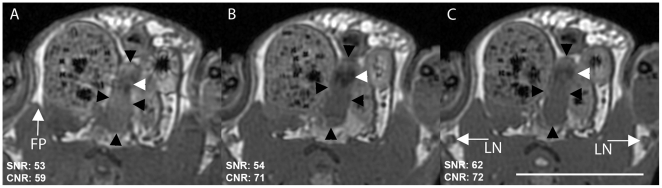
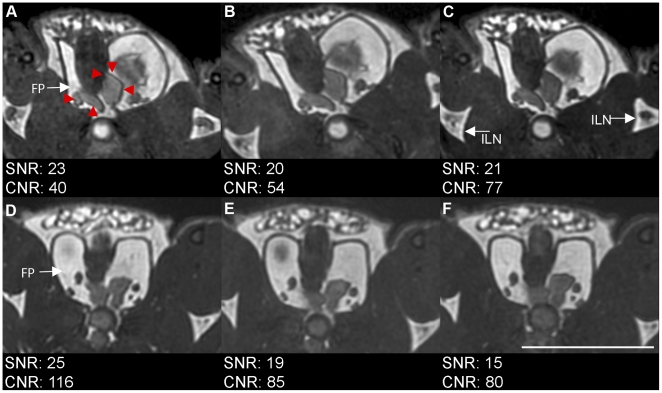
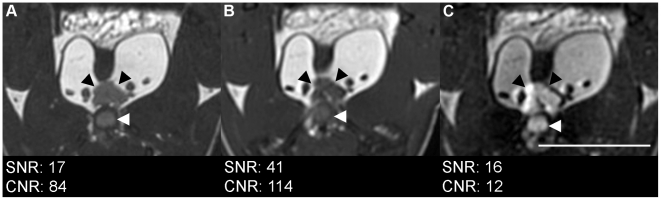
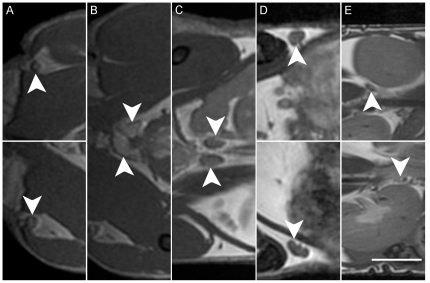
Results: SNR and CNR increased with flip angle. As bandwidth increased, SNR, CNR and artifacts such as chemical shift decreased. The final optimized sequence was 4 PC, 2 NEX, FA 50°, BW ±62.5 kHz and took 14-26 minutes with 200 µm isotropic resolution. The SNR efficiency of the bSSFP images was higher than for T1WSE and T2WSE. CNR was highest for T1WSE, followed closely by bSSFP, with the T2WSE having the lowest CNR. With the bSSFP images the whole body and organs of interest including renal, iliac, inguinal and popliteal lymph nodes were visible.
Conclusion: We were able to obtain fast, high-resolution, high CNR images of the healthy mouse prostate with an optimized bSSFP sequence.
Conflict of interest statement
Figures
References
-
- Canadian Cancer Society. 2010. Canadian Cancer Statistics 2010.
-
- Thalmann GN, Sikes RA, Wu TT, Degeorges A, Chang SM, et al. LNCaP progression model of human prostate cancer: androgen-independence and osseous metastasis. Prostate. 2000;44:91–103. - PubMed
-
- Wolf P, Alt K, Bühler P, Katzenwadel A, Wetterauer U, et al. Anti-PSMA immunotoxin as novel treatment for prostate cancer? High and specific antitumor activity on human prostate xenograft tumors in SCID mice. Prostate. 2008;68:129–138. - PubMed
Publication types
MeSH terms
Grants and funding
LinkOut - more resources
Full Text Sources
Medical
Research Materials
