


Review
doi: 10.1007/s00424-011-0964-z.
Epub 2011 Apr 15.
Assessment of contractility in intact ventricular cardiomyocytes using the dimensionless 'Frank-Starling Gain' index
Affiliations
- PMID: 21494804
- PMCID: PMC3114067
- DOI: 10.1007/s00424-011-0964-z
Item in Clipboard
Review
Assessment of contractility in intact ventricular cardiomyocytes using the dimensionless 'Frank-Starling Gain' index
Pflugers Arch.
2011 Jul.
Abstract
This paper briefly recapitulates the Frank-Starling law of the heart, reviews approaches to establishing diastolic and systolic force-length behaviour in intact isolated cardiomyocytes, and introduces a dimensionless index called 'Frank-Starling Gain', calculated as the ratio of slopes of end-systolic and end-diastolic force-length relations. The benefits and limitations of this index are illustrated on the example of regional differences in Guinea pig intact ventricular cardiomyocyte mechanics. Potential applicability of the Frank-Starling Gain for the comparison of cell contractility changes upon stretch will be discussed in the context of intra- and inter-individual variability of cardiomyocyte properties.
Figures
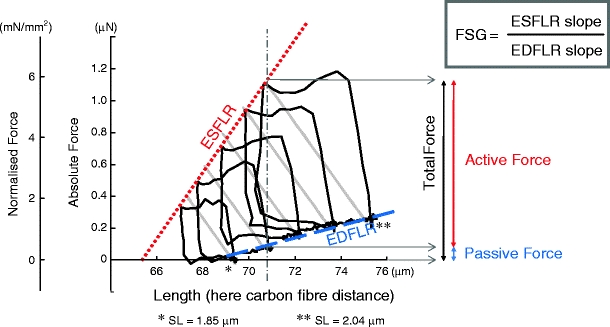
Diagram representing end-diastolic and end-systolic force–length relations (EDFLR and ESFLR, respectively) of a Guinea pig intact isolated ventricular cardiomyocyte, established using the carbon fibre (CF) technique. The EDFLR (dashed line, blue) is obtained by monitoring passive tension (force required to arrive at different pre-loads), while ESFLR (dotted line, red) is constructed by recording total force at the end of contractions, initiated from a range of different pre-loads (here covering a sarcomere length [SL] range from 1.85 to 2.05 μm). In Guinea pig, over the SL studied, ESFLR is independent of the mode of contraction (e.g. auxotonic, grey lines; work-loop, black; data from [23]). Within this linear range of the Frank–Starling (FS) response, the slopes of ESFLR and EDFLR can be divided to yield a dimensionless index of the pre-load-dependent change in contractility — the Frank–Starling Gain (FSG). FSG calculation is independent of whether or not absolute or normalised force data are used (see scales on the left), and any errors introduced during normalisation of force to sample cross-section are cancelled out
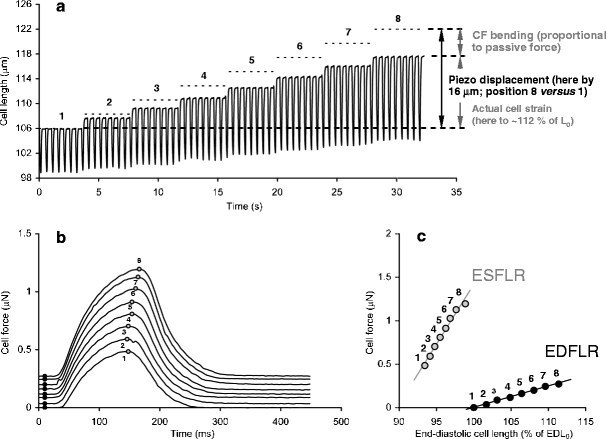
Representative experimental records of a set of auxotonic twitches of Guinea pig ventricular cardiomyocyte and extraction of ED/ESFLR using the CF technique. a Time series of cell shortening (pointing downwards) and consecutively applied increases in diastolic length (pointing upwards). Note that the piezo-motor command (2-μm step, indicated by dotted lines above respective curve segments) exceeds actual cell strain; the difference between externally applied command and cell strain represents diastolic CF bending, used to calculate passive (diastolic) force. b Cell force recordings plotted as a function of time (force pointing upwards), superimposed for different pre-loads (numbers correspond to those in panels a and c). c EDFLR and ESFLR (force plotted as a function of pre-load, expressed as percentage of EDL0) using data points illustrated in panel b

Illustration of differences in pre-load recruitable contractile reserve in cells with similar ESFLR, identified by FSG. Cells from RVbase and RVapex yield similar ESFLR (a) and EDFLR (b) slopes (individual data points and best linear fit shown). The non-significant trends toward higher ESFLR and lower EDFLR slopes in RVbase combine in a significantly increased FSG (*p < 0.05), which is indicative of a higher contractile reserve compared to RVapex. End-systolic force is expressed as percentage of ESF0 and end-systolic length as percentage of ESL0 (see Table 2 for details)
References
-
- Birks EJ, George RS, Hedger M, Bahrami T, Wilton P, Bowles CT, Webb C, Bougard R, Amrani M, Yacoub MH, Dreyfus G, Khaghani A. Reversal of severe heart failure with a continuous-flow left ventricular assist device and pharmacological therapy: a prospective study. Circulation. 2011;123(4):381–390. doi: 10.1161/CIRCULATIONAHA.109.933960. - DOI - PubMed
Publication types
MeSH terms
Grants and funding
LinkOut - more resources
Full Text Sources
Other Literature Sources
