Review
doi: 10.1146/annurev-biochem-081308-165917.
Sterol regulation of metabolism, homeostasis, and development
Affiliations
- PMID: 21495846
- PMCID: PMC3918218
- DOI: 10.1146/annurev-biochem-081308-165917
Item in Clipboard
Review
Sterol regulation of metabolism, homeostasis, and development
Annu Rev Biochem.
2011.
Abstract
Sterol metabolites are critical signaling molecules that regulate metabolism, development, and homeostasis. Oxysterols, bile acids (BAs), and steroids work primarily through cognate sterol-responsive nuclear hormone receptors to control these processes through feed-forward and feedback mechanisms. These signaling pathways are conserved from simple invertebrates to mammals. Indeed, results from various model organisms have yielded fundamental insights into cholesterol and BA homeostasis, lipid and glucose metabolism, protective mechanisms, tissue differentiation, development, reproduction, and even aging. Here, we review how sterols act through evolutionarily ancient mechanisms to control these processes.
Figures
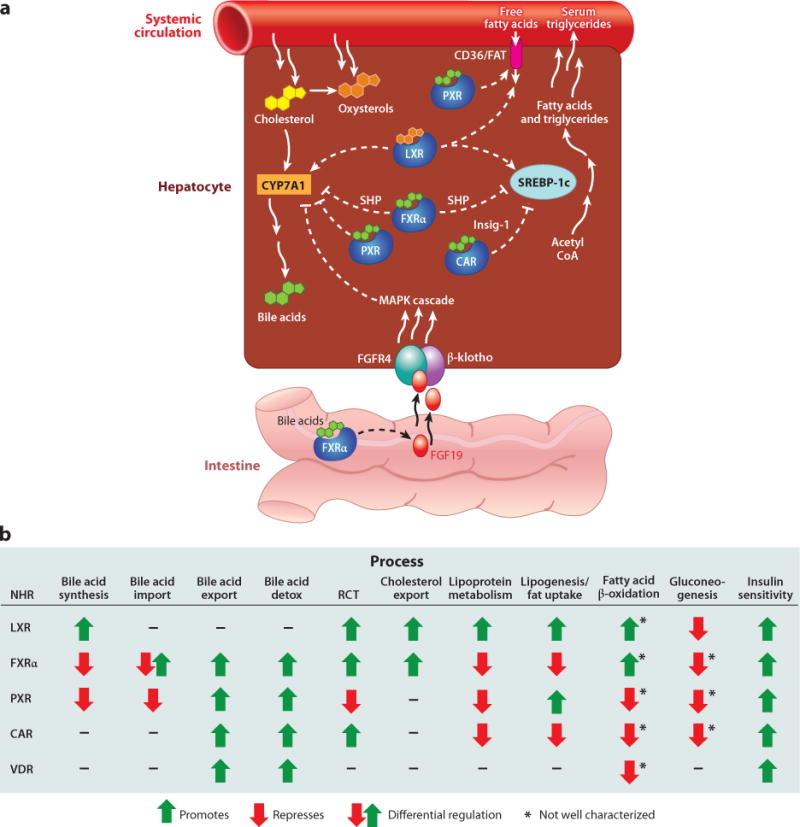
(A) Differential regulation of select components of bile acid (BA) synthesis and lipogenesis by the sterol-sensing NHRs. LXR and FXRαact in an opposing manner upon expression of the CYP7A1 cholesterol 7α-hydroxylase, impacting BA synthesis, and the SREBP-1c transcription factor, which regulates fatty acid and triglyceride synthesis. LXR and PXR also positively regulate the fatty acid translocase CD36/FAT, promoting uptake of free fatty acids. (B) Comparison of the roles of sterol-sensing NHRs in various metabolic processes demonstrates the pleiotropic actions of these receptors. CAR, constitutive androstane receptor; FGF19, fibroblast growth factor 19 (mouse FGF15); FXRα, farnesoid X receptor-α; Insig-1, an endoplasmic reticulum-associated membrane protein that prevents proteolytic activation of SREBP; LXR, liver X receptor; PXR, pregnane X receptor; SHP, small heterodimer partner; RCT, reverse cholesterol transport; VDR, vitamin D receptor.
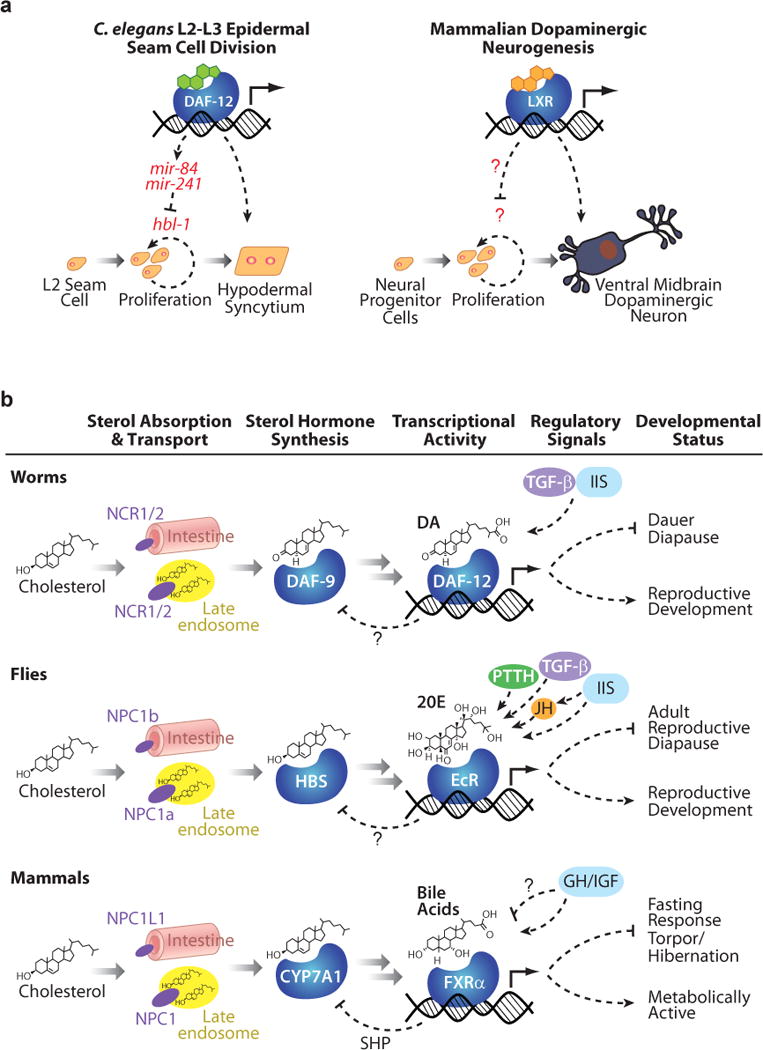
(A) In specific contexts, both C. elegans DAF-12 and the mammalian liver X receptor (LXR) act to inhibit proliferation of precursor cells to promote terminal differentiation. (B) Across phyla, similar mechanisms of cholesterol absorption and transport, sterol biosynthesis, and transcriptional regulation by sterol-sensing nuclear hormone receptors mediate decisions between energy-conserving states and normal reproductive development. Upstream endocrine networks, notably insulin/insulin-like growth factor-1 signaling, impact the production of sterol ligands, and thus activities of these receptors, although many mechanistic details remain to be uncovered. CYP7A1, a cytochrome P450 which acts at the rate-limiting step in mammalian BA synthesis; DA, dafachronic acid; DAF-9, C. elegans homolog of mammalian BA synthetic enzyme CYP27A1 required for DA production; DAF-12, C. elegans DA-activated nuclear hormone receptor; EcR, ecdysone receptor; GH, growth hormone; HBS, hormone biosynthesis; IGF, insulin-like growth factor; IIS, insulin/IGF-I Signaling; JH, juvenile hormone; mir-84, -241, targets of DAF-12 that are involved in developmental timing and seam cell differentiation during the L2-L3 stage in C. elegans; NCR1/2, C. elegans homologs of the Niemann-Pick C1 and Niemann-Pick C1-Like-1 sterol transporters; NPC1a, Drosophila homolog of Niemann-Pick C1; NPC1b, Drosophila homolog of Niemann-Pick C1-Like-1; NPC1, mammalian Niemann-Pick C1 sterol transporter; NPC1L1, mammalian Niemann-Pick C1-Like-1 sterol transporter; PTTH, prothoraciotropic hormone, TGF-β, transforming growth factor β.
References
Publication types
MeSH terms
Substances
Grants and funding
LinkOut - more resources
Full Text Sources