


Prevalence of major enteric pathogens in Australian dairy calves with diarrhoea
- PMID: 21495987
- PMCID: PMC7159393
- DOI: 10.1111/j.1751-0813.2011.00692.x
Prevalence of major enteric pathogens in Australian dairy calves with diarrhoea
Abstract
Objective: Determine the prevalence of the major enteric pathogens in dairy and dairy beef calves with diarrhoea in Australia.
Design: Cross-sectional study.
Methods: Faecal samples from 84 Australian dairy and dairy beef properties (597 samples) were screened for rotavirus and coronavirus using real-time reverse transcription polymerase chain reaction, for Salmonella spp. using selective enrichment faecal culture, and for enterotoxigenic Escherichia coli (K99) and Cryptosporidium parvum using a commercial enzyme-linked immunosorbent assay. A logistic regression with random effects model was used to compare prevalence of pathogens in dairy and dairy beef operations.
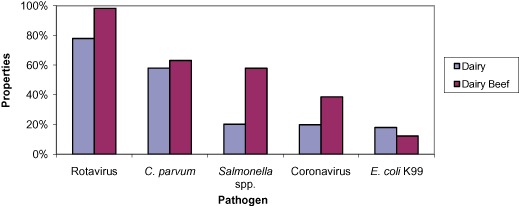
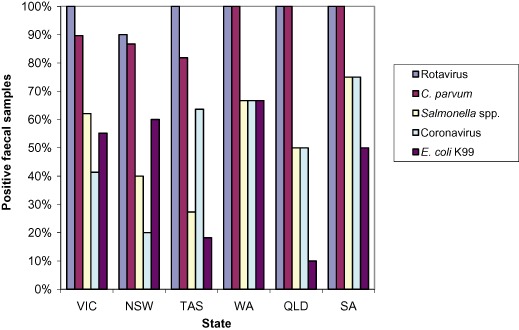
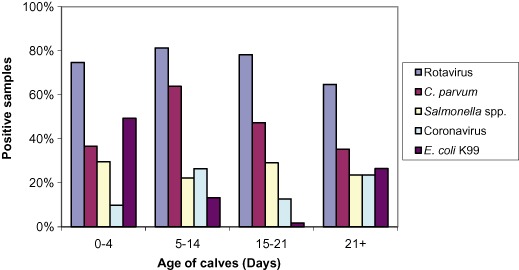
Results: Enteric pathogens were isolated from 97.6% of outbreaks and 95.0% of samples. Rotavirus was the most common pathogen identified (477/597, 79.9%) followed by C. parvum (349/597, 58.5%), Salmonella spp. (142/597, 23.8%), coronavirus (129/597, 21.6%) and E. coli K99 (104/597, 17.4%). Multiple pathogens were identified on 96.4% of farms and from 71.0% of samples. Samples from dairy beef properties were more likely to have multiple pathogens than dairy properties (P < 0.05), whereas rotavirus and Salmonella spp. were more likely to be identified in samples collected from dairy beef than dairy properties (P < 0.05).
Conclusion: Most outbreaks of calf diarrhoea in dairy and dairy beef operations involve multiple pathogens. Rotavirus and C. parvum were the most frequently identified pathogens across production systems. Salmonella spp. and rotavirus were more frequently identified in dairy beef operations.
© 2011 The Authors. Australian Veterinary Journal © 2011 Australian Veterinary Association.
Figures
References
-
- Lanz Uhde F, Kaufmann T, Sager H et al Prevalence of four enteropathogens in the faeces of young diarrhoeic dairy calves in Switzerland. Vet Rec 2008;163:362–366. - PubMed
-
- Frank NA, Kaneene JB. Management risk factors associated with calf diarrhea in Michigan dairy herds. J Dairy Sci 1993;76:1313–1323. - PubMed
Publication types
MeSH terms
LinkOut - more resources
Full Text Sources
Medical
Miscellaneous
