


Revealing boundary-contour based surface representation through the time course of binocular rivalry
- PMID: 21496462
- PMCID: PMC3090490
- DOI: 10.1016/j.visres.2011.04.005
Revealing boundary-contour based surface representation through the time course of binocular rivalry
Abstract
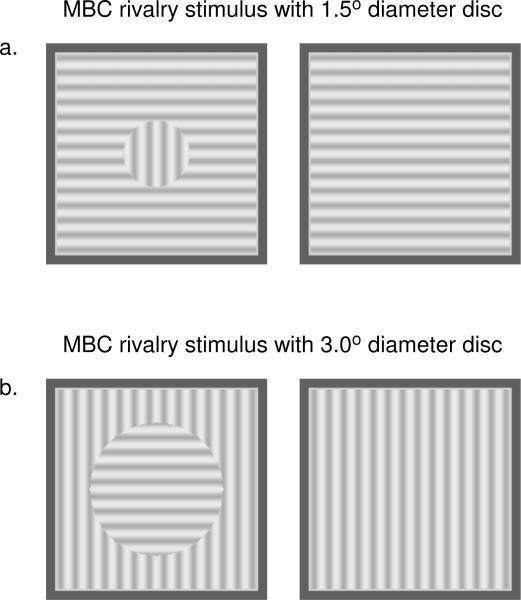
We varied the surface boundary-contour properties of binocular rivalry (BR) stimuli to measure the rivalry percept as a function of stimulus duration. Experiment 1 compared perception from BR stimuli with monocular boundary contour (MBC) and binocular boundary contour (BBC). We found global dominance is achieved with stimulus duration as short as 30ms for the MBC rivalry stimuli, whereas it takes more than 150 ms for the BBC rivalry stimuli. This shows that global dominance can occur rapidly in the absence of a corresponding boundary contour in one half-image. Experiment 2 measured the detection of a monocular Gabor probe located centrally on a 1.5° versus 3.0° MBC rivalry stimulus. We found reliable binocular suppression is observed earlier with the 1.5° MBC stimulus, presumably because of the probe being spatially located nearer to the boundary contour. These findings, in conjunction with those in Su et al. (2011), support the notion that the representation of the dominant surface begins at the MBC and spreads toward the center of the image.
Copyright © 2011 Elsevier Ltd. All rights reserved.
Figures



References
-
- Alais D, Blake R. Interactions between global motion and local binocular rivalry. Vision Research. 1998;38:637–644. - PubMed
-
- Blake R. A neural theory of binocular rivalry. Psychological Review. 1989;96:145–167. - PubMed
-
- Blake R, Westendorf DH, Overton R. What is suppressed during binocular rivalry? Perception. 1980;9:223–231. - PubMed
-
- Brainard DH. The Psychophysics Toolbox. Spatial Vision. 1997;10:433–436. - PubMed
-
- Caputo G. Texture brightness filling-in. Vision Research. 1998;38:841–851. - PubMed
Publication types
MeSH terms
Grants and funding
LinkOut - more resources
Full Text Sources
