


The first quantitative report of ventilation rate during in-hospital resuscitation of older children and adolescents
- PMID: 21497007
- PMCID: PMC3703745
- DOI: 10.1016/j.resuscitation.2011.03.020
The first quantitative report of ventilation rate during in-hospital resuscitation of older children and adolescents
Abstract
Aim: During adult cardiac arrest, rescuers frequently provide ventilations at rates exceeding those recommended by the American Heart Association (AHA). Excessive ventilation is associated with worse clinical outcome after adult cardiac arrest. This study is the first to characterize ventilation rate adherence to AHA guidelines during in-hospital pediatric cardiac arrest resuscitation.
Patients and methods: We prospectively enrolled children and adolescents (≥8 years of age) who suffered a cardiac arrest in a pediatric intensive care unit (PICU) or emergency department (ED) of a tertiary-care pediatric hospital. Ventilation rate (breaths per minute [bpm]) was monitored via changes in chest wall impedance (CWI) recorded by defibrillator electrode pads during cardiopulmonary resuscitation (CPR).
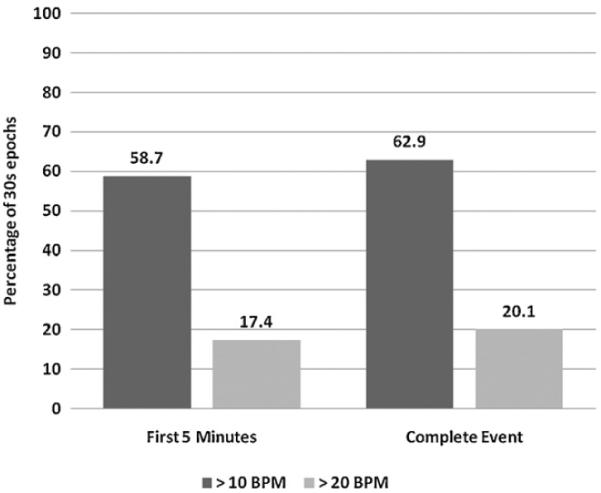
Results: Twenty-four CPR events were enrolled yielding 588 thirty-second CPR epochs. The proportion of CPR epochs with ventilation rates exceeding AHA guidelines (>10 bpm) was 63% (CI(95) 59-67%), significantly higher than our a priori hypothesis of 30% (p<0.01). The proportion of CPR epochs with ventilation rates exceeding 20 bpm was 20% (CI(95) 17-23). After controlling for location of arrest and initial event rhythm, resuscitations that occurred on nights/weekends were 3.6 times (CI(95): 1.6-7.9, p<0.01) more likely to have a ventilation rate exceeding AHA guidelines.
Conclusions: During in-hospital pediatric cardiac arrest, rescuers frequently provide artificial ventilations at rates in excess of AHA guidelines, with twenty percent of CPR time having ventilation rates double that recommended. Excessive ventilation was particularly common during CPR events that occurred on nights/weekends.
Copyright © 2011 Elsevier Ireland Ltd. All rights reserved.
Figures

References
-
- Chan PS, Jain R, Nallmothu BK, Berg RA, Sasson C. Rapid response teams: a systematic review and meta-analysis. Arch Intern Med. 2010;170:18–26. - PubMed
-
- Donoghue AJ, Nadkarni V, Berg RA, et al. Out-of-hospital pediatric cardiac arrest: an epidemiologic review and assessment of current knowledge. Ann Emerg Med. 2005;46:512–22. - PubMed
-
- Meaney PA, Nadkarni VM, Cook EF, et al. Higher survival rates among younger patients after pediatric intensive care unit cardiac arrests. Pediatrics. 2006;118:2424–33. - PubMed
-
- Nadkarni VM, Larkin GL, Peberdy MA, et al. First documented rhythm and clinical outcome from in-hospital cardiac arrest among children and adults. JAMA. 2006;295:50–7. - PubMed
Publication types
MeSH terms
Grants and funding
LinkOut - more resources
Full Text Sources
Other Literature Sources
Medical
