


Quality assessment and correlation of microsatellite instability and immunohistochemical markers among population- and clinic-based colorectal tumors results from the Colon Cancer Family Registry
- PMID: 21497289
- PMCID: PMC3077724
- DOI: 10.1016/j.jmoldx.2010.12.004
Quality assessment and correlation of microsatellite instability and immunohistochemical markers among population- and clinic-based colorectal tumors results from the Colon Cancer Family Registry
Abstract
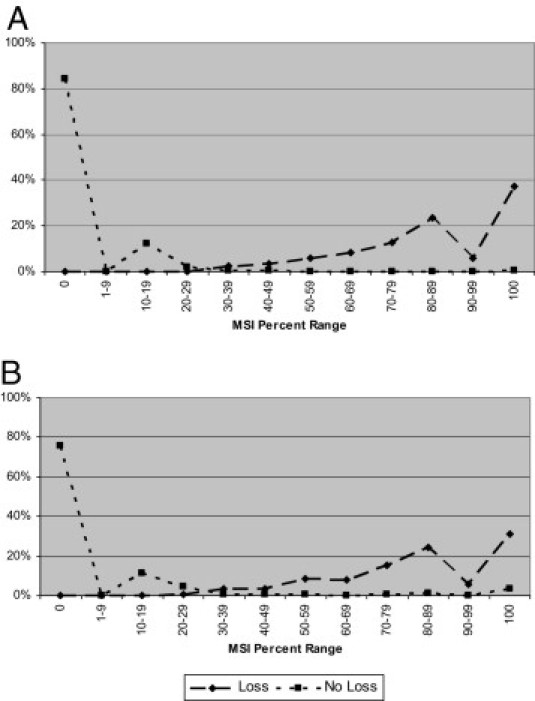
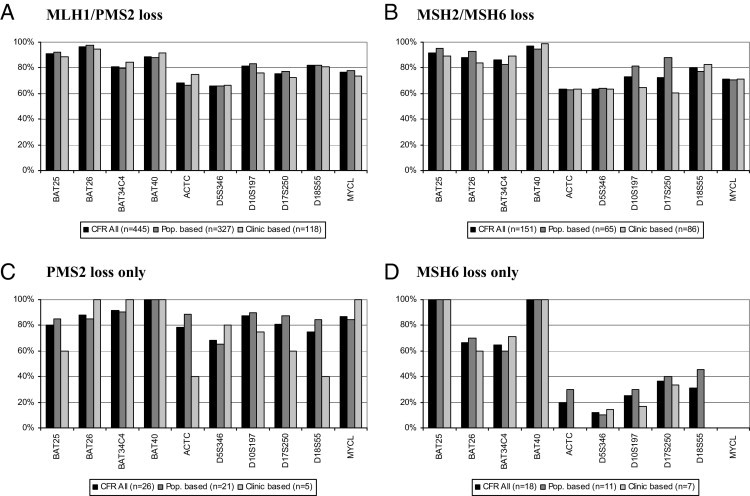
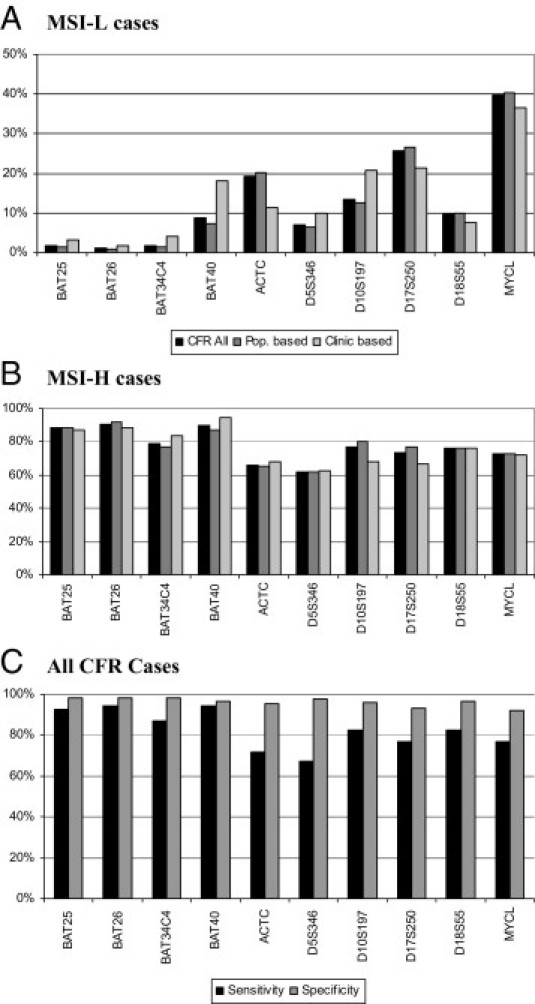
The detection of defective mismatch repair (MMR), as assessed by the presence of tumor microsatellite instability (MSI) and/or loss of MMR protein expression by IHC, has been useful for risk assessment, prognosis, and prediction of treatment in patients with colorectal cancer. We analyzed tumors for the presence of defective MMR from 5927 Colorectal Cancer Family Registry patients recruited at six international consortium sites. We evaluated the appropriate percentage instability cutoff used to distinguish the three MSI phenotypes [ie, stable (MSS), low instability (MSI-L), and high instability (MSI-H)]; the sensitivity, specificity, and performance characteristics of individual markers; and the concordance between MSI and IHC phenotypes. Guided by the results of the IHC testing, our findings indicate that the distinction between an MSI-H phenotype from a low-instability or MSS phenotype can best be accomplished by using a cutoff of 30% or greater of the markers showing instability. The sensitivity and specificity of the mononucleotide markers were higher than those of the dinucleotide markers. Specifically, BAT26 and BAT25 had the highest sensitivity (94%) and specificity (98%), and the use of mononucleotide markers alone identified 97% of the MSI-H cases correctly. As expected, the presence of MSI-H correlated with an older age of diagnosis, the presence of tumor in the proximal colon, and female sex.
Copyright © 2011 American Society for Investigative Pathology and the Association for Molecular Pathology. Published by Elsevier Inc. All rights reserved.
Figures
References
-
- Lengauer C., Kinzler K.W., Vogelstein B. Genetic instability in colorectal cancers. Nature. 1997;386:623–627. - PubMed
-
- Popat S., Hubner R., Houlston R.S. Systematic review of microsatellite instability and colorectal cancer prognosis. J Clin Oncol. 2005;23:609–618. - PubMed
-
- Peltomaki P. Deficient DNA mismatch repair: a common etiologic factor for colon cancer. Hum Mol Genet. 2001;10:735–740. - PubMed
-
- Bellizzi A.M., Frankel W.L. Colorectal cancer due to deficiency in DNA mismatch repair function: a review. Adv Anat Pathol. 2009;16:405–417. - PubMed
-
- Marra G., Boland C.R. Hereditary nonpolyposis colorectal cancer: the syndrome, the genes, and historical perspectives. J Natl Cancer Inst. 1995;87:1114–1125. - PubMed
Publication types
MeSH terms
Substances
Grants and funding
- R25 CA092049/CA/NCI NIH HHS/United States
- U01 CA074799/CA/NCI NIH HHS/United States
- UO1 CA074800/CA/NCI NIH HHS/United States
- UO1 CA074799/CA/NCI NIH HHS/United States
- U01 CA074794/CA/NCI NIH HHS/United States
- UO1 CA074806/CA/NCI NIH HHS/United States
- UO1 CA078296/CA/NCI NIH HHS/United States
- U01 CA097735/CA/NCI NIH HHS/United States
- CA-95011/CA/NCI NIH HHS/United States
- UO1 CA074794/CA/NCI NIH HHS/United States
- U01 CA074783/CA/NCI NIH HHS/United States
- U01 CA074806/CA/NCI NIH HHS/United States
- U01 CA078296/CA/NCI NIH HHS/United States
- U01 CA074800/CA/NCI NIH HHS/United States
- UO1 CA097735/CA/NCI NIH HHS/United States
- UO1 CA074783/CA/NCI NIH HHS/United States
LinkOut - more resources
Full Text Sources
Other Literature Sources
Medical
Research Materials
