


Obesity and knee osteoarthritis are not associated with impaired quadriceps specific strength in adults
- PMID: 21497317
- PMCID: PMC3080113
- DOI: 10.1016/j.pmrj.2010.12.011
Obesity and knee osteoarthritis are not associated with impaired quadriceps specific strength in adults
Abstract
Objective: To assess whether adults, aged 50-59 years, who are obese or moderately to severely obese have impaired quadriceps strength and muscle quality in comparison with adults who are not obese, both groups with and without knee osteoarthritis (OA).
Design: Cross-sectional observational study.
Setting: Rural community acquired sample.
Subjects: Seventy-seven men and 84 women, aged 50-59 years.
Methods: Comparisons by using mixed models for clustered data (2 lower limbs per participant) between groups defined by body mass index (BMI) (<30 kg/m(2), 30-35 kg/m(2), and ≥35 kg/m(2)), with and without knee OA MAIN OUTCOME MEASUREMENT: The slope of the relationship between quadriceps muscle cross-sectional area (CSA) and isokinetic knee extensor strength (dynamometer) in each BMI and OA group.
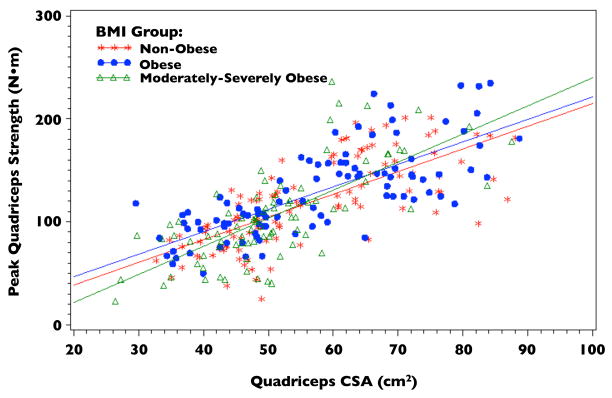
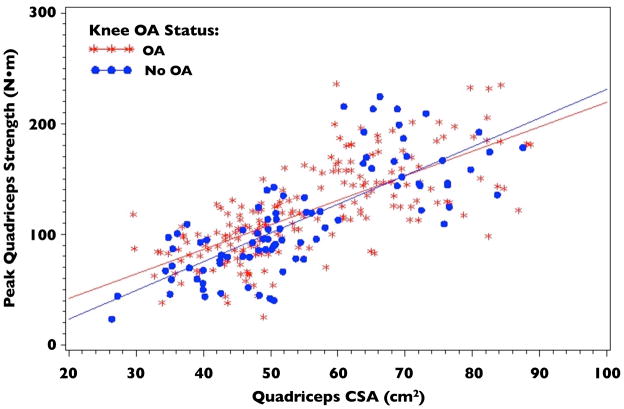
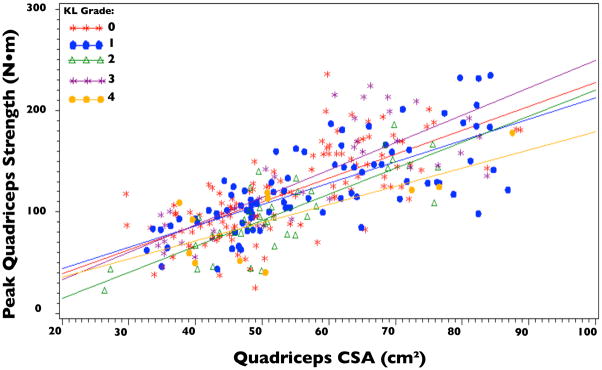
Results: There were 113 limbs (48.7% women), 101 limbs (38.6% women), and 89 limbs (73.0% women) in the <30 kg/m(2), 30-35 kg/m(2), and ≥35 kg/m(2) BMI groups, respectively; knee OA was present in 10.6%, 28.7%, and 58.4% of the limbs in each of these respective groups. Quadriceps CSA did not significantly differ among BMI groups in either gender or between subjects with and without knee OA. Peak quadriceps strength also did not significantly differ by BMI group or by the presence of knee OA. Multivariable analyses also demonstrated that peak quadriceps strength did not differ by BMI group, even after adjusting for (a) gender, (b) OA status, (c) intramuscular fat, or (d) quadriceps attenuation. The slopes for the relationships between quadriceps strength and CSA did not differ by BMI group, OA status, or their interaction.
Conclusions: Individuals who were obese and at risk for knee OA did not appear to have altered muscle strength or muscle quality compared with adults who were not obese and were aged 50-59 years. The absence of a difference in the relationship between peak quadriceps strength and CSA provided further evidence that there was not an impairment in quadriceps muscle quality in this cohort, which suggests that factors other than strength might mediate the association between obesity and knee OA.
Copyright © 2011 American Academy of Physical Medicine and Rehabilitation. Published by Elsevier Inc. All rights reserved.
Figures
References
-
- Teichtahl AJ, Wang Y, Wluka AE, Cicuttini FM. Obesity and knee osteoarthritis: new insights provided by body composition studies. Obesity (Silver Spring, Md) 2008;16:232–240. - PubMed
-
- Slemenda C, Brandt KD, Heilman DK, et al. Quadriceps weakness and osteoarthritis of the knee. Ann Intern Med. 1997;127:97–104. - PubMed
-
- Wearing SC, Hennig EM, Byrne NM, Steele JR, Hills AP. Musculoskeletal disorders associated with obesity: a biomechanical perspective. Obesity reviews. 2006;7:239–250. - PubMed
Publication types
MeSH terms
Grants and funding
LinkOut - more resources
Full Text Sources
