


Review
doi: 10.1016/j.tem.2011.03.004.
Epub 2011 Apr 15.
Unique ties between hepatitis C virus replication and intracellular lipids
Affiliations
- PMID: 21497514
- PMCID: PMC3118981
- DOI: 10.1016/j.tem.2011.03.004
Item in Clipboard
Review
Unique ties between hepatitis C virus replication and intracellular lipids
Trends Endocrinol Metab.
2011 Jun.
Abstract
Hepatitis C virus (HCV) infects approximately 3% of the world's population, establishing a lifelong infection in the majority of cases. The life cycle of HCV is closely tied to the lipid metabolism of liver cells, and lipid droplets have emerged as crucial intracellular organelles that support persistent propagation of viral infection. In this review, we examine recent advances in our understanding of how HCV usurps intracellular lipids to propagate, and highlight unique opportunities for therapeutic intervention.
Copyright © 2011 Elsevier Ltd. All rights reserved.
Figures
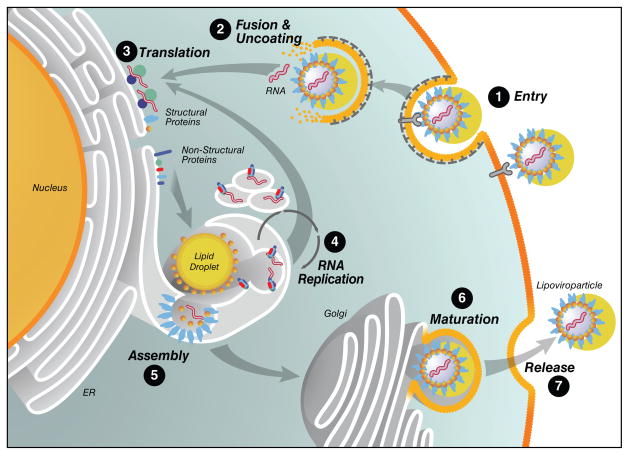
HCV lipoviroparticles enter target hepatocytes via receptor-mediated endocytosis (step 1). Released viral RNA is translated at the ER producing a single polyprotein precursor that is cleaved by host and viral proteases (steps 2 and 3). The viral non-structural proteins (NS2-NS5B) form RNA replication complexes in detergent-resistant lipid drafts where positive-strand RNA is replicated by the viral RNA-dependent RNA polymerase NS5B via a negative-strand intermediate (step 4). Newly synthesized positive-strand RNA is encapsidated by the viral nucleocapsid core in close proximity to lipid droplets, and envelope glycoproteins are acquired through budding into the ER lumen (step 5). Lipoviroparticles mature in the ER through interactions with lipoproteins (step 6) and exit the cell by via the cellular Golgi apparatus (step 7).
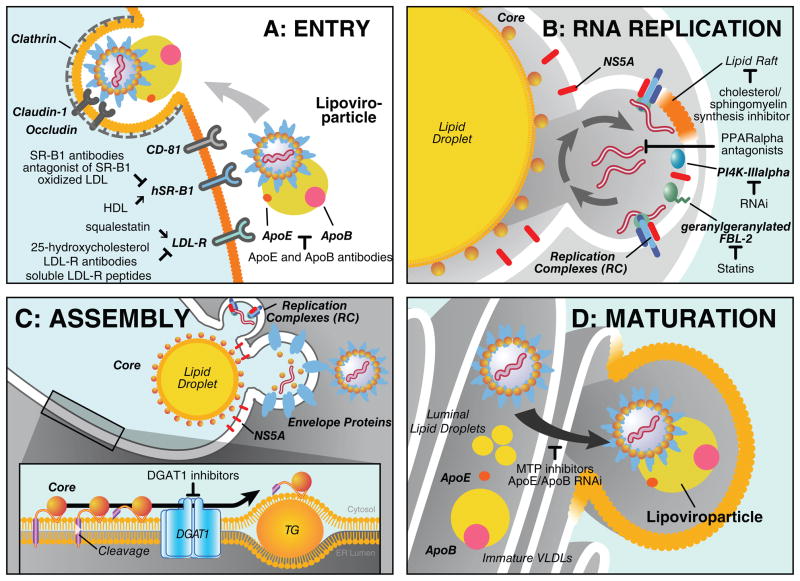
(a) Entry: After attachment of the lipoviroparticles to LDL-R and SR-B1 the virus binds to CD81 and subsequently claudin-1 and occludin, which mediate the late steps of viral entry. The virus is internalized by clathrin-dependent endocytosis. Antibodies against ApoB, ApoE, LDL-R, and SR-B1 inhibit viral entry. Modulation of cellular LDL-R expression through treatment with squalestatin or 25-hydroxycholesterol enhances or decreases HCV entry efficiency. Natural ligands of SR-B1 as HDL and oxidized LDL also affect entry. (b) RNA replication: Viral RNA replication complexes localize to lipid raft-containing, detergent-resistant membranes created by the viral protein NS4B. For full viral replication, these replication complexes need to be in close proximity to lipid droplets, a process that requires NS5A. Host factors required for the formation of replication complexes include geranylgeranylated FBL-2, which is a target for statins, and PI4K-IIIalpha. Cholesterol and sphingomyelin synthesis inhibitors impair viral RNA replication. PPARalpha antagonists disperse viral replication complexes. (c) Assembly at lipid droplets: Core is translated at the ER and released from the polyprotein through cleavage by SPP. Core interacts in the ER with DGAT1 and localizes to lipid droplets in a DGAT1-dependent manner. Once bound to the lipid droplet surface core recruits the viral RNA for encapsidation forming high-density immature virions. (d) Maturation: High-density virions mature by fusion with ApoB/ApoE-containing lipoproteins and/or lipidation to form mature low-density lipoviroparticle. This process can be impaired by treatment with MTP inhibitors and ApoB/ApoE siRNAs.
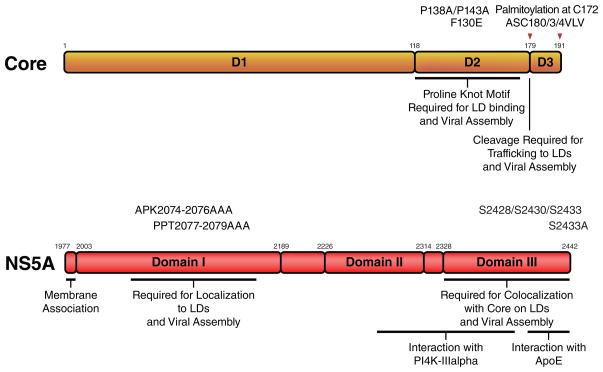
Core and NS5A are viral proteins with intrinsic lipid droplet-localizing properties. Depicted are domains and mutations connected with lipid droplet association and host factor interactions. Red arrows indicate the cleavage sites in core by host peptidases.
References
Publication types
MeSH terms
Substances
Grants and funding
LinkOut - more resources
Full Text Sources
