


An fMRI study of obesity, food reward, and perceived caloric density. Does a low-fat label make food less appealing?
- PMID: 21497628
- PMCID: PMC3124617
- DOI: 10.1016/j.appet.2011.03.017
An fMRI study of obesity, food reward, and perceived caloric density. Does a low-fat label make food less appealing?
Abstract
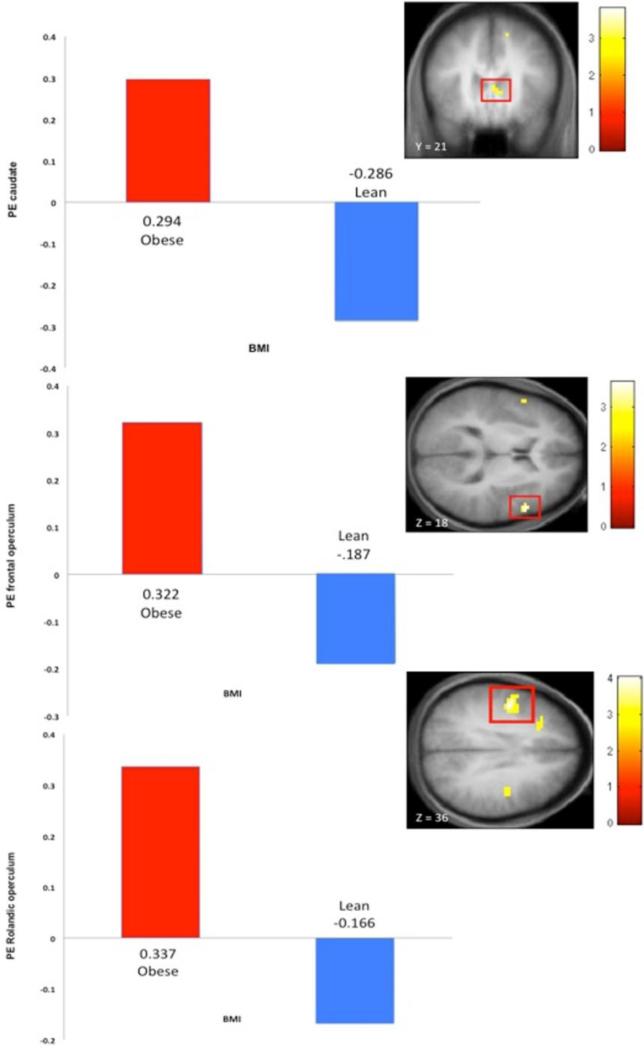
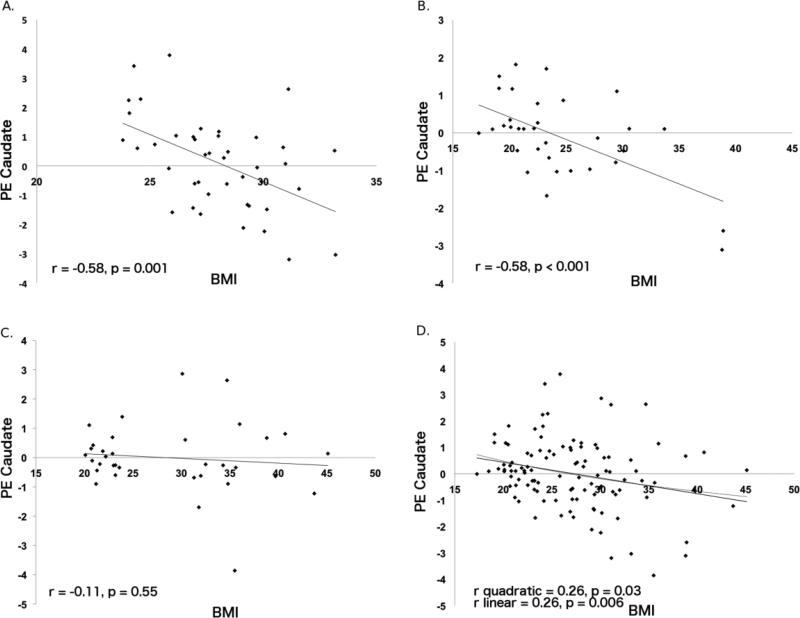
We tested the hypothesis that obese individuals experience greater activation of the gustatory and somatosensory cortex, but weaker activation of the striatum, in response to intake and anticipated intake of high-fat chocolate milkshake versus an isocaloric milkshake labeled low-fat and a tasteless solution using functional magnetic resonance imaging (fMRI) with 17 obese and 17 lean young women. Obese relative to lean women showed greater activation in somatosensory (Rolandic operculum), gustatory (frontal operculum), and reward valuation regions (amgydala, ventralmedial prefrontal cortex (vmPFC) in response to intake and anticipated intake of milkshake versus tasteless solution, though there was little evidence of reduced striatal activation. Obese relative to lean women also showed greater activation in the Rolandic operculum, frontal operculum, and vmPFC in response to isocaloric milkshakes labeled regular versus low-fat. Results suggest that hyper-responsivity of somatosensory, gustatory, and reward valuation regions may be related to overeating and that top-down processing influence reward encoding, which could further contribute to weight gain.
Copyright © 2011 Elsevier Ltd. All rights reserved.
Figures
References
-
- Bushman B. Effects of warning and information labels on consumption of full-fat, reduced-fat, and no-fat products. Journal of Applied Psychology. 1998;83:97–101. - PubMed
-
- Calle E, Thun M, Petrelli J, Rodriguez C, Heath C. Body mass index and mortality in a prospective cohort of US adults. New England Journal of Medicine. 1999;341:1097–1105. - PubMed
Publication types
MeSH terms
Substances
Grants and funding
LinkOut - more resources
Full Text Sources
Medical
