


Unexpected benefits: pathways from smoking restrictions in the home to psychological well-being and distress among urban Black and Puerto Rican Americans
- PMID: 21498429
- PMCID: PMC3150690
- DOI: 10.1093/ntr/ntr062
Unexpected benefits: pathways from smoking restrictions in the home to psychological well-being and distress among urban Black and Puerto Rican Americans
Abstract
Introduction: This study examined the pathways from smoking policies in the home (no ban, partial ban, and total ban on smoking) to psychological well-being (e.g., self-esteem) and psychological symptoms (e.g., depressive symptoms) as mediated by a healthy lifestyle (engaging in exercise, eating healthful foods, and sleeping enough) and cigarette smoking among a sample of urban Black and Puerto Rican Americans.
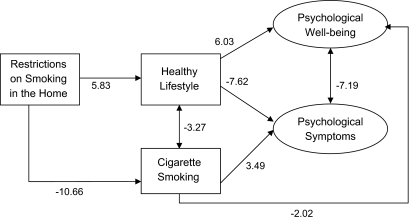
Methods: Questionnaire data were collected from 816 participants (mean age = 32 years). Structural equation modeling (SEM) was employed to examine the pathways of restrictions on smoking in the home to a healthy lifestyle, cigarette smoking, psychological well-being, and psychological distress.
Results: The SEM showed mediational pathways linking higher levels of restrictions on smoking in the home with a healthy lifestyle, which in turn was related negatively to psychological distress and positively to psychological well-being. Higher levels of restrictions on smoking in the home were also related inversely to cigarette smoking, which was related positively to psychological distress and negatively to psychological well-being.
Conclusions: Findings show that higher levels of restrictions on smoking in the home are associated with a healthier lifestyle and less cigarette smoking, which in turn are associated with better psychological functioning. Greater restrictions on smoking in the home may thus support positive lifestyle choices, including exercise and nutrition, as well as psychological functioning.
Figures
References
-
- Al-Delaimy WK, White MM, Trinidad DR, Messer K, Gilmer T, Zhu SH, et al. The California Tobsacco Control Program: Can we maintain the progress? Results from the California Tobacco Survey, 1990–2005. 2008. Retrieved from http://www.cdph.ca.gov/programs/tobacco/Documents/CTCP-CTSReport1990-200....
-
- Albers AB, Biener L, Siegel M, Cheng DM, Rigotti N. Household smoking bans and adolescent antismoking attitudes and smoking initiation: Findings from a longitudinal study of a Massachusetts youth cohort. American Journal of Public Health. 2008;98:1886–1893. doi:10.2105/AJPH.2007.129320. - PMC - PubMed
-
- Bentler PM. Comparative fit indexes in structural models. Psychological Bulletin. 1990;107:238–246. doi:10.1037/0033-2909.107.2.238. - PubMed
-
- Boden JM, Fergusson DM, Horwood LJ. Cigarette smoking and depression: Tests of causal linkages using a longitudinal birth cohort. British Journal of Psychiatry. 2010;196:440–446. doi:10.1192/bjp.bp.109.065912. - PubMed
Publication types
MeSH terms
Substances
Grants and funding
LinkOut - more resources
Full Text Sources
Medical
