At clinical high risk for psychosis: outcome for nonconverters
- PMID: 21498462
- PMCID: PMC3150607
- DOI: 10.1176/appi.ajp.2011.10081191
At clinical high risk for psychosis: outcome for nonconverters
Abstract
Objective: A major focus of early intervention research is determining the risk of conversion to psychosis and developing optimal algorithms of prediction. Although reported rates of nonconversion vary in the literature, the nonconversion rate always encompasses a majority (50%-85%) of the sample participants. Less is known about the outcome among this group, referred to as false positive individuals.
Method: A longitudinal study was conducted of more than 300 prospectively identified treatment-seeking individuals meeting criteria for a psychosis-risk syndrome. Participants were recruited and evaluated across eight clinical research centers as part of the North American Prodrome Longitudinal Study. Over a 2.5-year follow-up assessment period, 214 (71%) participants had not made the transition to psychosis.
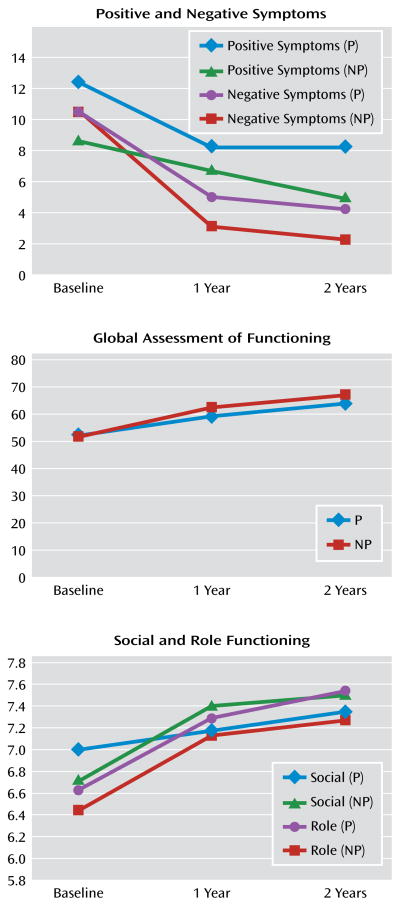
Results: The sample examined included 111 individuals who had at least 1 year of follow-up data available and did not transition to psychosis within the study duration. In year 1, there was significant improvement in ratings for attenuated positive and negative symptoms. However, at least one attenuated positive symptom was still present for 43% of the sample at 1 year and for 41% at 2 years. At the follow-up timepoints, social and role functioning were significantly poorer in the clinical sample relative to nonpsychiatric comparison subjects.
Conclusions: Help-seeking individuals who meet prodromal criteria appear to represent those who are truly at risk for psychosis and are showing the first signs of illness, those who remit in terms of the symptoms used to index clinical high-risk status, and those who continue to have attenuated positive symptoms.
Figures
Comment in
-
Early intervention for schizophrenia: the risk-benefit ratio of antipsychotic treatment in the prodromal phase.Am J Psychiatry. 2011 Aug;168(8):761-3. doi: 10.1176/appi.ajp.2011.11050765. Am J Psychiatry. 2011. PMID: 21813489 No abstract available.
References
-
- Ruhrmann S, Schultze-Lutter F, Salokangas RK, Heinimaa M, Linszen D, Dingemans P, Birchwood M, Patterson P, Juckel G, Heinz A, Morrison A, Lewis S, von Reventlow HG, Klosterkotter J. Prediction of psychosis in adolescents and young adults at high risk: results from the Prospective European Prediction of Psychosis Study. Arch Gen Psychiatry. 2010;67:241–251. - PubMed
-
- Yung AR, Phillips LJ, Yuen HP, Francey SM, McFarlane CA, Hallgren M, McGorry PD. Psychosis prediction: a 12-month follow-up of a high-risk (prodromal) group. Schizophr Res. 2003;60:21–32. - PubMed
-
- Yung AR, McGorry PD, McFarlane CA, Jackson HJ, Patton GC, Rakkar A. Monitoring and care of young people at incipient risk of psychosis. Schizophr Bull. 1996;22:283–303. - PubMed
-
- Miller TJ, McGlashan TH, Rosen JL, Somjee L, Markovich PJ, Stein K, Woods SW. Prospective diagnosis of the initial prodrome for schizophrenia based on the Structured Interview for Prodromal Syndromes: preliminary evidence of interrater reliability and predictive validity. Am J Psychiatry. 2002;159:863–865. - PubMed
Publication types
MeSH terms
Grants and funding
- R01 MH061523/MH/NIMH NIH HHS/United States
- P50 MH080272/MH/NIMH NIH HHS/United States
- U01 MH0-66134/MH/NIMH NIH HHS/United States
- K23 MH-01905/MH/NIMH NIH HHS/United States
- U01 MH066134/MH/NIMH NIH HHS/United States
- R01 MH-60720/MH/NIMH NIH HHS/United States
- K05MH01654/MH/NIMH NIH HHS/United States
- R01 MH043518/MH/NIMH NIH HHS/United States
- K05 MH001654/MH/NIMH NIH HHS/United States
- R01 MH065079/MH/NIMH NIH HHS/United States
- U01 MH082022/MH/NIMH NIH HHS/United States
- K23 MH001905/MH/NIMH NIH HHS/United States
- U01 MH066069/MH/NIMH NIH HHS/United States
- R01 MH-065562/MH/NIMH NIH HHS/United States
- R01 MH-065079/MH/NIMH NIH HHS/United States
- R01 MH-061523/MH/NIMH NIH HHS/United States
- R01 MH062066/MH/NIMH NIH HHS/United States
- R01 MH065562/MH/NIMH NIH HHS/United States
- K24 MH-76191/MH/NIMH NIH HHS/United States
- R21 MH075027/MH/NIMH NIH HHS/United States
- R01MH-062066/MH/NIMH NIH HHS/United States
- U01 MH066160/MH/NIMH NIH HHS/United States
- K24 MH076191/MH/NIMH NIH HHS/United States
- R01 MH-066069/MH/NIMH NIH HHS/United States
- P50 MH-080272/MH/NIMH NIH HHS/United States
- R21MH-075027/MH/NIMH NIH HHS/United States
- R18 MH-43518/MH/NIMH NIH HHS/United States
- R01 MH060720/MH/NIMH NIH HHS/United States
- R37 MH043518/MH/NIMH NIH HHS/United States
- U01 MH-066160/MH/NIMH NIH HHS/United States
- U01 MH082004/MH/NIMH NIH HHS/United States
- U01 MH081944/MH/NIMH NIH HHS/United States
LinkOut - more resources
Full Text Sources
Other Literature Sources
Medical