


Mechanism of cholesterol efflux in humans after infusion of reconstituted high-density lipoprotein
- PMID: 21498847
- PMCID: PMC6590868
- DOI: 10.1093/eurheartj/ehr103
Mechanism of cholesterol efflux in humans after infusion of reconstituted high-density lipoprotein
Abstract
Objectives: Infusion of reconstituted HDL (rHDL) leads to changes in HDL metabolism as well as to an increased capacity of plasma to support cholesterol efflux providing an opportunity to investigate mechanisms linking cholesterol efflux to changes in plasma HDL.
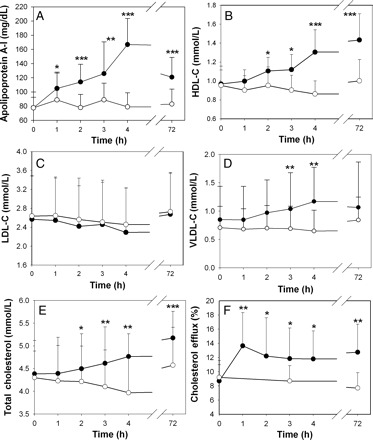
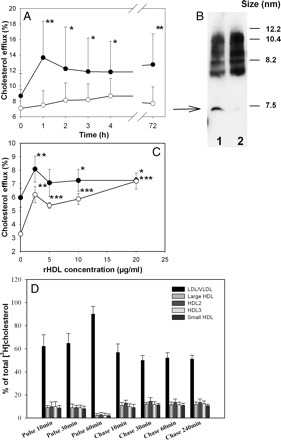
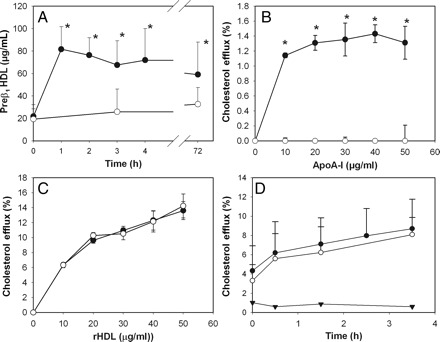
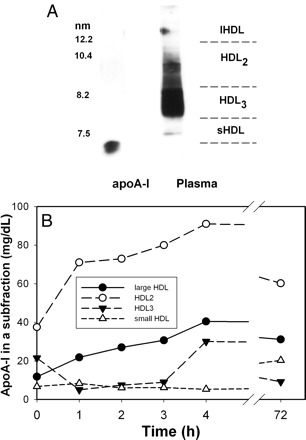
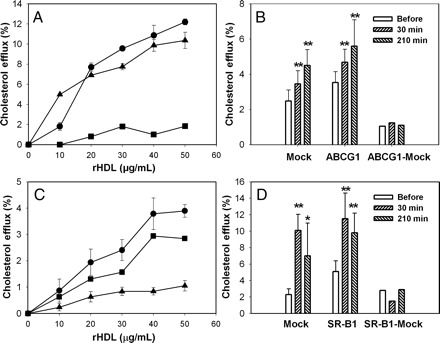
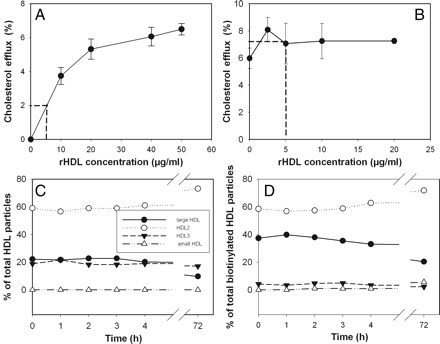
Methods and results: Patient plasmas after infusion of rHDL were tested ex vivo for their capacity to stimulate cholesterol efflux. Reconstituted HDL enhanced mobilization of cholesterol from tissues in vivo as shown by rising HDL cholesterol concentrations over the infusion period. Infusion of rHDL in vivo led to increased cholesterol efflux ex vivo; surprisingly, removing apoB-containing lipoproteins while preserving all HDL subfractions eliminated this increase. Infusion of rHDL led to the remodelling of plasma HDL; however, the capacity of plasma to support cholesterol efflux did not correlate with changes in the concentrations of any of HDL subfractions. Unmodified rHDL accounted for only a proportion of the increment in cholesterol efflux capacity. Furthermore, studies using HeLa and BHK cells overexpressing ABCA1, ABCG1, and SR-B1 showed that the contribution of these cellular mediators of cholesterol efflux to the enhanced capacity of plasma for the efflux was minimal.
Conclusion: Enhanced cholesterol efflux from tissues requires the presence of apoB-containing lipoproteins and may involve enhanced flow of cholesterol through multiple components of the reverse cholesterol transport pathway rather than being determined by a specific HDL subfraction.
Figures
References
-
- Shaw JA, Bobik A, Murphy A, Kanellakis P, Blombery P, Mukhamedova N, Woollard K, Lyon S, Sviridov D, Dart AM. Infusion of reconstituted high-density lipoprotein leads to acute changes in human atherosclerotic plaque. Circ Res. 2008;103:1084–1091. - PubMed
-
- Nicholls SJ, Tuzcu EM, Sipahi I, Schoenhagen P, Crowe T, Kapadia S, Nissen SE. Relationship between atheroma regression and change in lumen size after infusion of apolipoprotein A-I Milano. J Am Coll Cardiol. 2006;47:992–997. - PubMed
-
- Sviridov D, Hoang A, Ooi E, Watts G, Barrett PHR, Nestel P. Indices of reverse cholesterol transport in subjects with metabolic syndrome after treatment with rosuvastatin. Atherosclerosis. 2008;197:732–739. - PubMed
-
- de la Llera-Moya M, Drazul-Schrader D, Asztalos BF, Cuchel M, Rader DJ, Rothblat GH. The ability to promote efflux via ABCA1 determines the capacity of serum specimens with similar high-density lipoprotein cholesterol to remove cholesterol from macrophages. Arterioscler Thromb Vasc Biol. 2010;30:796–801. - PMC - PubMed
-
- Nanjee MN, Cooke CJ, Olszewski WL, Miller NE. Concentrations of electrophoretic and size subclasses of apolipoprotein A-I-containing particles in human peripheral lymph. Arterioscler Thromb Vasc Biol. 2000;20:2148–2155. - PubMed
Publication types
MeSH terms
Substances
LinkOut - more resources
Full Text Sources
Medical
Molecular Biology Databases
Research Materials
Miscellaneous
