


Renin and cardiovascular disease: Worn-out path, or new direction
- PMID: 21499495
- PMCID: PMC3077814
- DOI: 10.4330/wjc.v3.i3.72
Renin and cardiovascular disease: Worn-out path, or new direction
Abstract
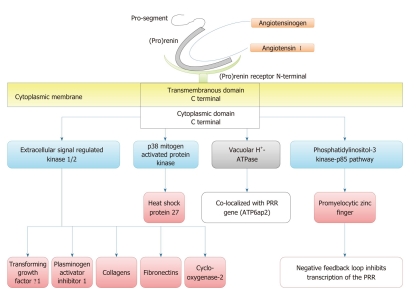
Inhibition of the renin angiotensin system has beneficial effects in cardiovascular prevention and treatment. The advent of orally active direct renin inhibitors adds a novel approach to antagonism of the renin-angiotensin system. Inhibition of the first and rate-limiting step of the renin angiotensin cascade offers theoretical advantages over downstream blockade. However, the recent discovery of the (pro)renin receptor which binds both renin and prorenin, and which can not only augment catalytic activity of both renin and prorenin in converting angiotensinogen to angiotensin I, but also signal intracellularly via various pathways to modulate gene expression, adds a significant level of complexity to the field. In this review, we will examine the basic and clinical data on renin and its inhibition in the context of cardiovascular pathophysiology.
Keywords: Angiotensin; Cardiovascular disease; Prorenin receptor; Renin; Renin receptor.
Figures

References
-
- Bright R. Tabular view of the morbid appearances in 100 cases connected with albuminous urine: With observations. Guy's Hosp Rep. 1836;1:380–400.
-
- Tigerstedt R, Bergman PG. Niere und Kreislauf. Scand Arch Physiol. 1898;8:223–271.
-
- Basso N, Terragno NA. History about the discovery of the renin-angiotensin system. Hypertension. 2001;38:1246–1249. - PubMed
-
- Abassi Z, Winaver J, Feuerstein GZ. The biochemical pharmacology of renin inhibitors: implications for translational medicine in hypertension, diabetic nephropathy and heart failure: expectations and reality. Biochem Pharmacol. 2009;78:933–940. - PubMed
-
- Lloyd-Jones D, Adams RJ, Brown TM, Carnethon M, Dai S, De Simone G, Ferguson TB, Ford E, Furie K, Gillespie C, et al. Executive summary: heart disease and stroke statistics--2010 update: a report from the American Heart Association. Circulation. 2010;121:948–954. - PubMed
LinkOut - more resources
Full Text Sources
