


Comparative genome sequence analysis underscores mycoparasitism as the ancestral life style of Trichoderma
- PMID: 21501500
- PMCID: PMC3218866
- DOI: 10.1186/gb-2011-12-4-r40
Comparative genome sequence analysis underscores mycoparasitism as the ancestral life style of Trichoderma
Abstract
Background: Mycoparasitism, a lifestyle where one fungus is parasitic on another fungus, has special relevance when the prey is a plant pathogen, providing a strategy for biological control of pests for plant protection. Probably, the most studied biocontrol agents are species of the genus Hypocrea/Trichoderma.
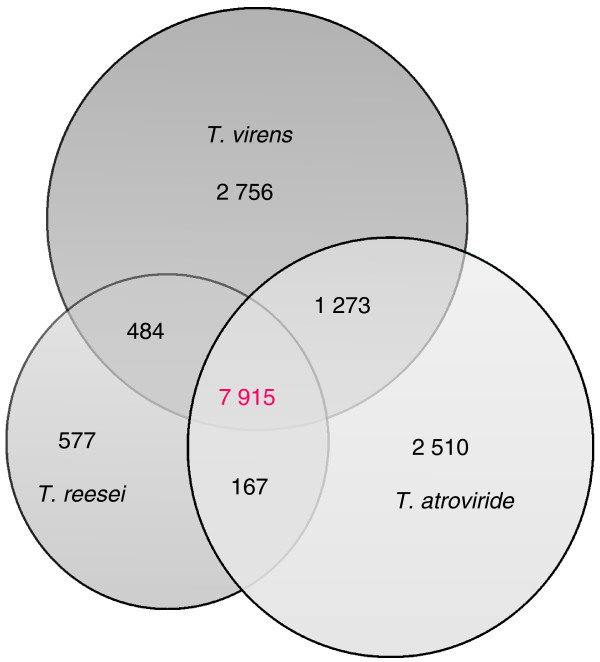
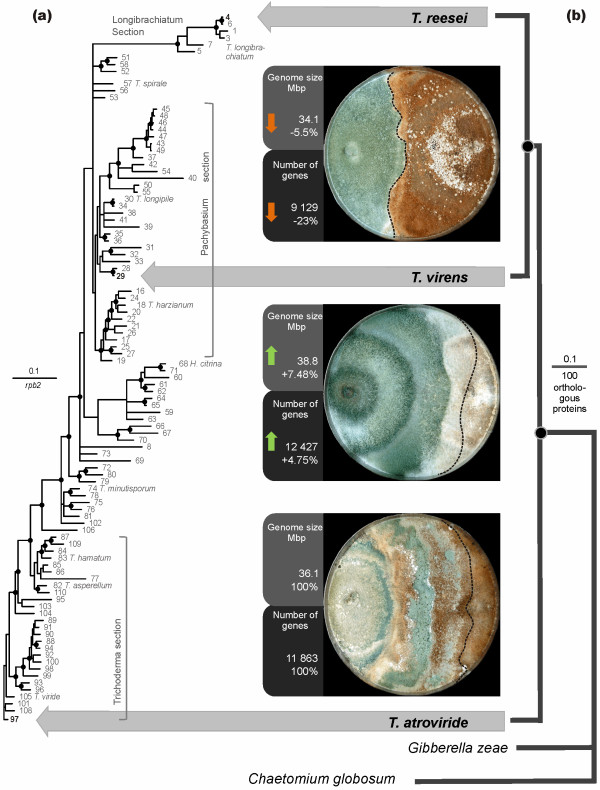
Results: Here we report an analysis of the genome sequences of the two biocontrol species Trichoderma atroviride (teleomorph Hypocrea atroviridis) and Trichoderma virens (formerly Gliocladium virens, teleomorph Hypocrea virens), and a comparison with Trichoderma reesei (teleomorph Hypocrea jecorina). These three Trichoderma species display a remarkable conservation of gene order (78 to 96%), and a lack of active mobile elements probably due to repeat-induced point mutation. Several gene families are expanded in the two mycoparasitic species relative to T. reesei or other ascomycetes, and are overrepresented in non-syntenic genome regions. A phylogenetic analysis shows that T. reesei and T. virens are derived relative to T. atroviride. The mycoparasitism-specific genes thus arose in a common Trichoderma ancestor but were subsequently lost in T. reesei.
Conclusions: The data offer a better understanding of mycoparasitism, and thus enforce the development of improved biocontrol strains for efficient and environmentally friendly protection of plants.
© 2011 Kubicek et al.; licensee BioMed Central Ltd.
Figures
References
-
- Vincent C, Goettel MS, Lazarovits G. Biological Control: A Global Perspective: Case Studies from Around the World. Wallingford, UK: CAB International; 2007.
Publication types
MeSH terms
Substances
Grants and funding
LinkOut - more resources
Full Text Sources
Other Literature Sources
Molecular Biology Databases
