


Impact of daily temperature fluctuations on dengue virus transmission by Aedes aegypti
- PMID: 21502510
- PMCID: PMC3088608
- DOI: 10.1073/pnas.1101377108
Impact of daily temperature fluctuations on dengue virus transmission by Aedes aegypti
Abstract
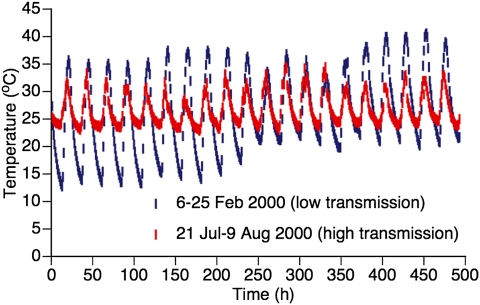
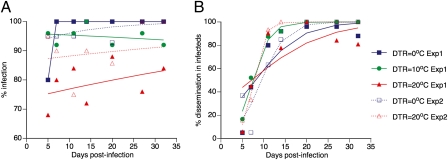
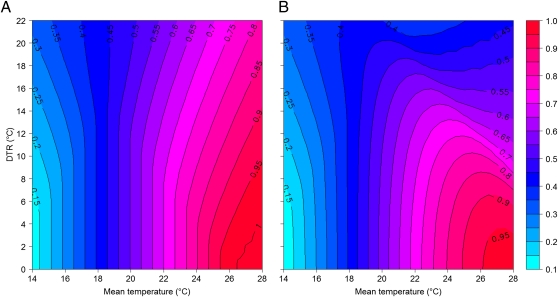
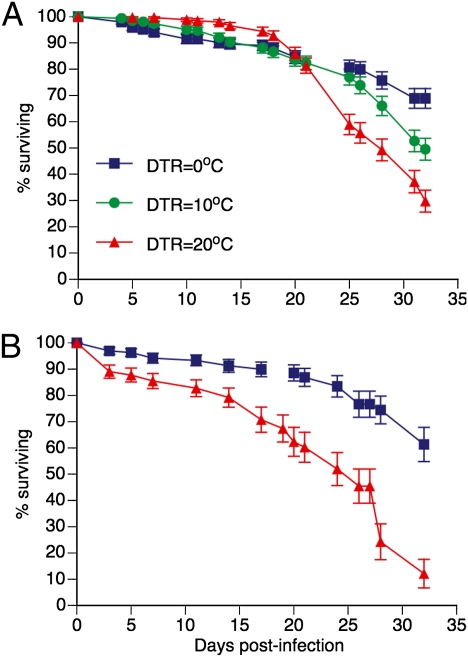
Most studies on the ability of insect populations to transmit pathogens consider only constant temperatures and do not account for realistic daily temperature fluctuations that can impact vector-pathogen interactions. Here, we show that diurnal temperature range (DTR) affects two important parameters underlying dengue virus (DENV) transmission by Aedes aegypti. In two independent experiments using different DENV serotypes, mosquitoes were less susceptible to virus infection and died faster under larger DTR around the same mean temperature. Large DTR (20 °C) decreased the probability of midgut infection, but not duration of the virus extrinsic incubation period (EIP), compared with moderate DTR (10 °C) or constant temperature. A thermodynamic model predicted that at mean temperatures <18 °C, DENV transmission increases as DTR increases, whereas at mean temperatures >18 °C, larger DTR reduces DENV transmission. The negative impact of DTR on Ae. aegypti survival indicates that large temperature fluctuations will reduce the probability of vector survival through EIP and expectation of infectious life. Seasonal variation in the amplitude of daily temperature fluctuations helps to explain seasonal forcing of DENV transmission at locations where average temperature does not vary seasonally and mosquito abundance is not associated with dengue incidence. Mosquitoes lived longer and were more likely to become infected under moderate temperature fluctuations, which is typical of the high DENV transmission season than under large temperature fluctuations, which is typical of the low DENV transmission season. Our findings reveal the importance of considering short-term temperature variations when studying DENV transmission dynamics.
Conflict of interest statement
The authors declare no conflict of interest.
Figures
References
-
- Rogers DJ, Randolph SE. Climate change and vector-borne diseases. Adv Parasitol. 2006;62:345–381. - PubMed
-
- Lafferty KD. The ecology of climate change and infectious diseases. Ecology. 2009;90:888–900. - PubMed
-
- McMichael AJ, Woodruff RE, Hales S. Climate change and human health: Present and future risks. Lancet. 2006;367:859–869. - PubMed
-
- Wilson K. Global warming and the spread of disease: The debate heats up. Trends Ecol Evol. 2000;15:488. - PubMed
Publication types
MeSH terms
Grants and funding
LinkOut - more resources
Full Text Sources
Medical
