


Identification of broad-spectrum antiviral compounds and assessment of the druggability of their target for efficacy against respiratory syncytial virus (RSV)
- PMID: 21502533
- PMCID: PMC3084118
- DOI: 10.1073/pnas.1017142108
Identification of broad-spectrum antiviral compounds and assessment of the druggability of their target for efficacy against respiratory syncytial virus (RSV)
Abstract
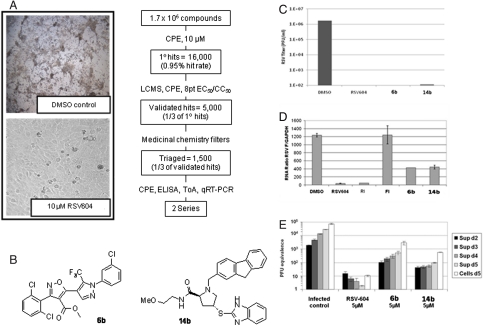
The search for novel therapeutic interventions for viral disease is a challenging pursuit, hallmarked by the paucity of antiviral agents currently prescribed. Targeting of viral proteins has the inextricable challenge of rise of resistance. Safe and effective vaccines are not possible for many viral pathogens. New approaches are required to address the unmet medical need in this area. We undertook a cell-based high-throughput screen to identify leads for development of drugs to treat respiratory syncytial virus (RSV), a serious pediatric pathogen. We identified compounds that are potent (nanomolar) inhibitors of RSV in vitro in HEp-2 cells and in primary human bronchial epithelial cells and were shown to act postentry. Interestingly, two scaffolds exhibited broad-spectrum activity among multiple RNA viruses. Using the chemical matter as a probe, we identified the targets and identified a common cellular pathway: the de novo pyrimidine biosynthesis pathway. Both targets were validated in vitro and showed no significant cell cytotoxicity except for activity against proliferative B- and T-type lymphoid cells. Corollary to this finding was to understand the consequences of inhibition of the target to the host. An in vivo assessment for antiviral efficacy failed to demonstrate reduced viral load, but revealed microscopic changes and a trend toward reduced pyrimidine pools and findings in histopathology. We present here a discovery program that includes screen, target identification, validation, and druggability that can be broadly applied to identify and interrogate other host factors for antiviral effect starting from chemical matter of unknown target/mechanism of action.
Conflict of interest statement
The authors declare no conflict of interest.
Figures


References
-
- Chanock R, Roizman B, Myers R. Recovery from infants with respiratory illness of a virus related to chimpanzee coryza agent (CCA): Isolation, properties and characterization. Am. J. Epidemiol. 1957;66:281–290. - PubMed
-
- Centers for Disease Control and Prevention. Respiratory syncytial virus activity—United States, 1999–2000 season. JAMA J Am Med Assoc. 2001;285:287–288. - PubMed
-
- Falsey AR, et al. Respiratory syncytial virus infection in elderly and high-risk adults. New Engl J Med. 2009;352:1749–1759. - PubMed
-
- Shay DK, et al. Bronchiolitis-associated hospitalizations among US children, 1980–1996. JAMA J Am Med Assoc. 1999;282:1440–1446. - PubMed
-
- Smyth RL, Openshaw PJM. Bronchiolitis. Lancet. 2006;368:312–322. - PubMed
MeSH terms
Substances
LinkOut - more resources
Full Text Sources
Other Literature Sources
Medical
