


Genetic predictors of fibrin D-dimer levels in healthy adults
- PMID: 21502573
- PMCID: PMC3095913
- DOI: 10.1161/CIRCULATIONAHA.110.009480
Genetic predictors of fibrin D-dimer levels in healthy adults
Abstract
Background: Fibrin fragment D-dimer, one of several peptides produced when crosslinked fibrin is degraded by plasmin, is the most widely used clinical marker of activated blood coagulation. To identity genetic loci influencing D-dimer levels, we performed the first large-scale, genome-wide association search.
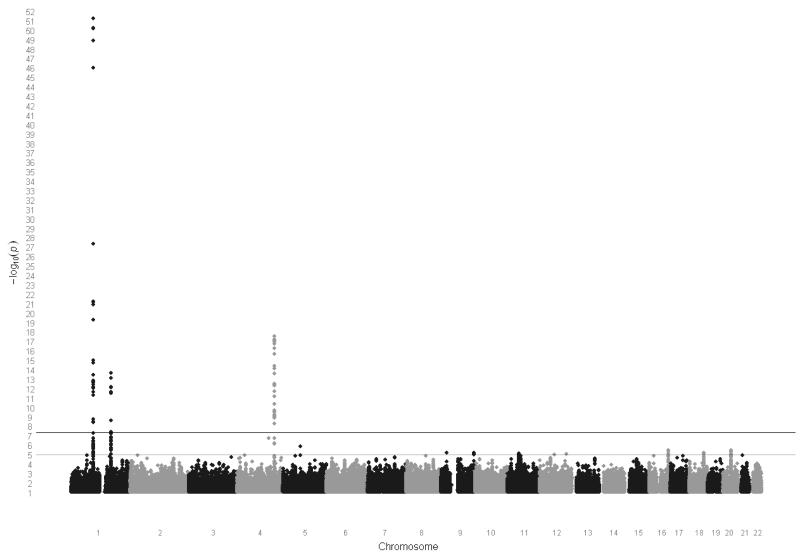
Methods and results: A genome-wide investigation of the genomic correlates of plasma D-dimer levels was conducted among 21 052 European-ancestry adults. Plasma levels of D-dimer were measured independently in each of 13 cohorts. Each study analyzed the association between ≈2.6 million genotyped and imputed variants across the 22 autosomal chromosomes and natural-log–transformed D-dimer levels using linear regression in additive genetic models adjusted for age and sex. Among all variants, 74 exceeded the genome-wide significance threshold and marked 3 regions. At 1p22, rs12029080 (P=6.4×10(-52)) was 46.0 kb upstream from F3, coagulation factor III (tissue factor). At 1q24, rs6687813 (P=2.4×10(-14)) was 79.7 kb downstream of F5, coagulation factor V. At 4q32, rs13109457 (P=2.9×10(-18)) was located between 2 fibrinogen genes: 10.4 kb downstream from FGG and 3.0 kb upstream from FGA. Variants were associated with a 0.099-, 0.096-, and 0.061-unit difference, respectively, in natural-log–transformed D-dimer and together accounted for 1.8% of the total variance. When adjusted for nonsynonymous substitutions in F5 and FGA loci known to be associated with D-dimer levels, there was no evidence of an additional association at either locus.
Conclusions: Three genes were associated with fibrin D-dimer levels. Of these 3, the F3 association was the strongest, and has not been previously reported.
Figures
References
-
- Wells PS, Anderson DR, Rodger M, Forgie M, Kearon C, Dreyer J, Kovacs G, Mitchell M, Lewandowski B, Kovacs MJ. Evaluation of D-dimer in the diagnosis of suspected deep-vein thrombosis. N Engl J Med. 2003;349:1227–1235. - PubMed
-
- Di Nisio M, Squizzato A, Rutjes AW, Buller HR, Zwinderman AH, Bossuyt PM. Diagnostic accuracy of D-dimer test for exclusion of venous thromboembolism: a systematic review. J Thromb Haemost. 2007;5:296–304. - PubMed
-
- Ridker PM, Hennekens CH, Cerskus A, Stampfer MJ. Plasma concentration of cross-linked fibrin degradation product (D-dimer) and the risk of future myocardial infarction among apparently healthy men. Circulation. 1994;90:2236–2240. - PubMed
-
- Cushman M, Lemaitre RN, Kuller LH, Psaty BM, Macy EM, Sharrett AR, Tracy RP. Fibrinolytic activation markers predict myocardial infarction in the elderly. The Cardiovascular Health Study. Arterioscler Thromb Vasc Biol. 1999;19:493–498. - PubMed
-
- Lowe GD, Rumley A, Sweetnam PM, Yarnell JW, Rumley J. Fibrin D-dimer, markers of coagulation activation and the risk of major ischaemic heart disease in the caerphilly study. Thromb Haemost. 2001;86:822–827. - PubMed
Publication types
MeSH terms
Substances
Grants and funding
- R01 HL095080/HL/NHLBI NIH HHS/United States
- U01 HL080295/HL/NHLBI NIH HHS/United States
- U.1275.00.001(61128)/MRC_/Medical Research Council/United Kingdom
- 068545/Z/02/WT_/Wellcome Trust/United Kingdom
- R01 HL087652/HL/NHLBI NIH HHS/United States
- N01-HC-85086/HC/NHLBI NIH HHS/United States
- SAG09977/BB_/Biotechnology and Biological Sciences Research Council/United Kingdom
- U01 DK062418/DK/NIDDK NIH HHS/United States
- P30 DK063491/DK/NIDDK NIH HHS/United States
- N01 HC025195/HL/NHLBI NIH HHS/United States
- 091746/WT_/Wellcome Trust/United Kingdom
- G0000934/MRC_/Medical Research Council/United Kingdom
- DK063491/DK/NIDDK NIH HHS/United States
- N01 HC035129/HC/NHLBI NIH HHS/United States
- 076113/B/04/Z/WT_/Wellcome Trust/United Kingdom
- M01-RR00425/RR/NCRR NIH HHS/United States
- 079895/WT_/Wellcome Trust/United Kingdom
- N02-HL-6-4278/HL/NHLBI NIH HHS/United States
- N01-HC-25195/HC/NHLBI NIH HHS/United States
- HL073410/HL/NHLBI NIH HHS/United States
- CZB/4/710/CSO_/Chief Scientist Office/United Kingdom
- MC_U127561128/MRC_/Medical Research Council/United Kingdom
- N01 HC015103/HC/NHLBI NIH HHS/United States
- N01 HC085086/HL/NHLBI NIH HHS/United States
- CZB/4/276/CSO_/Chief Scientist Office/United Kingdom
- N01 HC055222/HL/NHLBI NIH HHS/United States
- R01 HL 087652/HL/NHLBI NIH HHS/United States
- N01-HC-55222/HC/NHLBI NIH HHS/United States
- 068545/WT_/Wellcome Trust/United Kingdom
- K24 DK080140/DK/NIDDK NIH HHS/United States
- N01 HC085079/HL/NHLBI NIH HHS/United States
- N01-HC-75150/HC/NHLBI NIH HHS/United States
- 079996/WT_/Wellcome Trust/United Kingdom
- MC_PC_U127561128/MRC_/Medical Research Council/United Kingdom
- M01 RR000425/RR/NCRR NIH HHS/United States
- HL095080/HL/NHLBI NIH HHS/United States
- G0700704/MRC_/Medical Research Council/United Kingdom
- N01-HC-85079/HC/NHLBI NIH HHS/United States
- BB/F019394/1/BB_/Biotechnology and Biological Sciences Research Council/United Kingdom
- 091746/Z//WT_/Wellcome Trust/United Kingdom
- MC_QA137934/MRC_/Medical Research Council/United Kingdom
- N01 HC075150/HL/NHLBI NIH HHS/United States
- R01 HL073410/HL/NHLBI NIH HHS/United States
- N01 HC045133/HC/NHLBI NIH HHS/United States
LinkOut - more resources
Full Text Sources
Miscellaneous
