


Isolation and live imaging of enteric progenitors based on Sox10-Histone2BVenus transgene expression
- PMID: 21504042
- PMCID: PMC3212811
- DOI: 10.1002/dvg.20748
Isolation and live imaging of enteric progenitors based on Sox10-Histone2BVenus transgene expression
Abstract
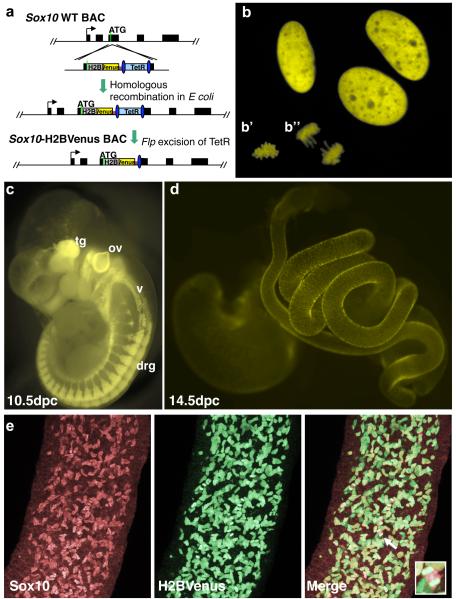
To facilitate dynamic imaging of neural crest (NC) lineages and discrimination of individual cells in the enteric nervous system (ENS) where close juxtaposition often complicates viewing, we generated a mouse BAC transgenic line that drives a Histone2BVenus (H2BVenus) reporter from Sox10 regulatory regions. This strategy does not alter the endogenous Sox10 locus and thus facilitates analysis of normal NC development. Our Sox10-H2BVenus BAC transgene exhibits temporal, spatial, and cell-type specific expression that reflects endogenous Sox10 patterns. Individual cells exhibiting nuclear-localized fluorescence of the H2BVenus reporter are readily visualized in both fixed and living tissue and are amenable to isolation by fluorescence activated cell sorting (FACS). FACS-isolated H2BVenus+ enteric NC-derived progenitors (ENPs) exhibit multipotency, readily form neurospheres, self-renew in vitro and express a variety of stem cell genes. Dynamic live imaging as H2BVenus+ ENPs migrate down the fetal gut reveals cell fragmentation suggesting that apoptosis occurs at a low frequency during normal development of the ENS. Confocal imaging both during population of the fetal intestine and in postnatal gut muscle strips revealed differential expression between individual cells consistent with down-regulation of the transgene as progression towards non-glial fates occurs. The expression of the Sox10-H2BVenus transgene in multiple regions of the peripheral nervous system will facilitate future studies of NC lineage segregation as this tool is expressed in early NC progenitors and maintained in enteric glia.
Copyright © 2011 Wiley-Liss, Inc.
Figures


References
-
- Abud HE, Young HM, Newgreen DF. Analysing tissue and gene function in intestinal organ culture. Methods Mol Biol. 2008;468:275–286. - PubMed
-
- Anderson RB, Stewart AL, Young HM. Phenotypes of neural-crest-derived cells in vagal and sacral pathways. Cell Tissue Res. 2006a;323:11–25. - PubMed
-
- Anderson RB, Turner KN, Nikonenko AG, Hemperly J, Schachner M, Young HM. The cell adhesion molecule l1 is required for chain migration of neural crest cells in the developing mouse gut. Gastroenterology. 2006b;130:1221–1232. - PubMed
Publication types
MeSH terms
Substances
Grants and funding
- P60 DK020593/DK/NIDDK NIH HHS/United States
- DK58404/DK/NIDDK NIH HHS/United States
- P30 DK058404/DK/NIDDK NIH HHS/United States
- P30 HD015052/HD/NICHD NIH HHS/United States
- R21 DK064251/DK/NIDDK NIH HHS/United States
- EY08126/EY/NEI NIH HHS/United States
- P30 EY008126/EY/NEI NIH HHS/United States
- P30 CA068485/CA/NCI NIH HHS/United States
- HD15052/HD/NICHD NIH HHS/United States
- DK20593/DK/NIDDK NIH HHS/United States
- U24 DK059637/DK/NIDDK NIH HHS/United States
- DK59637/DK/NIDDK NIH HHS/United States
- P30 DK020593/DK/NIDDK NIH HHS/United States
- CA68485/CA/NCI NIH HHS/United States
- DK064251/DK/NIDDK NIH HHS/United States
LinkOut - more resources
Full Text Sources
Medical
Molecular Biology Databases
