. 2011 Apr 20;100(8):1969-76.
doi: 10.1016/j.bpj.2011.02.061.

A new state of cardiac myosin with very slow ATP turnover: a potential cardioprotective mechanism in the heart

Affiliations

A new state of cardiac myosin with very slow ATP turnover: a potential cardioprotective mechanism in the heart

Pleuni Hooijman et al. Biophys J. .

Abstract

The mechanisms that control cardiac contractility are complex. Recent work we conducted in vertebrate skeletal muscle identified a new state of myosin, the super-relaxed state (SRX), which had a very low metabolic rate. To determine whether this state also exists in cardiac muscle we used quantitative epi-fluorescence to measure single nucleotide turnovers by myosin in bundles of relaxed permeable rabbit ventricle cells. We measured two turnover times--one compatible with the normal relaxed state, and one much slower which was shown to arise from myosin heads in the SRX. In both skeletal and cardiac muscle, the SRX appears to play a similar role in relaxed cells, providing a state with a very low metabolic rate. However, in active muscle the properties of the SRX differ dramatically. We observed a rapid transition of myosin heads out of the SRX in active skeletal fibers, whereas the population of the SRX remained constant in active cardiac cells. This property allows the SRX to play a very different role in cardiac muscle than in skeletal muscle. The SRX could provide a mechanism for decreasing the metabolic load on the heart, being cardioprotective, particularly in time of stress such as ischemia.


Figures

Figure 1
Figure 1
Changes in fluorescence intensity during the chase phase of the single nucleotide turnover experiments are shown for mantATP chased by ATP (O), and for ATP chased by mantATP (●). In both experiments the intensity changes in two phases—a rapid phase with a time constant of ∼10–15 s and a slow phase with a time constant of ∼140 s. The symmetry between the two experiments shows that the single nucleotide turnover measurements are the same for mantATP replacing ATP and for ATP replacing mantATP. The data were fit with a double-exponential function (solid lines). Parameters of the fits to the data shown here are provided in the Supporting Material.
Figure 2
Figure 2
Comparison of three conditions is shown: 1), incubation in 250 μM mantATP chased by 4mM ATP (●); 2), incubation in 250 μM mantATP chased by 4 mM ADP (○); and 3), incubation in 250 μM mantADP chased by 4 mM ADP (▵). All of the data were obtained from the same muscle bundle. Parameters of the fits to the data shown here are provided in the Supporting Material.
Figure 3
Figure 3
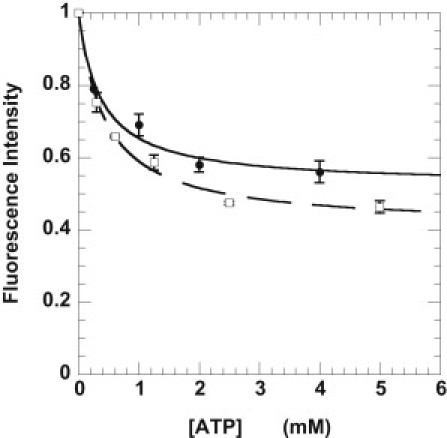
Determination of the fraction of mant nucleotides bound specifically to the ATP binding sites in both skeletal muscle fibers (□, dashed line) and cardiac cells (●, solid line). The cells were incubated in 250 μM mantATP with varied concentrations of ATP. The fluorescence obtained was normalized to the fluorescence in the absence of added ATP. The data were fit to a simple competition model. (Solid and dashed lines) Intensity = INS + (1 − INS)/([ATP]•KappATP /[mATP]•KappmATP + 1), where INS is the intensity due to nonspecific binding. This defines the fraction of mant-nucleotides nonspecifically bound to the cell bundles, and the ratio of the apparent affinities of the two nucleotides for the myosin binding site, Kapp. The equation was derived assuming that both nucleotides are present in excess of their Km values, which is true for the conditions used. The nonspecific fraction was 0.41 ± 0.02 for skeletal fibers (data from Stewart et al. (10)) and 0.52 ± 0.03 for cardiac cells. The ratio of the affinities of ATP and mantATP was 0.56 ± 0.07 for skeletal fibers and 0.67 ± 0.18 for cardiac cells.
Figure 4
Figure 4
Bundle of cardiac cells visualized by spinning-disk confocal microscopy after 1.5 min in the chase phase. The cells were incubated in a solution containing 125 μM mantATP for 2 min then chased with a solution containing 4 mM ATP for 1.5 min before taking the image. The horizontal stripes are ∼1.5 μm in width, close to the length of the A-band in cardiac muscles, showing that much of the fluorescence intensity remaining in the muscle is associated with the A-band. The sarcomere length is 2.1 μm. The bar represents 10 μm.
Figure 5
Figure 5
SRX is present in active cardiac muscle but not active skeletal muscle. Muscles were relaxed in mantATP and were chased with either a relaxing solution containing 4mM ATP (red) or an activating solution containing an additional 3 mM CaCl2 in the presence of 5 mM EGTA, pCa = 5.7 (blue). (A) In skeletal fibers, the fluorescence decays slowly in a relaxing solution (upper curve), but quickly in an activating solution (lower curve). This shows that in activated skeletal fibers the myosin heads transition rapidly out of the SRX. (B) In cardiac muscles, the decay of fluorescence is not changed between chase with relaxing and activating solutions. This shows that myosin heads in the SRX remain in that state when adjacent myosin heads are interacting with actin and generating force. Parameters of the fits to the data shown here are provided in the Supporting Material.

References

    1. Gibbs C.L. Cardiac energetics: sense and nonsense. Clin. Exp. Pharmacol. Physiol. 2003;30:598–603. - PubMed
    1. Depre C., Vatner S.F. Cardioprotection in stunned and hibernating myocardium. Heart Fail. Rev. 2007;12:307–317. - PubMed
    1. Moss R.L., Fitzsimons D.P. Regulation of contraction in mammalian striated muscles—the plot thick-ens. J. Gen. Physiol. 2010;136:21–27. - PMC - PubMed
    1. Colson B.A., Bekyarova T., Moss R.L. Protein kinase A-mediated phosphorylation of cMyBP-C increases proximity of myosin heads to actin in resting myocardium. Circ. Res. 2008;103:244–251. - PMC - PubMed
    1. Kooij V., Boontje N., van der Velden J. Protein kinase C α and ɛ phosphorylation of troponin and myosin binding protein C reduce Ca2+ sensitivity in human myocardium. Basic Res. Cardiol. 2010;105:289–300. - PMC - PubMed

Publication types

LinkOut - more resources