


Suppressed monocyte recruitment drives macrophage removal from atherosclerotic plaques of Apoe-/- mice during disease regression
- PMID: 21505265
- PMCID: PMC3083793
- DOI: 10.1172/JCI43802
Suppressed monocyte recruitment drives macrophage removal from atherosclerotic plaques of Apoe-/- mice during disease regression
Abstract
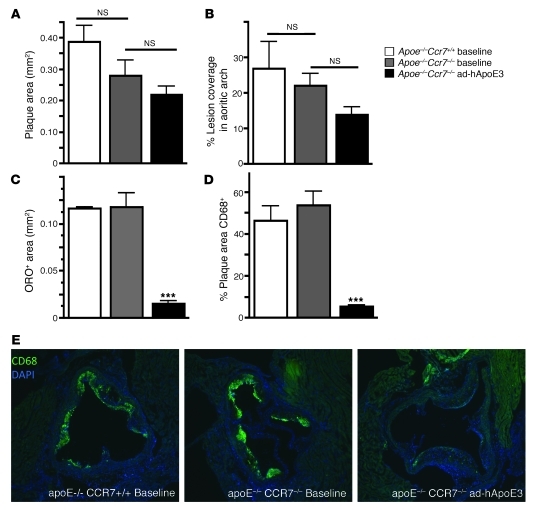
Experimental models of atherosclerosis suggest that recruitment of monocytes into plaques drives the progression of this chronic inflammatory condition. Cholesterol-lowering therapy leads to plaque stabilization or regression in human atherosclerosis, characterized by reduced macrophage content, but the mechanisms that underlie this reduction are incompletely understood. Mice lacking the gene Apoe (Apoe-/- mice) have high levels of cholesterol and spontaneously develop atherosclerotic lesions. Here, we treated Apoe-/- mice with apoE-encoding adenoviral vectors that induce plaque regression, and investigated whether macrophage removal from plaques during this regression resulted from quantitative alterations in the ability of monocytes to either enter or exit plaques. Within 2 days after apoE complementation, plasma cholesterol was normalized to wild-type levels, and HDL levels were increased 4-fold. Oil red O staining and quantitative mass spectroscopy revealed that esterified cholesterol content was markedly reduced. Plaque macrophage content decreased gradually and was 72% lower than baseline 4 weeks after apoE complementation. Importantly, this reduction in macrophages did not involve migratory egress from plaques or CCR7, a mediator of leukocyte emigration. Instead, marked suppression of monocyte recruitment coupled with a stable rate of apoptosis accounted for loss of plaque macrophages. These data suggest that therapies to inhibit monocyte recruitment to plaques may constitute a more viable strategy to reduce plaque macrophage burden than attempts to promote migratory egress.
Figures



References
-
- Farb A, et al. Coronary plaque erosion without rupture into a lipid core. A frequent cause of coronary thrombosis in sudden coronary death. Circulation. 1996;93(7):1354–1363. - PubMed
-
- Shah PK. Pathophysiology of plaque rupture and the concept of plaque stabilization. Cardiol Clin. 1996;14(1):17–29. - PubMed
-
- Libby P, Schoenbeck U, Mach F, Selwyn AP, Ganz P. Current concepts in cardiovascular pathology: the role of LDL cholesterol in plaque rupture and stabilization. Am J Med. 1998;104(2A):14S–18S. - PubMed
Publication types
MeSH terms
Substances
Grants and funding
LinkOut - more resources
Full Text Sources
Other Literature Sources
Medical
Molecular Biology Databases
Miscellaneous
