


The influence of serotonin transporter polymorphisms on cortical activity: a resting EEG study
- PMID: 21507249
- PMCID: PMC3110125
- DOI: 10.1186/1471-2202-12-33
The influence of serotonin transporter polymorphisms on cortical activity: a resting EEG study
Abstract
Background: The serotonin transporter gene (5-HTT) is a key regulator of serotonergic neurotransmission and has been linked to various psychiatric disorders. Among the genetic variants, polymorphisms in the 5-HTT gene-linked polymorphic region (5-HTTLPR) and variable-number-of-tandem-repeat in the second intron (5-HTTVNTR) have functional consequences. However, their genetic impact on cortical oscillation remains unclear. This study examined the modulatory effects of 5-HTTLPR (L-allele carriers vs. non-carriers) and 5-HTTVNTR (10-repeat allele carriers vs. non-carriers) polymorphism on regional neural activity in a young female population.
Methods: Blood samples and resting state eyes-closed electroencephalography (EEG) signals were collected from 195 healthy women and stratified into 2 sets of comparisons of 2 groups each: L-allele carriers (N=91) vs. non-carriers for 5-HTTLPR and 10-repeat allele carriers (N=25) vs. non-carriers for 5-HTTVNTR. The mean power of 18 electrodes across theta, alpha, beta, gamma, gamma1, and gamma2 frequencies was analyzed. Between-group statistics were performed by an independent t-test, and global trends of regional power were quantified by non-parametric analyses.
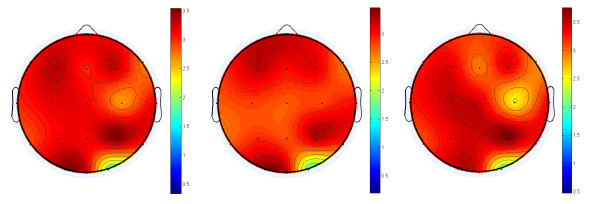
Results: Among 5-HTTVNTR genotypes, 10-repeat allele carriers showed significantly low regional power at gamma frequencies across the brain. We noticed a consistent global trend that carriers with low transcription efficiency of 5-HTT possessed low regional powers, regardless of frequency bands. The non-parametric analyses confirmed this observation, with P values of 3.071×10⁻⁸ and 1.459×10⁻¹² for 5-HTTLPR and 5-HTTVNTR, respectively.
Conclusions and limitations: Our analyses showed that genotypes with low 5-HTT activity are associated with less local neural synchronization during relaxation. The implication with respect to genetic vulnerability of 5-HTT across a broad range of psychiatric disorders is discussed. Given the low frequency of 10-repeat allele of 5-HTTVNTR in our research sample, the possibility of false positive findings should also be considered.
Figures
References
-
- Hoehe MR, Wendel B, Grunewald I, Chiaroni P, Levy N, Morris-Rosendahl D, Macher JP, Sander T, Crocq MA. Serotonin transporter (5-HTT) gene polymorphisms are not associated with susceptibility to mood disorders. Am J Med Genet. 1998;81:1–3. doi: 10.1002/(SICI)1096-8628(19980207)81:1<1::AID-AJMG1>3.0.CO;2-2. - DOI - PubMed
-
- Kuzelova H, Ptacek R, Macek M. The serotonin transporter gene (5-HTT) variant and psychiatric disorders: review of current literature. Neuro Endocrinol Lett. 2010;31:4–10. - PubMed
-
- Ramasubbu R, Tobias R, Bech-Hansen NT. Extended evaluation of serotonin transporter gene functional polymorphisms in subjects with post-stroke depression. Can J Psychiatry. 2008;53:197–201. - PubMed
-
- Barton DA, Esler MD, Dawood T, Lambert EA, Haikerwal D, Brenchley C, Socratous F, Hastings J, Guo L, Wiesner G. et al. Elevated brain serotonin turnover in patients with depression: effect of genotype and therapy. Arch Gen Psychiatry. 2008;65:38–46. doi: 10.1001/archgenpsychiatry.2007.11. - DOI - PubMed
Publication types
MeSH terms
Substances
LinkOut - more resources
Full Text Sources
