


Initiation of DNA replication: functional and evolutionary aspects
- PMID: 21508040
- PMCID: PMC3091809
- DOI: 10.1093/aob/mcr075
Initiation of DNA replication: functional and evolutionary aspects
Abstract
Background: The initiation of DNA replication is a very important and highly regulated step in the cell division cycle. It is of interest to compare different groups of eukaryotic organisms (a) to identify the essential molecular events that occur in all eukaryotes, (b) to start to identify higher-level regulatory mechanisms that are specific to particular groups and (c) to gain insights into the evolution of initiation mechanisms.
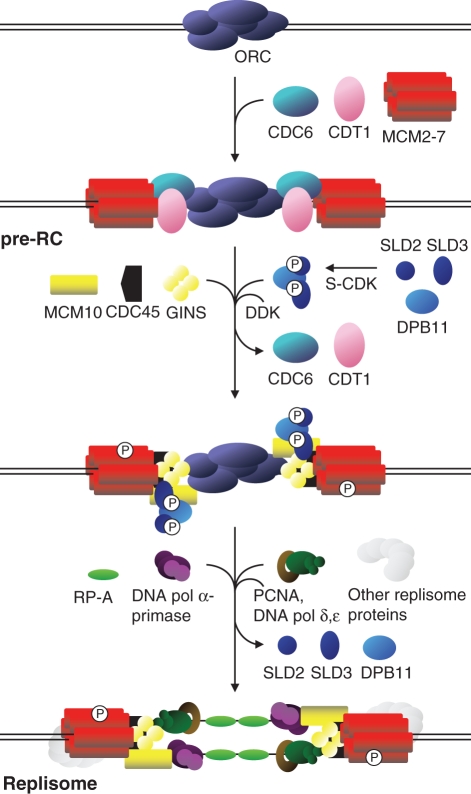
Scope: This review features a wide-ranging literature survey covering replication origins, origin recognition and usage, modification of origin usage (especially in response to plant hormones), assembly of the pre-replication complex, loading of the replisome, genomics, and the likely origin of these mechanisms and proteins in Archaea.
Conclusions: In all eukaryotes, chromatin is organized for DNA replication as multiple replicons. In each replicon, replication is initiated at an origin. With the exception of those in budding yeast, replication origins, including the only one to be isolated so far from a plant, do not appear to embody a specific sequence; rather, they are AT-rich, with short tracts of locally bent DNA. The proteins involved in initiation are remarkably similar across the range of eukaryotes. Nevertheless, their activity may be modified by plant-specific mechanisms, including regulation by plant hormones. The molecular features of initiation are seen in a much simpler form in the Archaea. In particular, where eukaryotes possess a number of closely related proteins that form 'hetero-complexes' (such as the origin recognition complex and the MCM complex), archaeans typically possess one type of protein (e.g. one MCM) that forms a homo-complex. This suggests that several eukaryotic initiation proteins have evolved from archaeal ancestors by gene duplication and divergence.
Figures
References
-
- Aves SJ. DNA replication initiation. Methods in Molecular Biology. 2009;521:3–17. - PubMed
-
- Bell SP. The origin recognition complex: from simple origins to complex functions. Genes and Development. 2002;16:659–672. - PubMed
-
- Bell SP, Stillman B. ATP-dependent recognition of eukaryotic origins of DNA replication by a multi-protein complex. Nature. 1992;357:128–134. - PubMed
Publication types
MeSH terms
Substances
LinkOut - more resources
Full Text Sources
Molecular Biology Databases
