Indolent mantle cell leukemia: a clinicopathological variant characterized by isolated lymphocytosis, interstitial bone marrow involvement, kappa light chain restriction, and good prognosis
- PMID: 21508124
- PMCID: PMC3148905
- DOI: 10.3324/haematol.2010.036277
Indolent mantle cell leukemia: a clinicopathological variant characterized by isolated lymphocytosis, interstitial bone marrow involvement, kappa light chain restriction, and good prognosis
Abstract
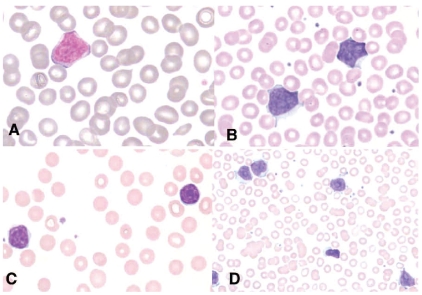
Background: Cases of mantle cell lymphoma with indolent behavior have been reported, but are poorly identified by current clinical risk models. Early studies found peripheral blood involvement to be an adverse prognostic factor; however, cases of a seemingly indolent variant of mantle cell lymphoma, characterized by peripheral blood involvement and minimal nodal disease, have been incompletely described, particularly with regard to bone marrow findings. We report a series of leukemic phase mantle cell lymphomas with a non-progressive or slowly progressive course.
Design and methods: Cases presenting with mantle cell lymphoma limited to the peripheral blood/bone marrow from 2000-2010 were identified. Diagnoses were established by morphology, flow cytometric analysis and requisite evidence of IGH-CCND1@ by fluorescence in-situ hybridization or t(11;14)(q13;q32) by cytogenetics. Patients with lymphadenopathy, splenomegaly and gastrointestinal symptomatology were excluded.
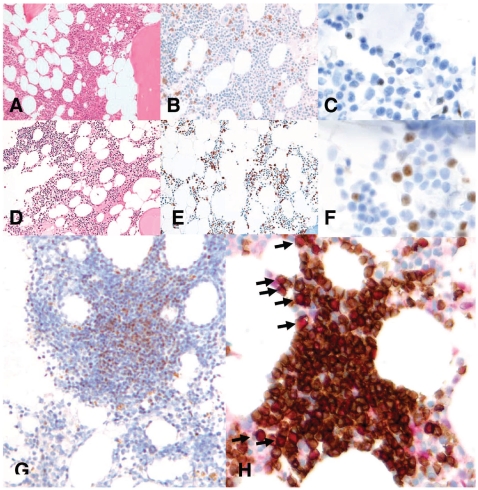
Results: Patients (n=8, median age 60.5 years) were asymptomatic with mild lymphocytosis (8.7×10(9)/L; range, 4.5-14.2×10(9)/L) and cytology typical of mantle cell lymphoma. Flow cytometric analysis showed that all expressed CD5, CD19, CD20, variable CD23, and a striking kappa immunoglobulin light chain restriction (7/8 cases). Bone marrow biopsy at diagnosis showed interstitial single or small lymphoid aggregates with similar patterns of CD20 and cyclin D1 immunostaining which were not readily discernable by hematoxylin and eosin stain. SOX11 was negative (4/5) or only weakly expressed (1/5). The median follow-up was 27 months (range, 5-109 months) and all patients, but one, are alive with no clinical evidence of disease. The prevalence of indolent mantle cell lymphoma presenting only with lymphocytosis, among all mantle cell lymphomas diagnosed during the same period, was 3%.
Conclusions: Leukemic mantle cell lymphoma limited to blood and bone marrow is an indolent variant characterized by mild-moderate lymphocytosis, interstitial low-level bone marrow involvement, simple karyotype, kappa light chain expression, cyclin D1 expression with lack of SOX11, and slow or absent clinical progression. Some cases may represent a mantle cell lymphoma counterpart to chronic lymphocytic leukemia - phenotype monoclonal B-cell lymphocytosis. Recognition of this variant could inform treatment decisions and possibly avoid unnecessary treatment.
Figures
Comment in
-
Indolent mantle cell lymphoma.Haematologica. 2011 Aug;96(8):1086-8. doi: 10.3324/haematol.2011.047357. Haematologica. 2011. PMID: 21810971 Free PMC article. No abstract available.
References
-
- A clinical evaluation of the International Lymphoma Study Group classification of non-Hodgkin’s lymphoma. The Non-Hodgkin’s Lymphoma Classification Project. Blood. 1997;89(11):3909–18. - PubMed
-
- Swerdlow SH, Campo E, Harris NL, Jaffe ES, Pileri SA, Stein H, et al. WHO Classification of Tumours of the Haematopoietic and Lymphoid Tissues. Lyon: IARC; 2008. pp. 229–32.
-
- Jares P, Colomer D, Campo E. Genetic and molecular pathogenesis of mantle cell lymphoma: perspectives for new targeted therapeutics. Nat Rev Cancer. 2007;7(10):750–62. - PubMed
-
- Espinet B, Sole F, Pedro C, Garcia M, Bellosillo B, Salido M, et al. Clonal proliferation of cyclin D1-positive mantle lymphocytes in an asymptomatic patient: an early-stage event in the development or an indolent form of a mantle cell lymphoma? Hum Pathol. 2005;36(11):1232–7. - PubMed
-
- Nodit L, Bahler DW, Jacobs SA, Locker J, Swerdlow SH. Indolent mantle cell lymphoma with nodal involvement and mutated immunoglobulin heavy chain genes. Hum Pathol. 2003;34(10):1030–4. - PubMed
MeSH terms
Substances
LinkOut - more resources
Full Text Sources
Research Materials