


Case Reports
doi: 10.1128/JCM.02326-10.
Epub 2011 Apr 20.
Chronic rhinofacial mucormycosis caused by Mucor irregularis (Rhizomucor variabilis) in India
Affiliations
- PMID: 21508154
- PMCID: PMC3122748
- DOI: 10.1128/JCM.02326-10
Item in Clipboard
Case Reports
Chronic rhinofacial mucormycosis caused by Mucor irregularis (Rhizomucor variabilis) in India
J Clin Microbiol.
2011 Jun.
Abstract
In this article, we describe a chronic case of rhinofacial mucormycosis caused by Mucor irregularis, formerly known as Rhizomucor variabilis var. variabilis, a rare mycotic agent in humans. The infection caused progressive destruction of the nasal septum and soft and hard palate, leading to collapse of the nose bridge and an ulcerative gaping hole. The mucoralean mold cultured from a nasal biopsy specimen was determined by multilocus DNA sequence data to be conspecific with M. irregularis.
Figures
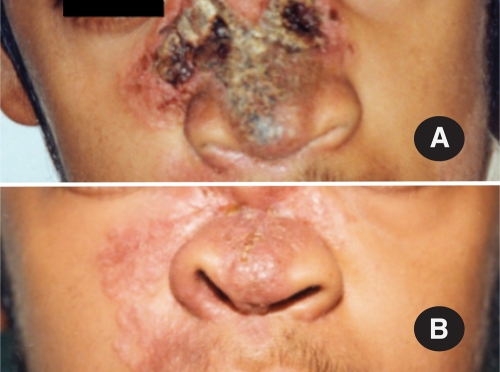
Patient showing nasal lesions caused by Mucor irregularis NRRL 32535 (Hema 8791) before (A) and after (B) 6 months of treatment with fluconazole. Given that fluconazole is inactive against mucoralen fungi, we speculate the infection resolved independently, possibly because this isolate cannot grow at 37°C.
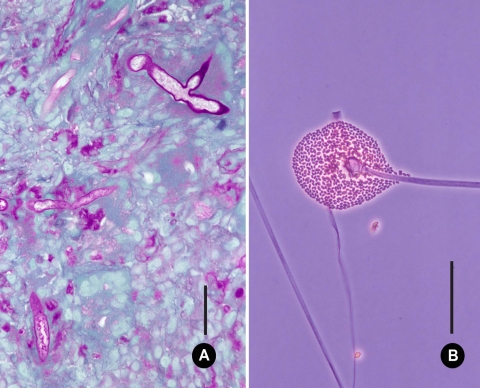
Microscopic features of Mucor irregularis NRRL 32535. (A) Section of nasal biopsy tissue showing broad, nonseptate, hyphal elements stained with periodic acid Schiff's reagent. Bar, 25 μm. (B) Sporangiophore, columella, and sporangiospores. Bar, 250 μm.
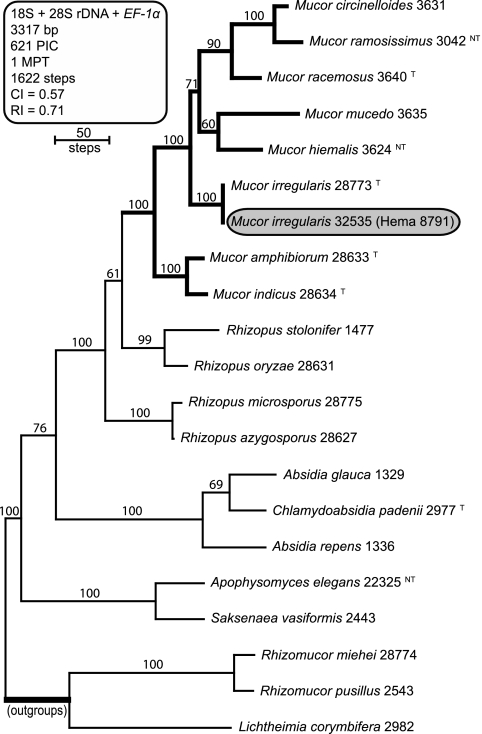
Bootstrap consensus phylogram depicting phylogenetic relationships of Mucor irregularis NRRL 32535 (Hema 8791) to other clinically important members of the Mucorales. The phylogram is the single-most-parsimonious tree (MPT) inferred from a three-locus data set comprising the nuclear ribosomal small subunit 18S rDNA, and portions of the nuclear ribosomal large subunit 28S rDNA and translation elongation factor (EF-1α) gene. Note that M. irregularis NRRL 32535 and NRRL 28773, the ex type strain (T) of Rhizomucor variabilis var. variabilis, appear to be conspecific. Numbers above internodes represent bootstrap support based on 1,000 maximum parsimony pseudoreplicates of the data. Sequences of Rhizomucor miehei, R. pusillus, and Lichtheimia corymbifera were used to root the phylogram. PIC, parsimony informative characters; CI, consistency index; RI, retention index; T, ex type strain; NT, ex neotype strain.
References
-
- Álvarez E., et al. 2011. Two new species of Mucor from clinical samples. Med. Mycol. 49:62–72 - PubMed
-
- Andrews G., Kurien M., Anandi V., Ramakrishna B., Raman R. 1996. Nasosinusal fungal granuloma—clinical profile. Singapore Med. J. 37:470–474 - PubMed
-
- Chakrabarti A., et al. 2001. Ten years' experience in zygomycosis at a tertiary care centre in India. J. Infect. 42:261–266 - PubMed
Publication types
MeSH terms
Substances
Associated data
- Actions
- Actions
- Actions
LinkOut - more resources
Full Text Sources
Molecular Biology Databases
