


Serine/threonine kinase gene Stpk-V, a key member of powdery mildew resistance gene Pm21, confers powdery mildew resistance in wheat
- PMID: 21508323
- PMCID: PMC3093467
- DOI: 10.1073/pnas.1016981108
Serine/threonine kinase gene Stpk-V, a key member of powdery mildew resistance gene Pm21, confers powdery mildew resistance in wheat
Abstract
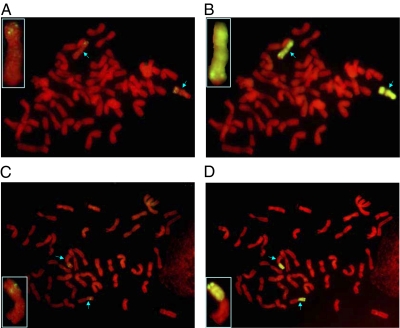
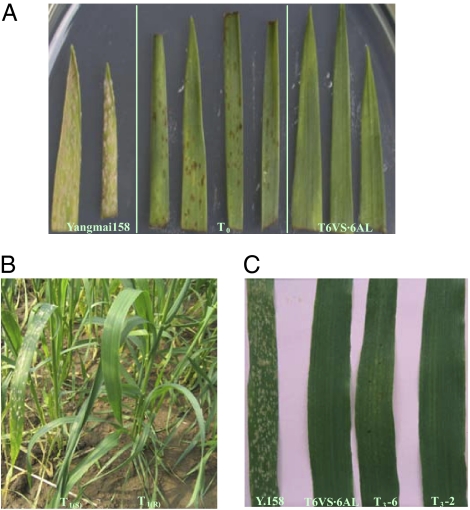
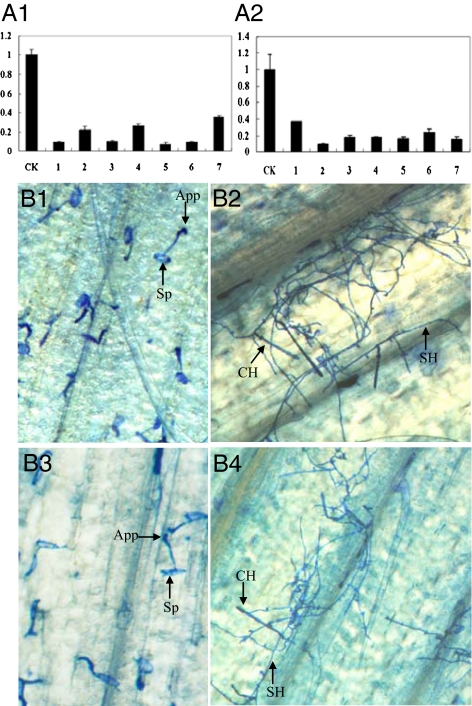
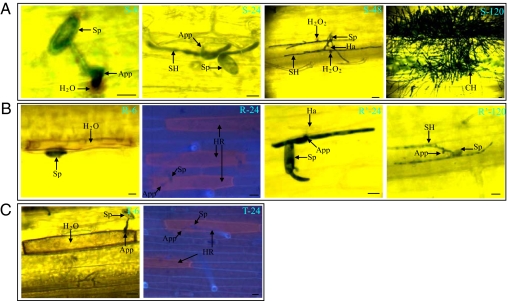
Powdery mildew resistance gene Pm21, located on the chromosome 6V short arm of Haynaldia villosa and transferred to wheat as a 6VS·6AL translocation (T6VS·6AL), confers durable and broad-spectrum resistance to wheat powdery mildew. Pm21 has become a key gene resource for powdery mildew resistance breeding all over the world. In China, 12 wheat varieties containing Pm21 have been planted on more than 3.4 million hectares since 2002. Pm21 has been intractable to molecular genetic mapping because the 6VS does not pair and recombine with the 6AS. Moreover, all known accessions of H. villosa are immune to powdery mildew fungus. Pm21 is still defined by cytogenetics as a locus. In the present study, a putative serine and threonine protein kinase gene Stpk-V was cloned and characterized with an integrative strategy of molecular and cytogenetic techniques. Stpk-V is located on the Pm21 locus. The results of a single cell transient expression assay showed that Stpk-V could decrease the haustorium index dramatically. After the Stpk-V was transformed into a susceptible wheat variety Yangmai158, the characterized transgenic plants showed high and broad-spectrum powdery mildew resistance similar to T6VS·6AL. Silencing of the Stpk-V by virus-induced gene silencing in both T6VS·6AL and H. villosa resulted in their increased susceptibility. Stpk-V could be induced by Bgt and exogenous H(2)O(2), but it also mediated the increase of endogenous H(2)O(2), leading to cell death and plant resistance when the plant was attacked by Bgt.
Conflict of interest statement
The authors declare no conflict of interest.
Figures
Comment in
-
Alien introgressions represent a rich source of genes for crop improvement.Proc Natl Acad Sci U S A. 2011 May 10;108(19):7657-8. doi: 10.1073/pnas.1104845108. Epub 2011 Apr 28. Proc Natl Acad Sci U S A. 2011. PMID: 21527718 Free PMC article. No abstract available.
References
-
- Huang X, Röder MS. Molecular mapping of powdery mildew resistance genes in wheat: A review. Euphytica. 2004;137:203–223.
-
- Li Z, Li B, Tong Y. The contribution of distant hybridization with decaploid Agropyron elongatum to wheat improvement in China. J Genet Genomics. 2008;35:451–456. - PubMed
-
- Bennett FGA. Resistance to powdery mildew in wheat: A review of its use in agriculture and breeding programmes. Plant Pathol. 1984;33:279–300.
-
- Griffey CA, Das MK, Stromberg EL. Effectiveness of adult-plant resistance in reducing grain yield loss to powdery mildew in winter wheat. Plant Dis. 1993;77:618–622.
-
- He R, et al. Inheritance and mapping of powdery mildew resistance gene Pm43 introgressed from Thinopyrum intermedium into wheat. Theor Appl Genet. 2009;118:1173–1180. - PubMed
Publication types
MeSH terms
Substances
Associated data
- Actions
- Actions
- Actions
- Actions
- Actions
- Actions
- Actions
LinkOut - more resources
Full Text Sources
Other Literature Sources
