Comparative Study
. 2011 Jul;36(8):1545-56.
doi: 10.1038/npp.2011.61. Epub 2011 Apr 20.

Hippocampal focal knockout of CBP affects specific histone modifications, long-term potentiation, and long-term memory

Affiliations
Comparative Study

Hippocampal focal knockout of CBP affects specific histone modifications, long-term potentiation, and long-term memory

Ruth M Barrett et al. Neuropsychopharmacology. 2011 Jul.

Abstract

To identify the role of the histone acetyltransferase (HAT) CREB-binding protein (CBP) in neurons of the CA1 region of the hippocampus during memory formation, we examine the effects of a focal homozygous knockout of CBP on histone modifications, gene expression, synaptic plasticity, and long-term memory. We show that CBP is critical for the in vivo acetylation of lysines on histones H2B, H3, and H4. CBP's homolog p300 was unable to compensate for the loss of CBP. Neurons lacking CBP maintained phosphorylation of the transcription factor CREB, yet failed to activate CREB:CBP-mediated gene expression. Loss of CBP in dorsal CA1 of the hippocampus resulted in selective impairments to long-term potentiation and long-term memory for contextual fear and object recognition. Together, these results suggest a necessary role for specific chromatin modifications, selectively mediated by CBP in the consolidation of memories.


Figures
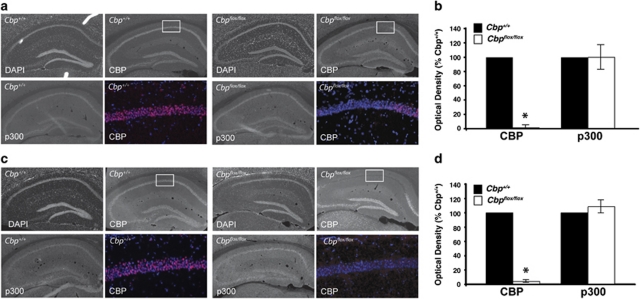
Figure 1
Figure 1
AAV-Cre infusion in Cbpflox/flox mice induces a focal loss of CBP, but no change in expression of CBP homolog p300. Perfusion-fixed immunostained coronal brain slices were prepared from Cbpflox/flox and Cbp+/+ mice at 3–6 weeks following intrahippocampal infusions of AAV-Cre, either serotype 2/2 or 2/1 (AAV2/2-Cre or AAV2/1-Cre). Quantification of immunostaining is shown on right. (a) Representative images showing DAPI labeling and CBP and p300 immunoreactivity in hippocampi of AAV2/2-Cre infused Cbp+/+ and Cbpflox/flox mice. The color images are × 20 magnifications of the regions boxed in white, labeled with DAPI (blue), and CBP (pink). The Cbp+/+ mice displayed expression of CBP throughout CA1, CA3, and the dentate gyrus. However the Cbpflox/flox mice display a focal loss of CBP in area CA1 of the hippocampus, while exhibiting no difference in p300 expression in this region. (b) Quantification of CBP and p300 optical density. (c) Representative images showing DAPI labeling and CBP and p300 immunoreactivity in hippocampi of AAV2/1-Cre infused Cbp+/+ and Cbpflox/flox mice. The color images are × 20 magnifications of the regions boxed in white, labeled with DAPI (blue), and CBP (pink). The Cbp+/+ mice displayed expression of CBP throughout CA1, CA3, and the dentate gyrus. However the Cbpflox/flox mice display a loss of CBP, while exhibiting no difference in p300 expression in this region. (d) Quantification of CBP and p300 optical density. *p<0.05.
Figure 2
Figure 2
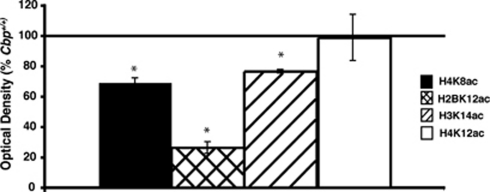
Focal homozygous gene deletion of Cbp results in altered histone acetylation. Hippocampal sections from Cbpflox/flox and Cbp+/+ mice infused with AAV2/1-Cre adjacent to sections immunolabeled for CBP were immunolabeled for H4K8ac, H2BK12ac, H3K14ac, and H4K12ac. Optical density of × 20 magnifications of area CA1 of the hippocampus was quantified. *p<0.05.
Figure 3
Figure 3
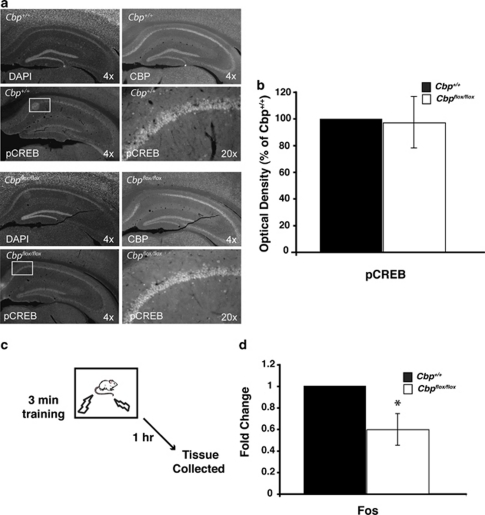
Phosphorylation of CREB is unaltered while expression of c-fos is reduced following fear conditioning in the absence CBP. (a) Representative images showing DAPI labeling and pCREB immunoreactivity in hippocampi of Cbp+/+ and Cbpflox/flox mice. Mice were infused with AAV2/2-Cre and at 2 weeks later were fear conditioned. Perfusion-fixed immunostained coronal brain slices were prepared from mice killed at 10 min following fear conditioning. The Cbp+/+ mice displayed expression of CBP throughout CA1, CA3, and the dentate gyrus. However the Cbpflox/flox mice display a focal loss of CBP, but exhibit no difference in pCREB expression in this region (bottom right two panels). (b) Quantification of pCREB immunostaining indicates no difference in pCREB in Cbp+/+ and Cbpflox/flox mice in the region of Cbp deletion. (c) Mice were infused with AAV2/1-Cre and at 2 weeks later were fear conditioned. At 1 h following training, quantitative RT-PCR shows that c-fos expression is significantly decreased in the dorsal hippocampus of Cbpflox/flox mice compared with wild-type littermates. *p<0.05.
Figure 4
Figure 4
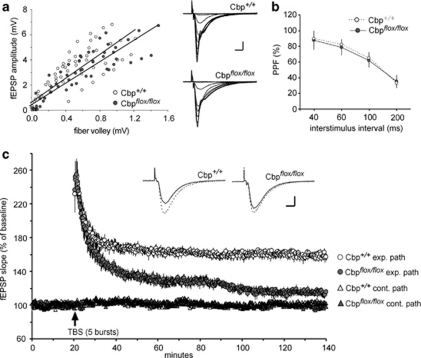
Local deletion of CBP disrupts LTP in hippocampal slices. Field EPSPs evoked by stimulation of either of two electrodes placed in the Schaffer-commissural projections were recorded in CA1b stratum radiatum of slices prepared from Cbp+/+ and Cbpflox/flox mice infused with AAV2/1-Cre (n=7 slices/group). (a) Input/output curves compare amplitudes of the presynaptic fiber volley to thefield excitatory postsynaptic potentials (fEPSP) amplitude across a range of stimulation currents (10, 20, 30, 40, and 50 μA). Slopes for the linear regression lines were not detectably different between the two groups. Representative traces are shown at right (scale bar: 1 mV/5 ms). (b) Paired pulse facilitation of the initial slope of the synaptic response was comparable (40, 60, 100, and 200 ms inter-pulse intervals) in the two groups of slices. (c) A train of five θ-bursts delivered to one of the two stimulation electrodes (exp. path) produced stable potentiation in slices from Cbp+/+ mice (open circles) but not in Cbpflox/flox slices (dark circles) (p<0.001 at the end of the 2 h post-TBS recording session). Synaptic responses recorded in the pathway (cont. path) that did not receive TBS remained stable throughout the experiment for both groups (open triangle, Cbp++; dark triangle, Cpbfloxflox). Insets show field excitatory postsynaptic potentials (fEPSP) traces collected during baseline testing (solid line) and at 2 h after TBS (dotted line). Scale: 1 mV/5 ms.
Figure 5
Figure 5
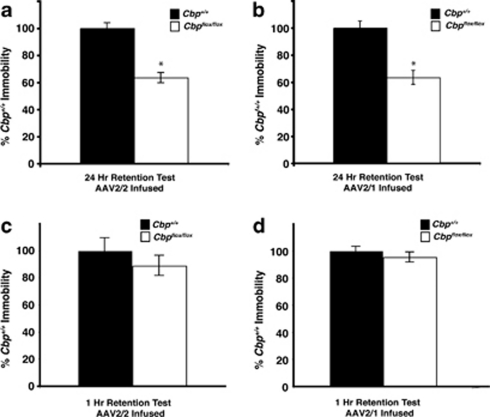
CBP deletion in the hippocampus impairs long-term, but not short-term memory. Memory for contextual fear conditioning was measured as immobility and is displayed as percent of wild type. (a) Cbp+/+ and Cbpflox/flox mice were infused with AAV2/2-Cre and at 2 weeks later were trained and tested for contextual fear conditioning. Cbpflox/flox mice (n=9) exhibited a significant decrease in levels of freezing in a 24 h retention test compared with Cbp+/+ mice (n=8). *p<0.05. (b) Cbpflox/flox and Cbp+/+ mice were administered intrahippocampal infusions of AAV2/1-Cre. At 2 weeks later they were given contextual fear conditioning training. Cbpflox/flox mice (n=9) exhibited a significant decrease in levels of freezing in a 24 h retention test compared with Cbp+/+ mice (n=8). *p<0.05. (c) Cbp+/+ and Cbpflox/flox mice were infused with AAV2/2-Cre and at 2 weeks later were trained and tested at 1 h for contextual fear conditioning. Cbpflox/flox mice (n=9) and Cbp+/+ mice (n=9) were not significantly different. (d) Cbp+/+ and Cbpflox/flox mice were infused with AAV2/1-Cre and at 2 weeks later were trained and tested at 1 h for contextual fear conditioning. Cbpflox/flox mice (n=9) and Cbp+/+ mice (n=10) were not significantly different.
Figure 6
Figure 6
CBP deletion in the hippocampus leads to impairment in hippocampus-dependent location-dependent object recognition that is not rescued by HDAC inhibition. (a) Mice received 10 min training in an environment with two identical objects and received a retention test 24 h later for object location memory (OLM) in which one object is moved to a new location. (b) AAV2/1-Cre infused Cbpflox/flox (n=12) mice exhibit a significant 24 h long-term memory deficit (p<0.05) in a hippocampus-dependent object location recognition task as compared with Cbp+/+ mice (n=9). (c) Mice received 10 min training in an environment with two identical objects and received a 90 min OLM test, in which one object is moved to a new location. (d) AAV2/1-Cre infused Cbpflox/flox (n=7) mice exhibit normal 90 min short-term memory for a familiar location as compared with Cbp+/+ mice (n=8). (e) Mice received 10 min training in an environment with two identical objects and received a retention test at 24 h later for object recognition memory (ORM) in which one object is replaced with a novel one. (f) AAV2/1-Cre infused Cbpflox/flox mice (n=4) exhibit normal 24 h long-term memory for a familiar object as compared with Cbp+/+ mice (n=9) in a hippocampus-independent object recognition task. (g) Mice received subthreshold training (3 min) in an environment with two identical objects immediately followed by i.p. injection of sodium butyrate (NaBut) and received a retention test 24 h later in which one object is moved to a new location. (h) Cbp+/+ mice treated with NaBut (n=7) exhibited a significant preference for the novel object while Cbp+/+ mice treated with vehicle (n=11) and Cbpflox/flox mice treated with vehicle (n=9) or NaBut (n=9) did not show a significant preference. *p<0.05.

Comment in

  • Forgot your HAT? CBP might be to blame.
    Miller CA. Miller CA. Neuropsychopharmacology. 2011 Jul;36(8):1543-4. doi: 10.1038/npp.2011.79. Neuropsychopharmacology. 2011. PMID: 21673711 Free PMC article. No abstract available.

References

    1. Alarcon JM, Malleret G, Touzani K, Vronskaya S, Ishii S, Kandel ER, et al. Chromatin acetylation, memory, and LTP are impaired in CBP+/- mice: a model for the cognitive deficit in Rubinstein-Taybi syndrome and its amelioration. Neuron. 2004;42:947–959. - PubMed
    1. Alberini CM. Transcription factors in long-term memory and synaptic plasticity. Physiol Rev. 2009;89:121–145. - PMC - PubMed
    1. Arany Z, Newsome D, Oldread E, Livingston DM, Eckner R. A family of transcriptional adaptor proteins targeted by the E1A oncoprotein. Nature. 1995;374:81–84. - PubMed
    1. Balderas I, Rodriguez-Ortiz CJ, Salgado-Tonda P, Chavez-Hurtado J, McGaugh JL, Bermudez-Rattoni F. The consolidation of object and context recognition memory involve different regions of the temporal lobe. Learn Mem. 2008;15:618–624. - PMC - PubMed
    1. Barrett RM, Wood MA. Beyond transcription factors: the role of chromatin modifying enzymes in regulating transcription required for memory. Learn Mem. 2008;15:460–467. - PMC - PubMed

Publication types