


Validity of Cardiac Markers as Diagnostic and Prognostic Indicators of Complications in Patients undergoing Percutaneous Coronary Intervention
- PMID: 21509079
- PMCID: PMC3074662
Validity of Cardiac Markers as Diagnostic and Prognostic Indicators of Complications in Patients undergoing Percutaneous Coronary Intervention
Abstract
Objectives: The aim of this study was to assess the diagnostic and prognostic value of heart-type fatty acid-binding protein (H-FABP) in elective percutaneous coronary intervention (PCI) and compare it with standard cardiac markers.
Methods: A prospective evaluation was done of 80 consecutive patients admitted for elective PCI. Serum cardiac troponin T (cTnT), cardiac troponin I (cTnI), creatine kinase-MB (CK-MB mass), myoglobin, and H-FABP were determined pre-angioplasty and 1, 2, 4, and 16-24 hrs post-angioplasty. Elevated cardiac markers were correlated with demographic, angiographic and procedural variables. Patients were followed up for 20-26 months.
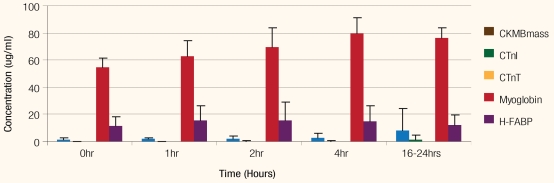
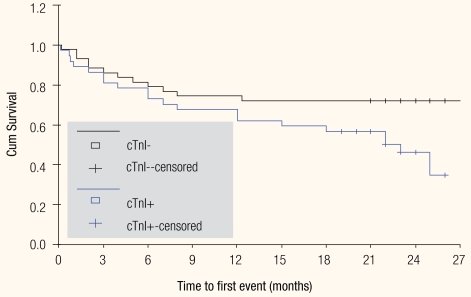
Results: H-FABP peaked early at 2 hours and was useful for the early detection of evolving AMI within 1-3 hours after angioplasty. Cardiac-TnI, myoglobin, H-FABP, CK-MB mass, and cTnT concentrations were elevated in 46.25%, 17.5%, 13.3%, 11.25%, and 7.5% respectively. Cardiac-TnI was the most sensitive marker for detecting all complications and was superior to all other markers. Elevated cardiac markers were correlated with old age (P < 0.02); chest pain ± ECG changes of ischaemia (P < 0.003); use of stents (P < 0.019) and major complications such as major dissection (P < 0.004); transient vessel closure (P < 0.022); bail out stent (P < 0.003), and AMI (P < 0.042). Elevated cardiac markers were associated with a reduction of event-free survival (16.92 versus 20.67 months, P < 0.03).
Conclusion: Heart-type-FABP measurements at 1 hour (or thereafter) post-PCI may offer an early chance of detecting evolving AMI; cTnI was the most sensitive marker for the detection of major complications in patients undergoing PCI. Measurements of cTnI 16-24 hours post-PCI should be part of the routine management of patients following elective PCI.
Keywords: Acute coronary syndrome; Cardiac markers; Cardiac troponins; Complications; Heart-type fatty acid-binding protein; PCI; Percutaneous coronary intervention.
Figures
References
-
- Parisi AF, Folland ED, Hartigan P. A comparison of angioplasty with medical therapy in the treatment of single-vessel coronary artery disease. Veterans Affairs ACME Investigators. N Engl J Med. 1992;326:10–16. - PubMed
-
- Myler RK, Shaw RE, Stertzer SH, Bashour TT, Ryan C, Hecht HS, et al. Unstable angina and coronary angioplasty. Circulation. 1990;82:II88–95. - PubMed
-
- Grines CL, Browne KF, Marco J, Rothbaum D, Stone GW, O’Keefe J, et al. A comparison of immediate angioplasty with thrombolytic therapy for acute myocardial infarction. The Primary Angioplasty in Myocardial Infarction Study Group. N Engl J Med. 1993;328:673–9. - PubMed
-
- Talley JD, Weintraub WS, Roubin GS, Douglas JS, Jr, Anderson HV, Jones EL, et al. Failed elective percutaneous transluminal coronary angioplasty requiring coronary artery bypass surgery: In-hospital and late clinical outcome at 5 years. Circulation. 1990;82:1203–13. - PubMed
-
- Dorros G, Cowley MJ, Janke L, Kelsey SF, Mullin SM, Van Raden M. In-hospital mortality rate in the National Heart, Lung, and Blood Institute Percutaneous Transluminal Coronary Angioplasty Registry. Am J Cardiol. 1984;53:17C–21C. - PubMed
LinkOut - more resources
Full Text Sources
Other Literature Sources
Research Materials
Miscellaneous