


Sleep disturbances and diminished quality of life in postural tachycardia syndrome
- PMID: 21509337
- PMCID: PMC3077350
Sleep disturbances and diminished quality of life in postural tachycardia syndrome
Abstract
Study objectives: Patients with postural tachycardia syndrome (POTS) commonly complain of fatigue, unrefreshing sleep, daytime sleepiness, and diminished quality of life. This study's objective was to assess the sleep quality and health-related quality of life in patients with POTS as compared with healthy control subjects.
Methods: Patients with POTS (n = 44) and healthy control subjects (n = 46) completed a battery of questionnaires including Medical Outcomes Study (MOS) Sleep Survey and the Epworth Sleepiness Scale to assess sleep, fatigue visual analogue scale (VAS) to assess fatigue, and the RAND-36 and EuroQol (EQ-5D) surveys to assess health-related quality of life.
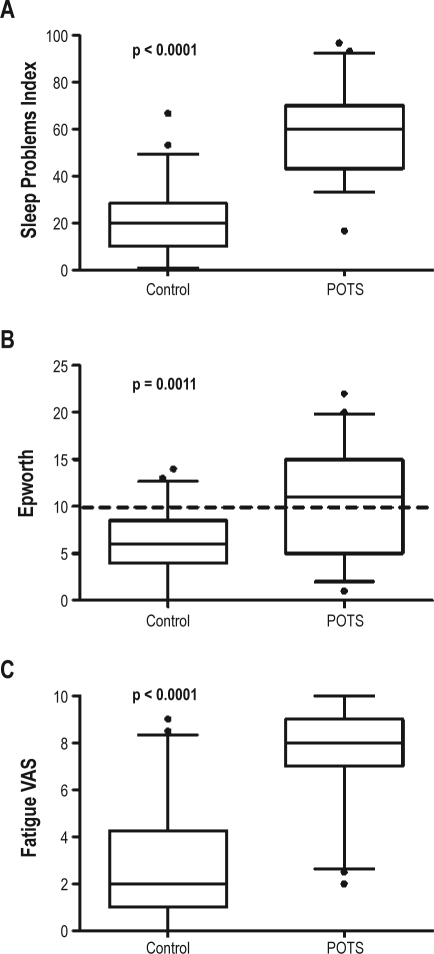
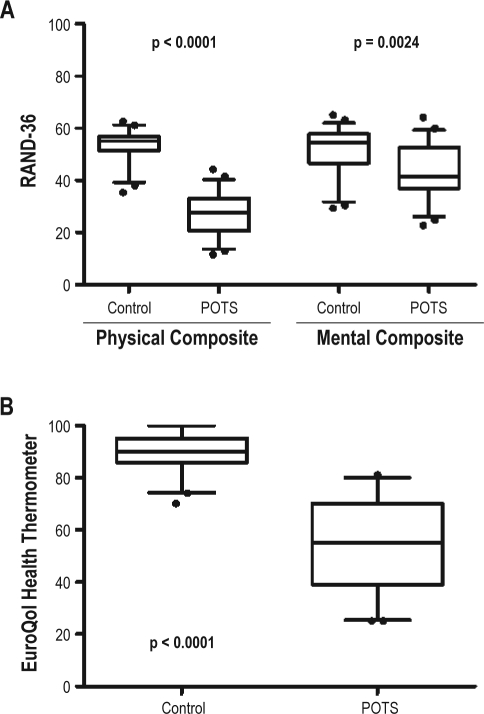
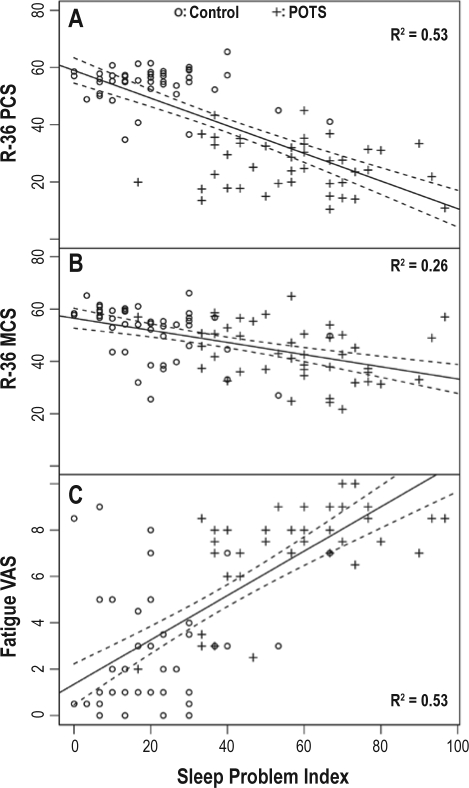
Results: Compared with healthy control subjects, patients with POTS have more sleep problems (58 ± 18 vs. 20 ± 13; p < 0.0001) and excessive daytime sleepiness (10.2 ± 5.7 vs. 6.2 ± 3.2; p < 0.0001), higher fatigue levels (7.5 ± 2.0 vs. 2.8 ± 2.5; p < 0.0001), and poor health-related quality of life (EQ-5D health thermometer 53 ± 17 vs. 89 ± 7; p < 0.0001). There were strong correlations between MOS Sleep Survey index and the fatigue VAS (Rs = 0.73; R(2) = 0.53; p < 0.0001) and the RAND-36 physical health composite scores (Rs = -0.70; R(2) = 0.53; p < 0.0001)
Conclusions: Patients with POTS have higher subjective daytime sleepiness, fatigue, and worse sleep and health related quality of life. The sleep problems contribute significantly to the diminished quality of life: ∼ 50% of the variability in HRQL can be explained by the variability in sleep problems. Further objective studies are needed to delineate the specific nature of the sleep problems in patients with POTS.
Keywords: Postural tachycardia syndrome; fatigue; quality of life; sleepiness.
Figures
References
-
- Low PA, Opfer-Gehrking TL, Textor SC, et al. Postural tachycardia syndrome (POTS) Neurology. 1995;45:S19–25. - PubMed
-
- Garland EM, Raj SR, Black BK, et al. The hemodynamic and neurohumoral phenotype of postural tachycardia syndrome. Neurology. 2007;69:790–798. - PubMed
-
- Benrud-Larson LM, Dewar MS, Sandroni P, et al. Quality of life in patients with postural tachycardia syndrome. Mayo Clin Proc. 2002;77:531–7. - PubMed
-
- Vanninen E, Tuunainen A, Kansanen M, et al. Cardiac sympathovagal balance during sleep apnea episodes. Clin Physiol. 1996;16:209–16. - PubMed
Publication types
MeSH terms
Grants and funding
LinkOut - more resources
Full Text Sources
Medical