Ingestion of micronutrient fortified breakfast cereal has no influence on immune function in healthy children: a randomized controlled trial
- PMID: 21510864
- PMCID: PMC3094279
- DOI: 10.1186/1475-2891-10-36
Ingestion of micronutrient fortified breakfast cereal has no influence on immune function in healthy children: a randomized controlled trial
Abstract
Background: This study investigated the influence of 2-months ingestion of an "immune" nutrient fortified breakfast cereal on immune function and upper respiratory tract infection (URTI) in healthy children during the winter season.
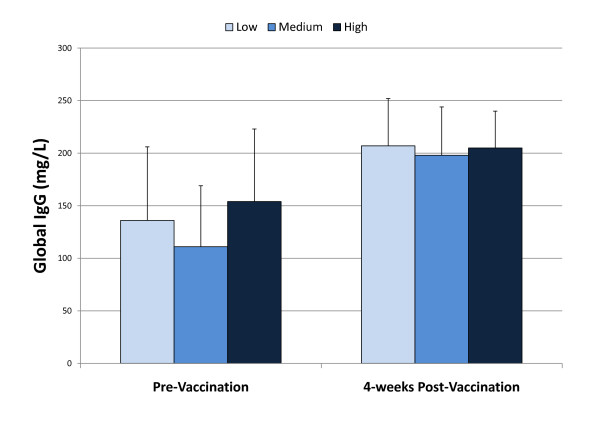
Methods: Subjects included 73 children (N=42 males, N=31 females) ranging in age from 7 to 13 years (mean±SD age, 9.9±1.7 years), and 65 completed all phases of the study. Subjects were randomized to one of three groups--low, moderate, or high fortification--with breakfast cereals administered in double blinded fashion. The "medium" fortified cereal contained B-complex vitamins, vitamins A and C, iron, zinc, and calcium, with the addition of vitamin E and higher amounts of vitamins A and C, and zinc in the "high" group. Immune measures included delayed-typed hypersensitivity, global IgG antibody response over four weeks to pneumococcal vaccination, salivary IgA concentration, natural killer cell activity, and granulocyte phagocytosis and oxidative burst activity. Subjects under parental supervision filled in a daily log using URTI symptoms codes.
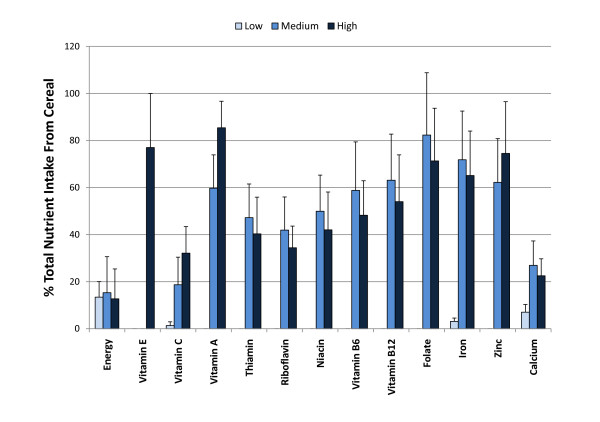
Results: Subjects ingested 3337±851 g cereal during the 2-month study, which represented 14% of total diet energy intake and 20-85% of selected vitamins and minerals. Despite significant increases in nutrient intake, URTI rates and pre- to- post-study changes in all immune function measures did not differ between groups.
Conclusions: Data from this study indicate that ingestion of breakfast cereal fortified with a micronutrient blend for two winter months by healthy, growing children does not significantly influence biomarkers for immune function or URTI rates.
Figures
Similar articles
-
Fortified breakfast cereal consumed daily for 12 wk leads to a significant improvement in micronutrient intake and micronutrient status in adolescent girls: a randomised controlled trial.Nutr J. 2016 Jul 14;15(1):69. doi: 10.1186/s12937-016-0185-6. Nutr J. 2016. PMID: 27418034 Free PMC article. Clinical Trial.
-
Micronutrient intakes, micronutrient status and lipid profiles among young people consuming different amounts of breakfast cereals: further analysis of data from the National Diet and Nutrition Survey of Young People aged 4 to 18 years.Public Health Nutr. 2003 Dec;6(8):815-20. doi: 10.1079/phn2003493. Public Health Nutr. 2003. PMID: 14641953
-
Vitamin D3 supplementation for 8 weeks leads to improved haematological status following the consumption of an iron-fortified breakfast cereal: a double-blind randomised controlled trial in iron-deficient women.Br J Nutr. 2019 May;121(10):1146-1157. doi: 10.1017/S0007114519000412. Epub 2019 Mar 1. Br J Nutr. 2019. PMID: 30819262 Clinical Trial.
-
Health effects of micronutrient fortified dairy products and cereal food for children and adolescents: A systematic review.PLoS One. 2019 Jan 23;14(1):e0210899. doi: 10.1371/journal.pone.0210899. eCollection 2019. PLoS One. 2019. PMID: 30673769 Free PMC article.
-
Home fortification of foods with multiple micronutrient powders for health and nutrition in children under two years of age (Review).Evid Based Child Health. 2013 Jan;8(1):112-201. doi: 10.1002/ebch.1895. Evid Based Child Health. 2013. PMID: 23878126 Review.
Cited by
-
Reference Intervals of and Relationships among Essential Trace Elements in Whole Blood of Children Aged 0-14 years.J Clin Lab Anal. 2017 Mar;31(2):e22043. doi: 10.1002/jcla.22043. Epub 2016 Aug 25. J Clin Lab Anal. 2017. PMID: 27558470 Free PMC article.
-
Fortification of maize flour with iron for controlling anaemia and iron deficiency in populations.Cochrane Database Syst Rev. 2018 Dec 22;12(12):CD010187. doi: 10.1002/14651858.CD010187.pub2. Cochrane Database Syst Rev. 2018. PMID: 30577080 Free PMC article.
-
Vitamin C and Neutrophil Function: Findings from Randomized Controlled Trials.Nutrients. 2019 Sep 4;11(9):2102. doi: 10.3390/nu11092102. Nutrients. 2019. PMID: 31487891 Free PMC article. Review.
-
The Effect of a Multivitamin and Mineral Supplement on Immune Function in Healthy Older Adults: A Double-Blind, Randomized, Controlled Trial.Nutrients. 2020 Aug 14;12(8):2447. doi: 10.3390/nu12082447. Nutrients. 2020. PMID: 32823974 Free PMC article. Clinical Trial.
-
Using Food Models to Enhance Sugar Literacy among Older Adolescents: Evaluation of a Brief Experiential Nutrition Education Intervention.Nutrients. 2019 Jul 31;11(8):1763. doi: 10.3390/nu11081763. Nutrients. 2019. PMID: 31370275 Free PMC article. Clinical Trial.
References
-
- Maggini S, Wintergerst ES, Beveridge S, Hornig DH. Selected vitamins and trace elements support immune function by strengthening epithelial barriers and cellular and humoral immune responses. Br J Nutr. 2007;98(Suppl 1):S29–35. - PubMed
-
- Prasad AS, Beck FW, Bao B, Fitzgerald JT, Snell DC, Steinberg JD, Cardozo LJ. Zinc supplementation decreases incidence of infections in the elderly: effect of zinc on generation of cytokines and oxidative stress. Am J Clin Nutr. 2007;85:837–844. - PubMed
-
- Keusch GT. The history of nutrition: malnutrition, infection and immunity. J Nutr. 2003;133:336S–340S. - PubMed
Publication types
MeSH terms
Substances
LinkOut - more resources
Full Text Sources
Miscellaneous