


doi: 10.1016/j.ccm.2011.02.013.
Lung retransplantation
Affiliations
- PMID: 21511096
- PMCID: PMC3081645
- DOI: 10.1016/j.ccm.2011.02.013
Item in Clipboard
Lung retransplantation
Clin Chest Med.
2011 Jun.
Abstract
Lung retransplantation comprises a small proportion of lung transplants performed throughout the world, but has become more frequent in recent years. The selection criteria for lung retransplantation are similar to those for initial lung transplant. Survival after lung retransplantation has improved over time, but still lags behind that of initial lung transplantation. These differences in outcome may be attributable to medical comorbidities. Lung retransplantation appears to be ethically justified; however, the optimal approach to lung allocation for retransplantation needs to be defined.
Copyright © 2011 Elsevier Inc. All rights reserved.
Figures
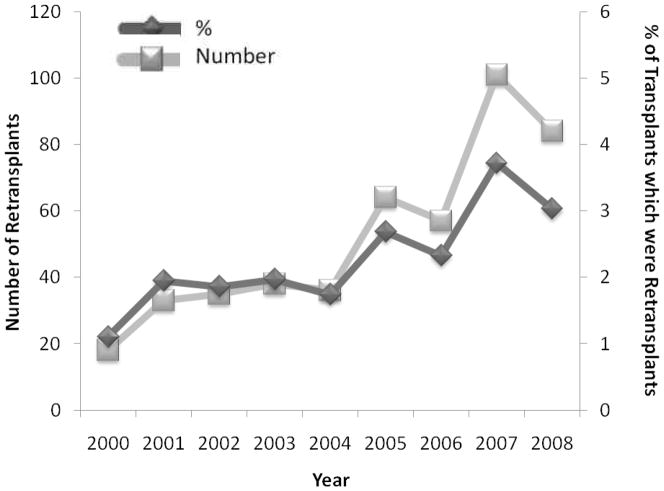
Adult lung retransplants performed (number and % of transplants) by year from 2000 to 2008 in the ISHLT Registry (p = 0.001 and p = 0.003 for associations between number and % with time). Data from Christie JD, Edwards LB, Kucheryavaya AY, et al. The Registry of the International Society for Heart and Lung Transplantation: twenty-seventh official adult lung and heart-lung transplant report--2010. J Heart Lung Transplant. 2010;29(10):1104–1118.
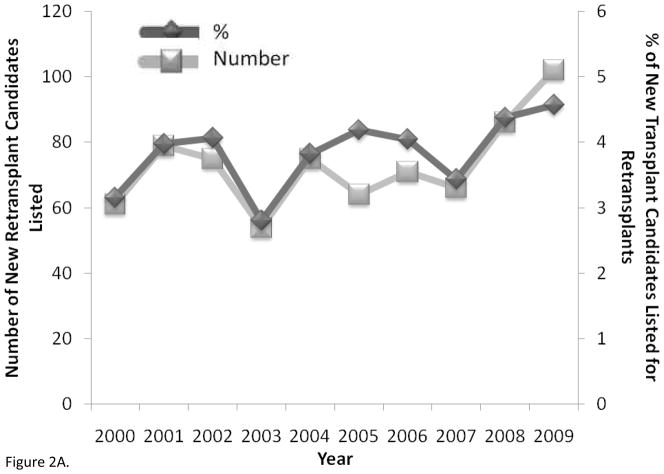
A) Adult lung retransplantation candidates newly listed (number and % of candidates) (p = 0.10 for associations between number and % with time) and B) adult lung retransplants performed (number and % of total transplants) by year from 2000 to 2009 in the United States (p < 0.001 and p = 0.003 for associations between number and % with time). Data from OPTN as of December 3, 2010, http://optn.transplant.hrsa.gov .
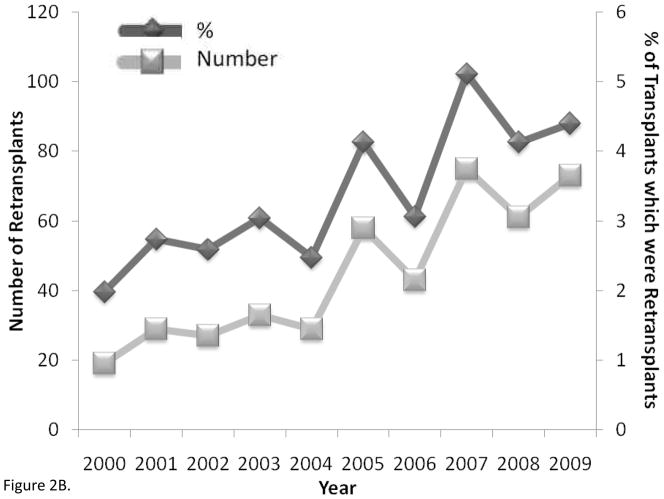
A) Adult lung retransplantation candidates newly listed (number and % of candidates) (p = 0.10 for associations between number and % with time) and B) adult lung retransplants performed (number and % of total transplants) by year from 2000 to 2009 in the United States (p < 0.001 and p = 0.003 for associations between number and % with time). Data from OPTN as of December 3, 2010, http://optn.transplant.hrsa.gov .
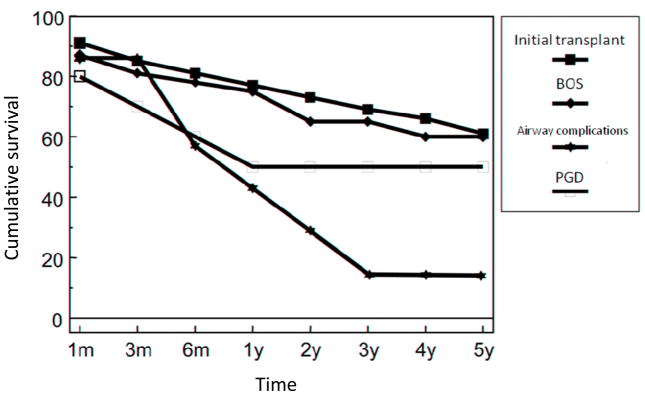
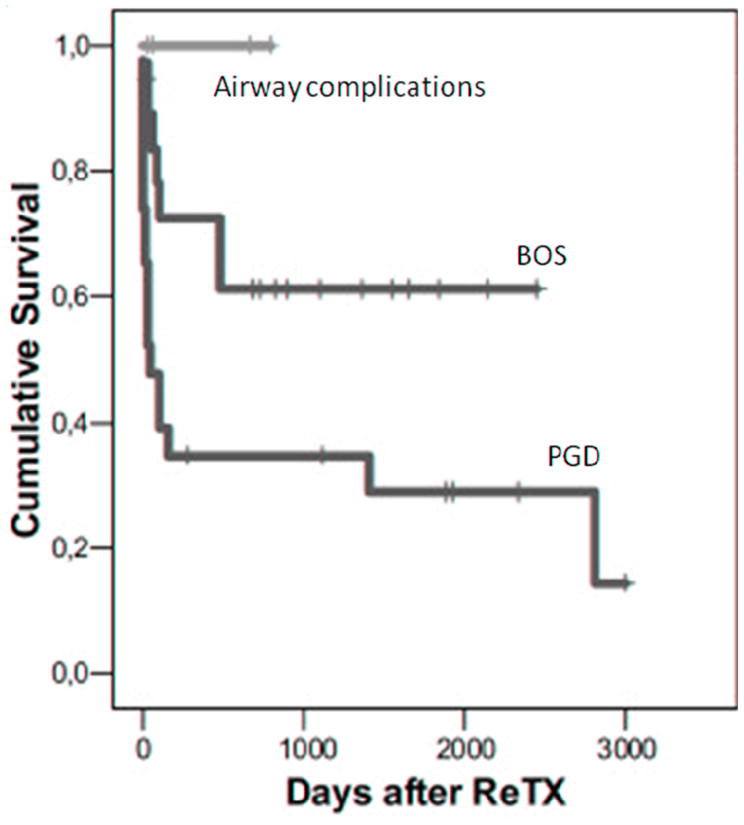
Survival of lung retransplant recipients (by indication) and initial lung transplant recipients before January 2004 (p = 0.001 for primary graft dysfunction (PGD) and airway complications vs. bronchiolitis obliterans syndrome (BOS) and initial transplant) (Adapted from Strueber M, Fischer S, Gottlieb J, et al. Long-term outcome after pulmonary retransplantation. J Thorac Cardiovasc Surg. 2006;132(2):407–412, with permission.)
Survival after lung retransplantation between 1995 and 2006 (p = 0.02 for primary graft dysfunction (PGD) vs. bronchiolitis obliterans syndrome (BOS), other differences were not significant) (Adapted from Aigner C, Jaksch P, Taghavi S, et al. Pulmonary retransplantation: is it worth the effort? A long-term analysis of 46 cases. J Heart Lung Transplant. 2008;27(1):60–65, with permission.)
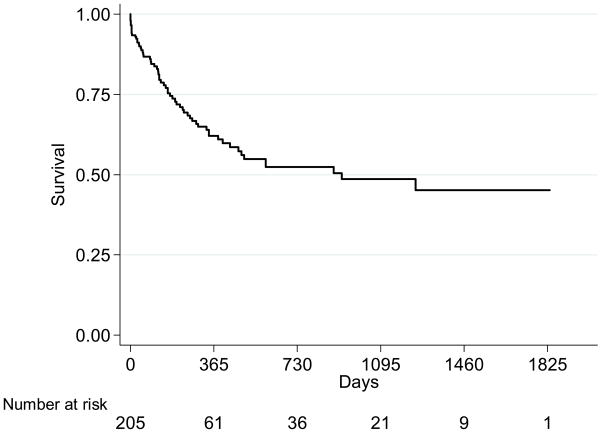
Kaplan-Meier survival estimate of lung retransplant recipients in the US from 2001 to 2006 (Reprinted with permission of the American Thoracic Society. Copyright © American Thoracic Society. From Kawut SM, Lederer DJ, Keshavjee S, et al. Outcomes after lung retransplantation in the modern era. Am J Respir Crit Care Med. 2008;177(1):114–120, Official Journal of the American Thoracic Society, Diane Gern, Publisher.)
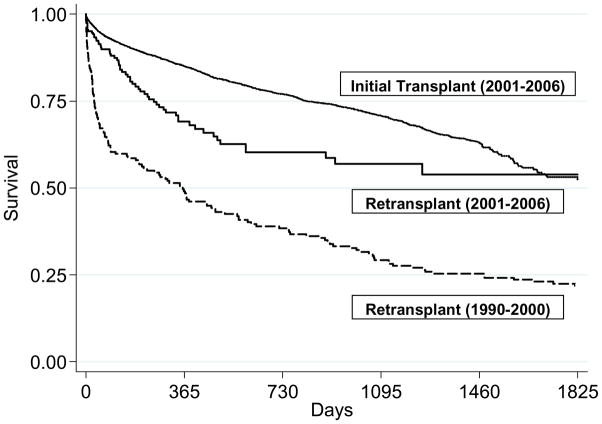
Survival estimates of modern initial lung transplantation (2001–2006), modern lung retransplantation (2001–2006), and historical lung retransplantation recipients (1990–2000) after adjustment for age (55 yr), sex (female), race/ethnicity (non-Hispanic white), procedure type (bilateral), mechanical ventilation (none), and pulmonary diagnosis (chronic obstructive pulmonary disease) (p < 0.05 for all comparisons) (Reprinted with permission of the American Thoracic Society. Copyright © American Thoracic Society. From Kawut SM, Lederer DJ, Keshavjee S, et al. Outcomes after lung retransplantation in the modern era. Am J Respir Crit Care Med. 2008;177(1):114–120, Official Journal of the American Thoracic Society, Diane Gern, Publisher.)
References
-
- Vakil N, Mason DP, Yun JJ, et al. Third-time lung transplantation in a patient with cystic fibrosis. J Thorac Cardiovasc Surg. 2010 - PubMed
-
- Christie JD, Edwards LB, Kucheryavaya AY, et al. The Registry of the International Society for Heart and Lung Transplantation: twenty-seventh official adult lung and heart-lung transplant report--2010. J Heart Lung Transplant. 2010;29(10):1104–1118. - PubMed
-
- Data from OPTN. Dec 3, 2010 . http://optn.transplant.hrsa.gov.
-
- Eberlein M, Garrity ER, Orens JB. Lung allocation in the United States. Clinics in Chest Medicine. In Press. - PubMed
-
- Egan TM, Murray S, Bustami RT, et al. Development of the new lung allocation system in the United States. Am J Transplant. 2006;6(5 Pt 2):1212–1227. - PubMed
Publication types
MeSH terms
Grants and funding
LinkOut - more resources
Full Text Sources
Medical
