. 2011 Jun;22(6):829-44.
doi: 10.1109/TNN.2011.2123917. Epub 2011 Apr 19.

Causality analysis of neural connectivity: critical examination of existing methods and advances of new methods

Affiliations

Causality analysis of neural connectivity: critical examination of existing methods and advances of new methods

Sanqing Hu et al. IEEE Trans Neural Netw. 2011 Jun.

Abstract

Granger causality (GC) is one of the most popular measures to reveal causality influence of time series and has been widely applied in economics and neuroscience. Especially, its counterpart in frequency domain, spectral GC, as well as other Granger-like causality measures have recently been applied to study causal interactions between brain areas in different frequency ranges during cognitive and perceptual tasks. In this paper, we show that: 1) GC in time domain cannot correctly determine how strongly one time series influences the other when there is directional causality between two time series, and 2) spectral GC and other Granger-like causality measures have inherent shortcomings and/or limitations because of the use of the transfer function (or its inverse matrix) and partial information of the linear regression model. On the other hand, we propose two novel causality measures (in time and frequency domains) for the linear regression model, called new causality and new spectral causality, respectively, which are more reasonable and understandable than GC or Granger-like measures. Especially, from one simple example, we point out that, in time domain, both new causality and GC adopt the concept of proportion, but they are defined on two different equations where one equation (for GC) is only part of the other (for new causality), thus the new causality is a natural extension of GC and has a sound conceptual/theoretical basis, and GC is not the desired causal influence at all. By several examples, we confirm that new causality measures have distinct advantages over GC or Granger-like measures. Finally, we conduct event-related potential causality analysis for a subject with intracranial depth electrodes undergoing evaluation for epilepsy surgery, and show that, in the frequency domain, all measures reveal significant directional event-related causality, but the result from new spectral causality is consistent with event-related time-frequency power spectrum activity. The spectral GC as well as other Granger-like measures are shown to generate misleading results. The proposed new causality measures may have wide potential applications in economics and neuroscience.


Figures
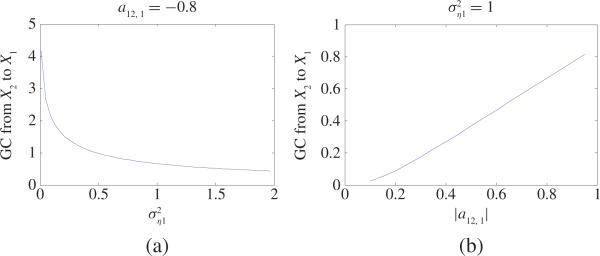
Fig. 1
Fig. 1
(a) GC values from X2 to X1 in (8) as the variance ση12 changes from 0.01 to 2 where a12, 1 = –0.8. (b) GC values from X2 to X1 in (8) as a12, 1 changes from –0.1 to –0.95 where ση12=1. From (a) one can see that GC value from X2 to X1 decreases as the variance ση12 increases. From (b) one can see that GC value from X2 to X1 increases as the amplitude |a12, 1| increases.
Fig. 2
Fig. 2
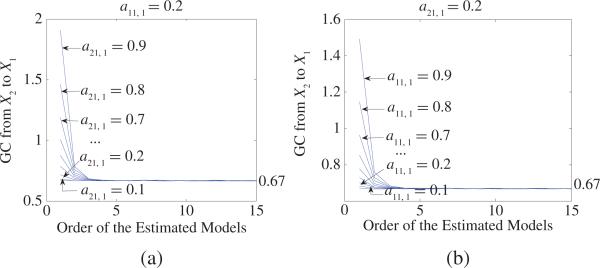
(a) GC from X2 to X1 as a function of the order of the estimated models for (9) when a11, 1 = 0.2 and a21, 1 changes from 0.1 to 0.9. (b) GC from X2 to X1 as a function of the order of the estimated models for (9) when a21, 1 = 0.2 and a11, 1 changes from 0.1 to 0.9. From (a) and (b), one can see that: 1) GC from X2 to X1 keeps steady and converges to 0.67 when the order p > 8, and 2) GC from X2 to X1 has nothing to do with parameters a11, 1 and a21, 1.
Fig. 3
Fig. 3
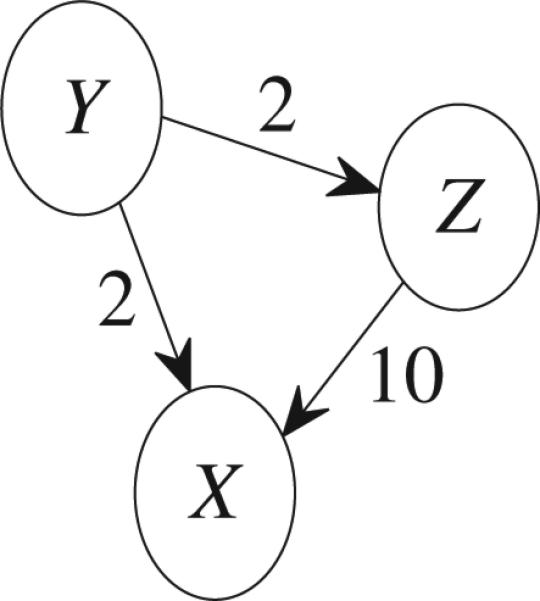
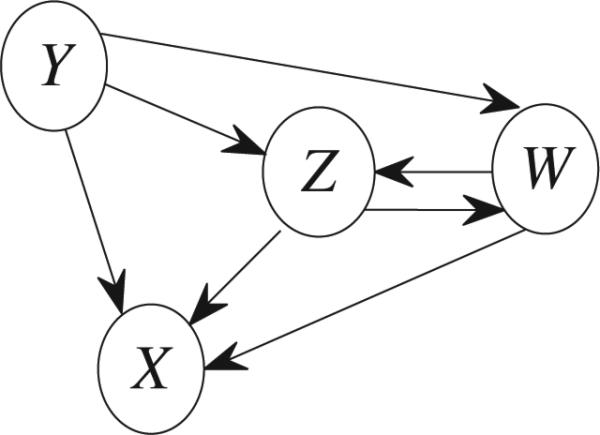
Connectivities among three time series.
Fig. 4
Fig. 4
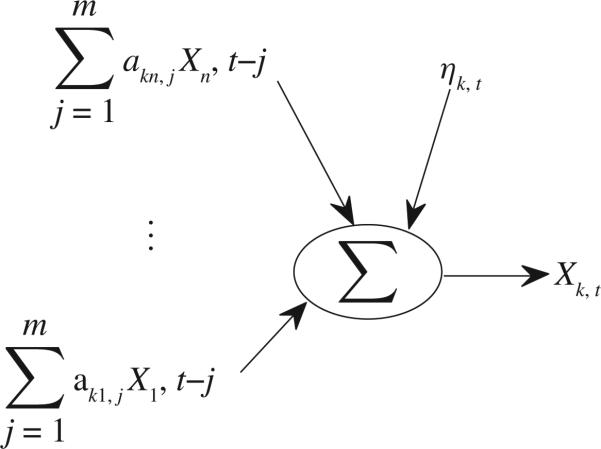
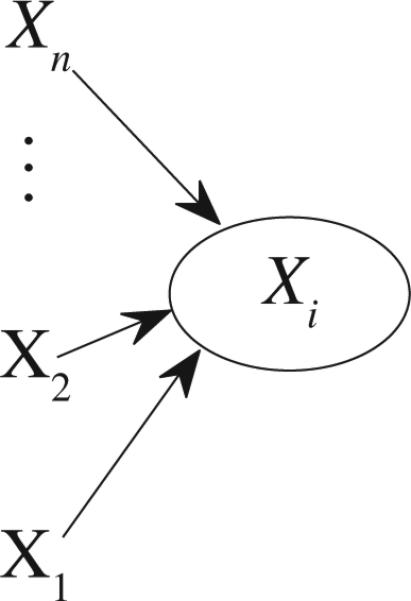
Contributions to Xk,t .
Fig. 5
Fig. 5
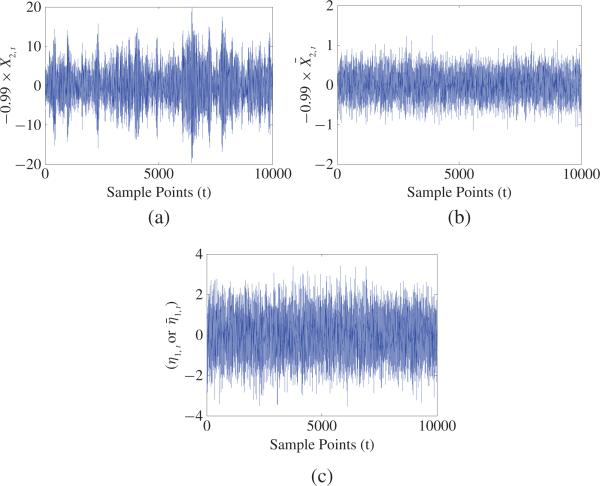
Plot of trajectories for –0.99X2,t, –0.992,t, and η1,t for one realization of (24) and (25) where Xi,0 = i,0 and ηi,t=ηi,t, i = 1, 2: (a) –0.99 X2,t 's trajectory for (24). (b) –0.992,t 's trajectory for (25)(c) η1,t 's or η1,ts trajectory.
Fig. 6
Fig. 6
Connectivities among four time series.
Fig. 7
Fig. 7
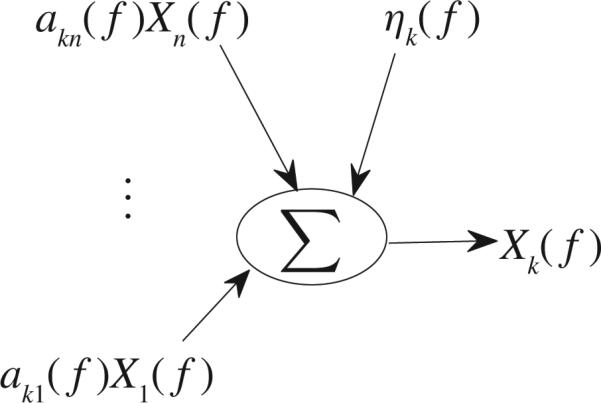
Contributions to Xk(f).
Fig. 8
Fig. 8
Xj's contributions to all signals Xi, i = 1, 2, . . . , n.
Fig. 9
Fig. 9
Past contributions to Xi's evolution from all signals Xj, j = 1, 2, . . . , n.
Fig. 10
Fig. 10
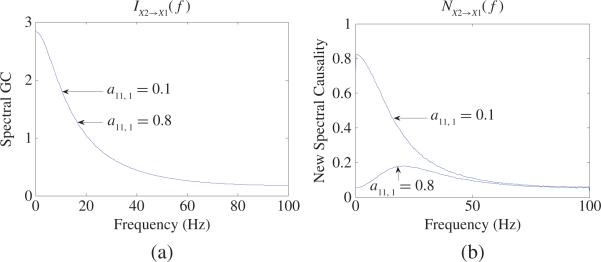
(a) Spectral GC results: IX2X1(f) based on (34) for (39) of two time series in two cases: a11, 1 0.1 and a11, 1 = 0.8. (b) New spectral causality results: NX2X1(f) for (39).
Fig. 11
Fig. 11
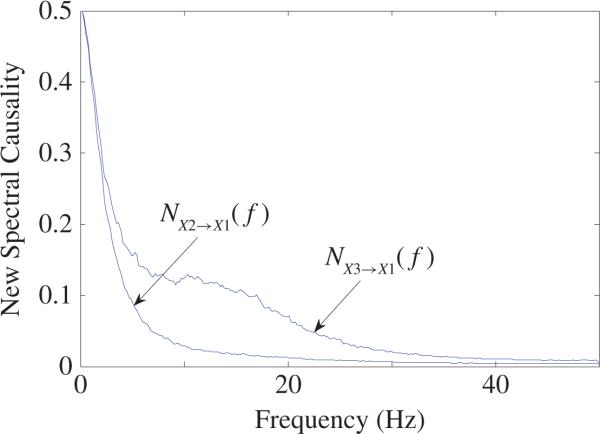
New spectral causality results: NX2DX1(f) and NX3DX1(f) for (40).
Fig. 12
Fig. 12
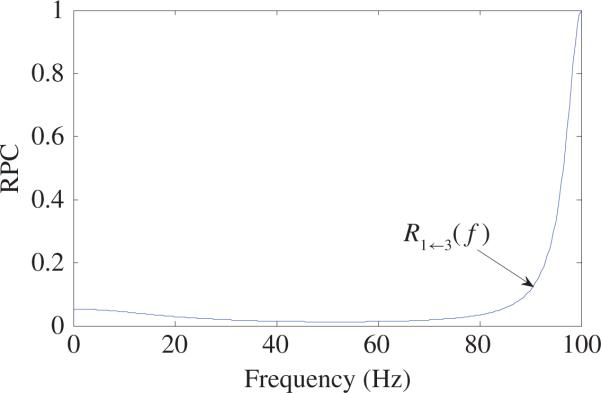
Curve of RPC R1←3(f) calculated based on (42).
Fig. 13
Fig. 13
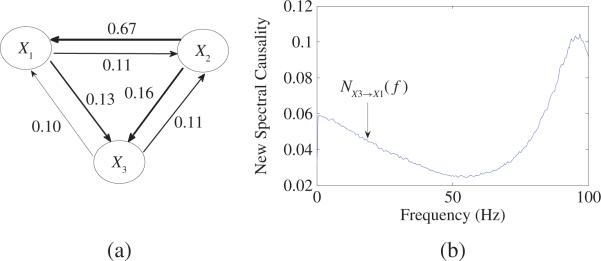
(a) Results of new causality based on (20) for (43) of three time series in time domain. Self-contributions are neglected. The resulting strength of the connections is schematically represented by the thickness of arrows. (b) New spectral causality from X3 to X1 is shown for (43) in frequency domain.
Fig. 14
Fig. 14
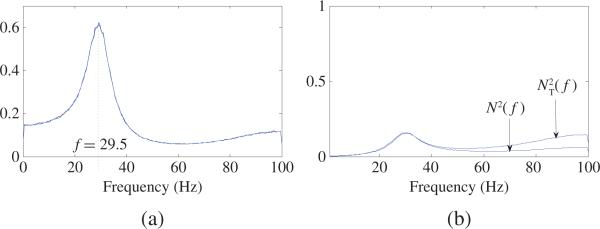
(a) Power spectra of X1, X2, X3. It can be seen that X1, X2, X3 have almost same powers across all frequencies and have an obvious peak at f = 29.5 Hz. (b) N(f)=NX3DX2(f)×NX2DX1(f) based on (44) and NT(f) = NX3X1 (f) based on the estimated AR model of the pair (X1, X3). One can see that NT(f) (i.e., the total causality from X3 to X1) is very close to N(f) (i.e., summation of causalities along all routes from X3 to X1) before 40 Hz. But after 40 Hz, N(f) > NT(f). For a general model, the exact relationship between N(f) and NT(f) is not known.
Fig. 15
Fig. 15
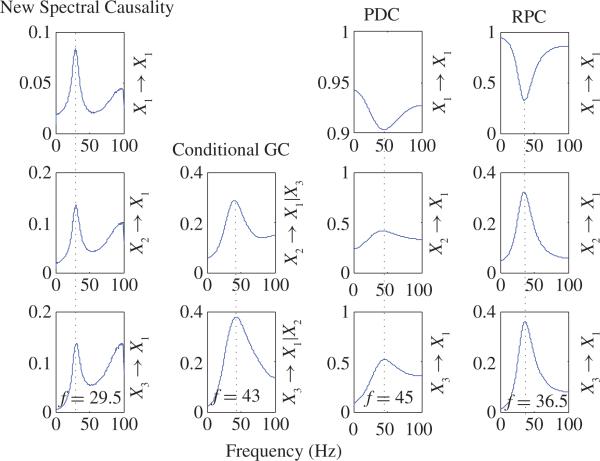
Comparison among new spectral causality, conditional spectral GC, PDC, and RPC together. The first, third, and fourth columns show direct new spectral causality, PDC, and RPC, respectively, from X1 to X1, from X2 to X1, and from X3 to X1. The second column shows conditional GC. It is notable that: 1) new spectral causality from X1 to X1, from X2 to X1, and from X3 to X1 are similar and have peaks at the same frequence of 29.5 Hz, which is consistent with the peak frequency of power spectra [see Fig. 14(a)], and 2) conditional GC, PDC, and RPC (from X2 to X1, and from X3 to X1) have peaks at different frequencies which are all different from 29.5 Hz.
Fig. 16
Fig. 16
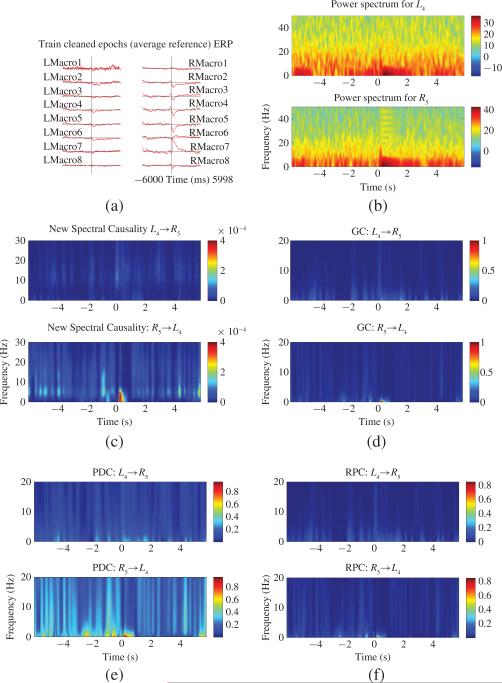
(a) ERPs for eight left Macrowire channels (LMacro1–LMacro8) and eight right Macrowire channels (RMacro1–RMacro8) where average reference is applied. (b) Power spectra for LMacro4 (or L4) and RMacro5 (or R5). (c) New spectral causality results between L4 and R5. (d) GC results between L4 and R5. (e) PDC results between L4 and R5. (f) RPC results between L4 and R5.

References

    1. Seth A. Granger causality. Scholarpedia. 2007;2(7):1667.
    1. Sun R. A neural network model of causality. IEEE Trans. Neural Netw. 1994 Jul.5(4):604–611. - PubMed
    1. Zou C, Denby KJ, Feng J. Granger causality versus dynamic Bayesian network inference: A comparative study. BMC Bioinf. 2009 Apr.10(1):401. - PMC - PubMed
    1. Wiener N. The theory of prediction. In: Beckenbach EF, editor. Modern Mathematics for Engineers. McGraw-Hill; New York: 1956. ch. 8.
    1. Granger CWJ. Investigating causal relations by econometric models and cross-spectral methods. Econometrica. 1969 Jul.37(3):424–438.

Publication types