Review
. 2011 Jun;21(3):306-18.
doi: 10.1016/j.sbi.2011.03.015. Epub 2011 Apr 21.

Computational approaches to RNA structure prediction, analysis, and design

Affiliations
Review

Computational approaches to RNA structure prediction, analysis, and design

Christian Laing et al. Curr Opin Struct Biol. 2011 Jun.

Abstract

RNA molecules are important cellular components involved in many fundamental biological processes. Understanding the mechanisms behind their functions requires RNA tertiary structure knowledge. Although modeling approaches for the study of RNA structures and dynamics lag behind efforts in protein folding, much progress has been achieved in the past two years. Here, we review recent advances in RNA folding algorithms, RNA tertiary motif discovery, applications of graph theory approaches to RNA structure and function, and in silico generation of RNA sequence pools for aptamer design. Advances within each area can be combined to impact many problems in RNA structure and function.


Figures

Figure 1
Figure 1
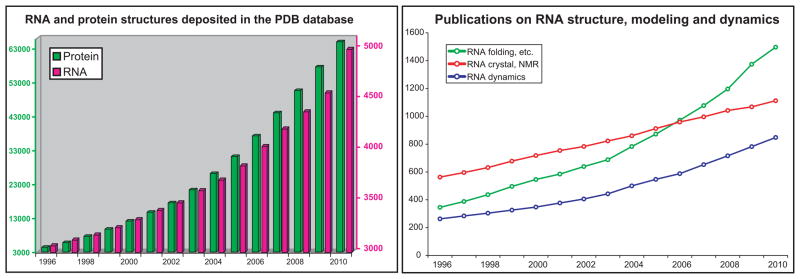
(left) Number of RNA structures deposited in the NDB nucleic acid database (http://ndbserver.rutgers.edu/) as of December 2010. Note different scales used for protein (left) and RNA (right); (right) The number of scientific publications by year whose title contains the words “RNA folding”, “RNA structure prediction”, “RNA modeling”, or “modeling RNA structure” are colored in green; the words “RNA crystal” or “RNA NMR” are colored in red; and the words “RNA dynamics”, “RNA simulation”, “ribosome dynamics”, or “ribosome simulations” are colored in blue. The word search was done using the ISI web of knowledge (www.isiknowledge.com/).
Figure 2
Figure 2
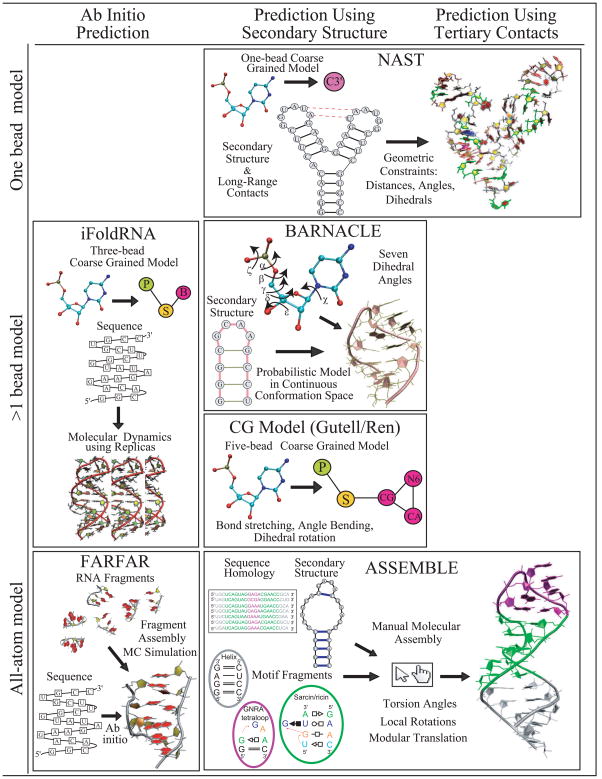
Examples of recent RNA 3D folding computer programs. The different algorithms are organized by their input data (ab initio or sequence, secondary structure, 3D contacts), as well as the level of model detail (from one-bead coarse grained models to all atom approaches).
Figure 3
Figure 3
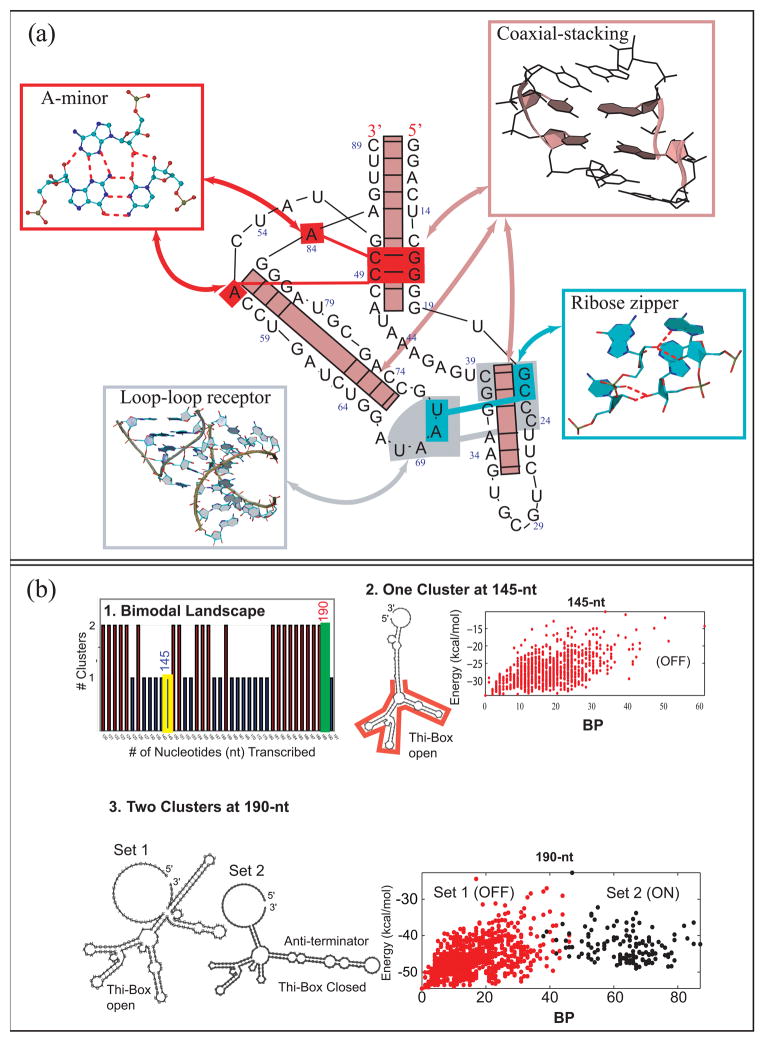
(a) Annotated diagram of the TPP riboswitch (PDB: 2GDI) shows several correlated motifs working in a cooperative way to stabilize RNA’s 3D conformation. These key motifs can be observed often in many other RNA structures. (b) TPP Riboswitch folding as a function of sequence elongation reveals: (1) either one or two conformational clusters of all suboptimal states for each sequence length. (2) At 145 nt, one cluster is apparent where the folding funnel (base pair difference against free energy plotted for the ensemble for all predicted suboptimal structures) shows a classic simple folding funnel landscape. (3) Near the full sequence length (190 nt), two clusters correspond to the two conformations. See [48] for details.
Figure 4
Figure 4
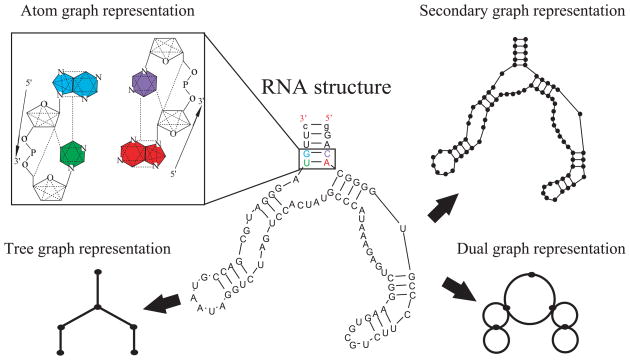
Graphic rules for converting RNA 2D structures using tree (lower left), dual (lower right), and secondary structure (upper right) graphs. In addition the atom graph representation (upper left) can characterize RNA 3D structures.
Figure 5
Figure 5
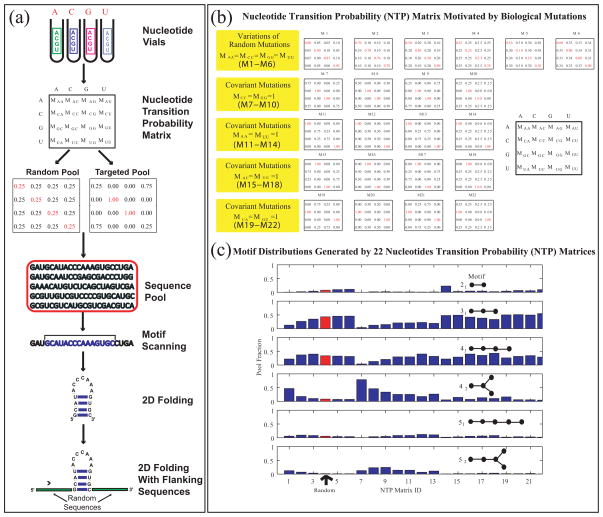
(a) In Silico Approach to Pool Design. RNA sequence pool generation can be simulated using the nucleotide transition probability matrix, which specifies nucleotide mixtures in the nucleotide vials (or mutation rates for all nucleotide bases). The matrix composition can be defined to be a random matrix, corresponding to experiments, or to mimic specific biological situations, as shown in (b). The resulting sequences can be “folded”' into 2D structures using existing algorithms and analyzed further to screen and filter the candidates against a target motif. The non-random matrices shown in (b) form a basis of 22 probability matrices that generate a wide range of RNA motifs in silico [40], as shown in (c), where motifs yields are organized by RAG graph labels, and the yields of random matrices are shown in red.

References

    1. Afonin KA, Bindewald E, Yaghoubian AJ, Voss N, Jacovetty E, Shapiro BA, Jaeger L. In vitro assembly of cubic RNA-based scaffolds designed in silico. Nat Nanotechnol. 2010;5:676–682. - PMC - PubMed
    1. Kasprzak W, Bindewald E, Kim TJ, Jaeger L, Shapiro BA. Use of RNA structure flexibility data in nanostructure modeling. Methods. 2010 - PMC - PubMed
    1. Sioud M. Ribozymes and siRnas: from structure to preclinical applications. Handb Exp Pharmacol. 2006:223–242. - PubMed
    1. Hess H, Jaeger L. Nanobiotechnology. Curr Opin Biotechnol. 2010;21:373–375. - PubMed
    1. Laing C, Schlick T. Computational approaches to 3D modeling of RNA. Journal of Physics: Condensed Matter. 2010;22:283101. This review compares available 3D structure prediction algorithms from an RNA dataset of 43 structures of various lengths and motifs. The study finds that algorithms vary widely in terms of prediction quality; most predictions have large root-mean square deviations from the crystal structure (e.g., RMSD>6Å) due to the limitations in predicting long-range contacts. - PMC - PubMed

Publication types