


Alcohol and drug use among patients presenting to an inner-city emergency department: a latent class analysis
- PMID: 21514734
- PMCID: PMC4020511
- DOI: 10.1016/j.addbeh.2010.12.028
Alcohol and drug use among patients presenting to an inner-city emergency department: a latent class analysis
Abstract
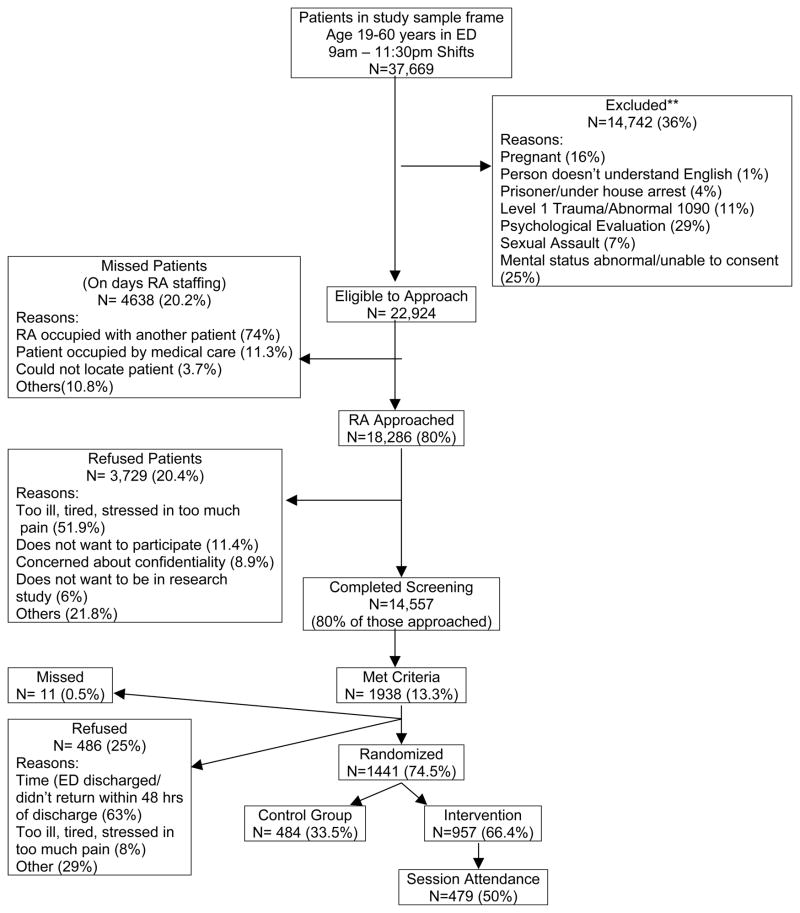
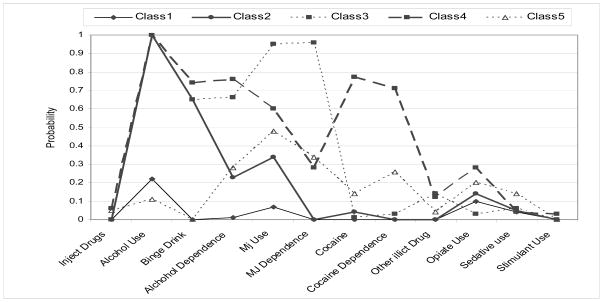
The inner city Emergency Department (ED) provides a window of opportunity for screening for alcohol and other drug misuse and substance use disorders (SUDs), in order to facilitate linkage for individuals who are in need of services targeting such issues. The majority of prior work in this area has focused on alcohol use. This study used latent class analyses to characterize substance use/SUDs among adults presenting to the ED for medical complaints or injuries. Participants (n=14,557; 77% participation; 45% male; 54% African-American) completed a computerized survey assessing demographics, health functioning, and substance use/SUDs. Although injured patients were significantly more likely to use tobacco, alcohol, and marijuana, and were more likely to have an alcohol use disorder, presenting complaint was not related to other drug use/diagnoses. Five latent classes were identified: (1) low users/SUDs (65.9%) (2) binge drinkers (24.3%), (3) marijuana users/SUD (3.5%), (4) cocaine users/SUD (2.9%), and (5) poly-drug users (3.3%). Compared to class 1, participants in the other classes were younger, male, without health insurance, with poor mental health functioning, tobacco users, and had prior substance use treatment. African-Americans were most likely to be in classes 3 or 4 and employed participants were most likely to be in class 2. In comparison to class 1, classes 2 and 3 reported better physical health; class 2 was more likely to present for injury whereas class 5 was more likely to present for a medical complaint. ED-based screening and interventions approaches need to address the co-occurrence of alcohol, illicit drug, and psychoactive prescription drug use.
Copyright © 2010. Published by Elsevier Ltd.
Figures
References
-
- Academic ED SBIRT Research Collaborative. The impact of screening, brief intervention, and referral for treatment on emergency department patients' alcohol use. Ann Emerg Med. 2007;50(6):699–710. - PubMed
-
- Adrian M, Barry S. Physical and mental health problems associated with the use of alcohol and drugs. Subst Use Misuse. 2003;38(11–13):1575–1614. - PubMed
-
- Agrawal A, Lynskey M, Madden P, Bucholz K, Heath A. A latent class analysis of illicit drug abuse/dependence: results from the National Epidemiological Survey on Alcohol and Related Conditions. Addiction. 2007;102(1):94–104. - PubMed
-
- American Psychiatric Association. Diagnostic and Statistical Manual of Mental Disorders. 4. Washington, DC: APA; 1994.
-
- Baker A, Lee N, Claire M, Lewin T, Grant T, Pohlman S, et al. Brief cognitive behavioural interventions for regular amphetamine users: a step in the right direction. Addiction. 2005;100(3):367–378. - PubMed
