. 2011 Jul;188(3):731-43.
doi: 10.1534/genetics.111.126995. Epub 2011 Apr 21.

The Drosophila gene disruption project: progress using transposons with distinctive site specificities

Affiliations

The Drosophila gene disruption project: progress using transposons with distinctive site specificities

Hugo J Bellen et al. Genetics. 2011 Jul.

Abstract

The Drosophila Gene Disruption Project (GDP) has created a public collection of mutant strains containing single transposon insertions associated with different genes. These strains often disrupt gene function directly, allow production of new alleles, and have many other applications for analyzing gene function. Here we describe the addition of ∼7600 new strains, which were selected from >140,000 additional P or piggyBac element integrations and 12,500 newly generated insertions of the Minos transposon. These additions nearly double the size of the collection and increase the number of tagged genes to at least 9440, approximately two-thirds of all annotated protein-coding genes. We also compare the site specificity of the three major transposons used in the project. All three elements insert only rarely within many Polycomb-regulated regions, a property that may contribute to the origin of "transposon-free regions" (TFRs) in metazoan genomes. Within other genomic regions, Minos transposes essentially at random, whereas P or piggyBac elements display distinctive hotspots and coldspots. P elements, as previously shown, have a strong preference for promoters. In contrast, piggyBac site selectivity suggests that it has evolved to reduce deleterious and increase adaptive changes in host gene expression. The propensity of Minos to integrate broadly makes possible a hybrid finishing strategy for the project that will bring >95% of Drosophila genes under experimental control within their native genomic contexts.


Figures
F<sc>igure</sc> 1
Figure 1
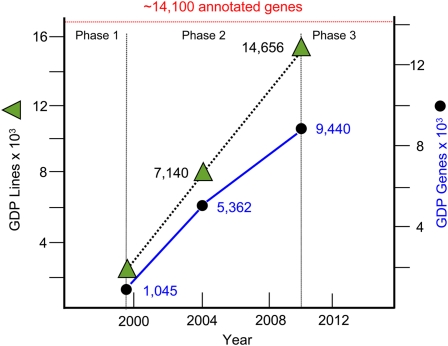
Growth of the GDP strain collection. The total number of GDP strains (green triangles) and the number of genes with one or more associated GDP lines (filled circles) are shown as a function of time beginning with the completion of the Drosophila genome sequence in 2000, which signaled the end of project phase 1. In 2010, the project completed phase 2 in which genes were targeted on the basis of the location of insertions from undirected forward screens.
F<sc>igure</sc> 2
Figure 2
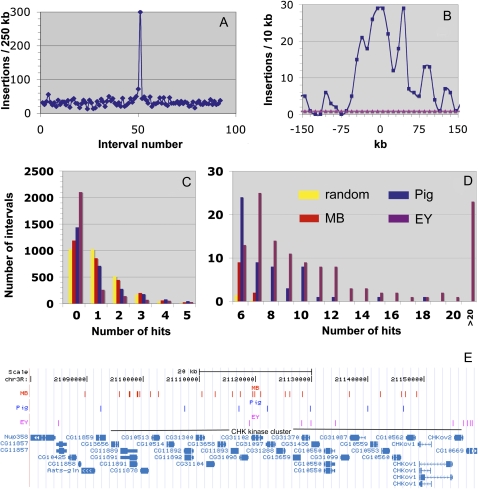
Saturation behavior of P, piggyBac, and Minos insertions. (A) Plot of MB insertions per 250 kb vs. interval number along chromosome 3L reveals a large hotspot. (B) MB insertions within 10-kb intervals around the hotspot in A. The number per interval expected by chance is shown in pink. 0 corresponds to 3L:12580233, the site on the homolog of the mobilized element in the MB screen. (C and D) Distribution of MB (red), piggyBac (blue), or EY (purple) insertions within 10-kb genomic intervals on chromosome 3R, compared with random transposition (Poisson distribution, yellow). To facilitate comparison, the same numbers of insertions were analyzed in each case (2790; corresponding to 1 insertion per interval). The number of intervals with 0 insertions (C, “0”) is relevant to coldspot behavior; intervals hit more frequently than by random expectation (D) are indicative of piggyBac and P-element hotspots. (E) The Minos hotspot located within a cluster of genes encoding CHK kinases on chromosome 3R. The locations of MB (Minos), Pig (piggyBac), and EY (P) element insertions are shown by vertical bars above the gene map of the region.
F<sc>igure</sc> 3
Figure 3
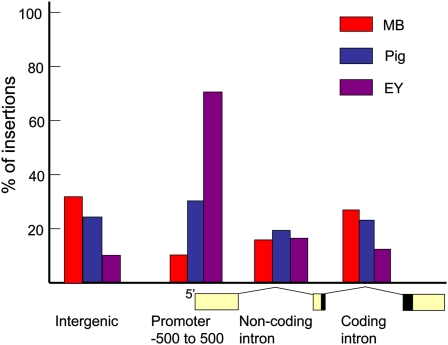
Transposon insertion with respect to transcript structure. The percentage of MB, piggyBac (Pig), and EY insertions located in the indicated regions of annotated transcripts are shown. Numbers may not sum to 100% because an insertion may disrupt multiple transcripts in different positions. A region was scored positive if one or more annotated transcripts with the indicated character were hit by an insertion. To simplify calculation, only the first four annotated transcripts hit by the insertion were considered in determining these values. Because of the large N values, the 95% confidence intervals of these proportions were always less than ±1%. Consequently, the differences were significant except in the case of MB compared to EY insertion in noncoding introns.
F<sc>igure</sc> 4
Figure 4
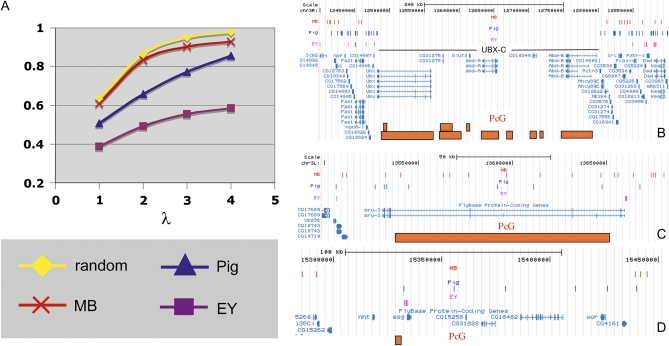
Transposons nonrandomly avoid some genomic intervals, including regions with PcG-dependent repressive marks. (A) The saturation behavior of 40-kb genomic intervals for transposon insertion on chromosome 3R is plotted as λ (the ratio of number of insertions/number of intervals) increases. Poisson (random) expectation (yellow), MB (Minos) elements (red), piggyBac elements (blue), and EY (P) elements (purple). EY elements saturate well below 100%. In contrast, MB elements approach saturation only slightly more slowly than random, whereas piggyBacs appear intermediate. (B) MB, piggyBac, and EY elements insert with greatly reduced frequency in the Bithorax gene cluster. Regions of the Drosophila genome as displayed on the UCSC browser are shown. Insertion sites for these elements are shown in labeled tracks above the map as vertical lines of unit thickness (MB in red; piggyBac in blue; EY in purple; thicker lines denote multiple insertions). The orange boxes display the approximate position of PcG-target regions as mapped by Schwartz et al. (2010). (C) Similar display of the bru-3 gene region shows that not all Polycomb-regulated chromatin domains are transposon poor. (D) The esg gene cluster and its surrounding region illustrates that some PcG targets are largely refractory to MB insertion, but not to the other two elements.

References

    1. Adams M. D., Celniker S. E., Holt R. A., Evans C. A., Gocayne J. D., et al. , 2000. The genome sequence of Drosophila melanogaster. Science 287: 2185–2195 - PubMed
    1. Aminetzach Y. T., Macpherson J. M., Petrov D. A., 2005. Pesticide resistance via transposition-mediated adaptive gene truncation in Drosophila. Science 309: 764–767 - PubMed
    1. Babenko V. N., Makunin I. V., Brusentsova I. V., Belyaeva E. S., Maksimov D. A., et al. , 2010. Paucity and preferential suppression of transgenes in late replication domains of the D. melanogaster genome. BMC Genomics 11: 318. - PMC - PubMed
    1. Bateman J. R., Lee A. M., Wu C. T., 2006. Site-specific transformation of Drosophila via ϕC31 integrase-mediated cassette exchange. Genetics 173: 769–777 - PMC - PubMed
    1. Bazopoulou D., Tavernarakis N., 2009. The NemaGENETAG initiative: large scale transposon insertion gene-tagging in Caenorhabditis elegans. Genetica 137: 39–46 - PubMed

Publication types

Substances