


Novel approach to parental permission and child assent for research: improving comprehension
- PMID: 21518711
- PMCID: PMC3387865
- DOI: 10.1542/peds.2010-3283
Novel approach to parental permission and child assent for research: improving comprehension
Abstract
Objective: The aim of this research was to test a multimedia permission/assent (P/A) process. The overall hypothesis was that children and their parents exposed to a multimedia P/A process would have better comprehension compared with those exposed to a text-based process.
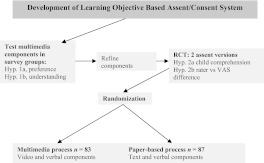
Methods: Traditional and multimedia P/A processes were created by using an innovative learning-objective approach. A total of 194 parent-child dyads (children aged 11-14 years) were enrolled: 24 dyads in a prestudy testing P/A components for preference and effect on comprehension and 170 dyads in a randomized trial of a multimedia or paper P/A process for a hypothetical study. Participants were predominantly white and were from a metropolitan area served by a tertiary care pediatric hospital and outpatient facility. Comprehension of 8 essential elements of the P/A process was assessed.
Results: The majority of prestudy subjects preferred the video version of the dual-energy radiograph absorptiometry description over the animated and paper versions combined (41 of 48 [85%]; P < .0001), and there were similar results for the abdominal ultrasound description (38 of 47 [81%]; P < .0001). Children exposed to the novel process showed significantly better overall comprehension compared with the paper P/A process (P = .0009), and there were highly significant differences in understanding of study procedures (P = .0002) and risks (P < .0001). The parental multimedia group had significantly better overall comprehension (P = .03).
Conclusions: Multimedia approaches to the research P/A process may improve overall understanding of research participation for children and parents. Improved understanding of study-specific research components (rather than research rights) may improve overall comprehension.
Figures
References
-
- Cuttini M. Proxy informed consent in pediatric research: a review. Early Hum Dev. 2000;60(2):89–100 - PubMed
-
- Erb TO, Schulman SR, Sugarman J. Permission and assent for clinical research in pediatric anesthesia. Anesth Analg. 2002;94(5):1155–1160 - PubMed
-
- Franck LS, Winter I, Oulton K. The quality of parental consent for research with children: a prospective repeated measure self-report survey. Int J Nurs Stud. 2007;44(4):525–533 - PubMed
-
- Rossi WC, Reynolds W, Nelson RM. Child assent and parental permission in pediatric research. Theor Med Bioeth. 2003;24(2):131–148 - PubMed
Publication types
MeSH terms
Grants and funding
LinkOut - more resources
Full Text Sources
