. 2011 Jul;55(7):3546-56.
doi: 10.1128/AAC.01127-10. Epub 2011 Apr 25.

Transcriptional profiling of azole-resistant Candida parapsilosis strains

Affiliations

Transcriptional profiling of azole-resistant Candida parapsilosis strains

A P Silva et al. Antimicrob Agents Chemother. 2011 Jul.

Abstract

Herein we describe the changes in the gene expression profile of Candida parapsilosis associated with the acquisition of experimentally induced resistance to azole antifungal drugs. Three resistant strains of C. parapsilosis were obtained following prolonged in vitro exposure of a susceptible clinical isolate to constant concentrations of fluconazole, voriconazole, or posaconazole. We found that after incubation with fluconazole or voriconazole, strains became resistant to both azoles but not to posaconazole, although susceptibility to this azole decreased, whereas the strain incubated with posaconazole displayed resistance to the three azoles. The resistant strains obtained after exposure to fluconazole and to voriconazole have increased expression of the transcription factor MRR1, the major facilitator transporter MDR1, and several reductases and oxidoreductases. Interestingly, and similarly to what has been described in C. albicans, upregulation of MRR1 and MDR1 is correlated with point mutations in MRR1 in the resistant strains. The resistant strain obtained after exposure to posaconazole shows upregulation of two transcription factors (UPC2 and NDT80) and increased expression of 13 genes involved in ergosterol biosynthesis. This is the first study addressing global molecular mechanisms underlying azole resistance in C. parapsilosis; the results suggest that similarly to C. albicans, tolerance to azoles involves the activation of efflux pumps and/or increased ergosterol synthesis.


Figures

Fig. 1.
Fig. 1.
Distribution of genes with differential expression in BC014RFLC, BC014RVRC, and BC014RPSC strains.
Fig. 2.
Fig. 2.
Selected process GO terms overrepresented in BC014RFLC strain. The full list is available in Table S1 in the supplemental material.
Fig. 3.
Fig. 3.
Hierarchical cluster analysis of gene expression changes in BC014RFLC and BC014RVRC. Cluster analysis of 130 genes that are differentially expressed in both BC014RFLC and BC014RVRC strains. Each cluster is represented by a different number, and the members of each cluster are listed in Table S5 in the supplemental material. The genes identified to be C. albicans orthologs are shown. Genes with decreased and increased expression are marked in yellow and blue, respectively. Genes in black were found with unchanged expression. The histogram in the upper left shows the distribution of the differentially expressed genes on the basis of their log FC levels. The x axis represents the log FC levels in the heat map. The y axis (labeled count) shows how many genes have a specific value or differential expression level.
Fig. 4.
Fig. 4.
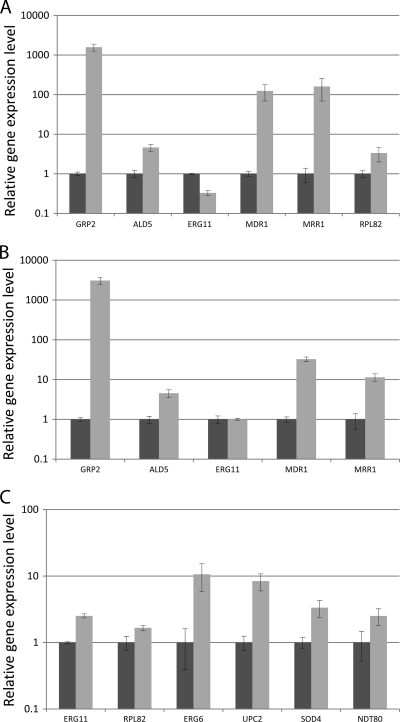
RT-qPCR analysis of genes whose expression was found to be altered in microarray analysis and that have been implicated in antifungal resistance (ERG5, ERG11, MDR1, MRR1, NTD80), stress response (GRP2), and metabolism (ALD5, RPL82). Black bars, susceptible strain BC014S; gray bars, BC014RFLC (A), BC014RVRC (B), and BC014RPSC (C) strains. In panels A and B, y-axis scales are logarithmic due to the large variance in gene expression levels. The expression level shown for each gene represents the variation in gene expression relative to the susceptible strain and is expressed as the average with standard deviation of five independent experiments. Each mean value was normalized to the amplification efficiency and to the amount of TUB4 (endogenous reference gene). All genes displayed levels of expression similar to the microarrray results.
Fig. 5.
Fig. 5.
Simplified ergosterol metabolic pathway, as described for S. cerevisiae (http://www.yeastgenome.org/). Genes upregulated or downregulated in BC014RFLC, BC014RVRC, and BC014RPSC strains are indicated in the table. Acetyl-CoA, acetyl coenzyme A.

References

    1. Akins R. A. 2005. An update on antifungal targets and mechanisms of resistance in Candida albicans. Med. Mycol. 43:285–318 - PubMed
    1. Alarco A. M., Raymond M. 1999. The bZip transcription factor Cap1p is involved in multidrug resistance and oxidative stress response in Candida albicans. J. Bacteriol. 181:700–708 - PMC - PubMed
    1. Albertson G. D., Niimi M., Cannon R. D., Jenkinson H. F. 1996. Multiple efflux mechanisms are involved in Candida albicans fluconazole resistance. Antimicrob. Agents Chemother. 40:2835–2841 - PMC - PubMed
    1. Almirante B., et al. 2006. Epidemiology, risk factors, and prognosis of Candida parapsilosis bloodstream infections: case-control population-based surveillance study of patients in Barcelona, Spain, from 2002 to 2003. J. Clin. Microbiol. 44:1681–1685 - PMC - PubMed
    1. Andes D., et al. 2006. Impact of antimicrobial dosing regimen on evolution of drug resistance in vivo: fluconazole and Candida albicans. Antimicrob. Agents Chemother. 50:2374–2383 - PMC - PubMed

Publication types

MeSH terms