. 2011 May 10;108(19):7872-7.
doi: 10.1073/pnas.1018344108. Epub 2011 Apr 25.

Chikungunya virus emergence is constrained in Asia by lineage-specific adaptive landscapes

Affiliations

Chikungunya virus emergence is constrained in Asia by lineage-specific adaptive landscapes

Konstantin A Tsetsarkin et al. Proc Natl Acad Sci U S A. .

Abstract

Adaptation of RNA viruses to a new host or vector species often results in emergence of new viral lineages. However, lineage-specific restrictions on the adaptive processes remain largely unexplored. Recently, a Chikungunya virus (CHIKV) lineage of African origin emerged to cause major epidemics of severe, persistent, debilitating arthralgia in Africa and Asia. Surprisingly, this new lineage is actively replacing endemic strains in Southeast Asia that have been circulating there for 60 y. This replacement process is associated with adaptation of the invasive CHIKV strains to an atypical vector, the Aedes albopictus mosquito that is ubiquitously distributed in the region. Here we demonstrate that lineage-specific epistatic interactions between substitutions at amino acid positions 226 and 98 of the E1 envelope glycoprotein, the latter of which likely resulted from a founder effect, have for 60 y restricted the ability of endemic Asian CHIKV strains to adapt to this new vector. This adaptive constraint appears to be allowing invasion of the unoccupied vector niche by Ae. albopictus-adapted African strains. These results underscore how different adaptive landscapes occupied by closely related viral genotypes can profoundly affect the outcome of viral evolution and disease emergence.


Conflict of interest statement

The authors declare no conflict of interest.

Figures

Fig. 1.
Fig. 1.
Genetic determinants restricting the effect of the E1-A226V mutation on infectivity of Asian CHIKV strains for Ae. albopictus. (A) Schematic representation and infectivity (OID50) of the chimeric viruses constructed based on genomes of ID85 (white) and LR (gray) CHIKV strains for Ae. albopictus (Galveston). The P value for each chimeric virus is derived from a comparision of OID50 values between it and ID85-GFP-226V. (B) Infectivity of CHIKV expressing residues of interest at positions E1-226, E1-98, and E1-211 in the backbone of ID85, ML06, and LR strains for Galveston (G) and Thailand (T) Ae. albopictus. The P value for each virus is derived from a comparison of OID50 values between it and the virus with the same genetic background that has valine at position E1-226, and strain-authentic residues at positions E1-98 and E1-211. The mutated residues for each background are in bold and underlined. OID50 values are expressed as Log10 pfu/mL. Asterisks stand for OID50-values that were calculated as an average of two independent experiments.
Fig. 2.
Fig. 2.
Effect of the E1-98T residue on dissemination of CHIKV strains in Ae. albopictus. Above each figure is a schematic representation of the viruses used in the competition assay. Asterisks indicate authentic residues for the respective CHIKV background. Thailand Ae. albopictus mosquitoes were presented with blood meals containing the indicated amount of a 1:1 mixture (based on plaque-forming units) of viruses expressing E1-98T and E1-98A residues in the backbone of ID85 (A) or ML06 (B) strains and processed at 10 dpi. Graphs show numbers and proportions of mosquitoes containing viruses expressing only threonine (98T), alanine (98A), or containing both viruses (98T/98A) in mosquitoes heads and legs (representing disseminated infections). (C) Competition between viruses of IOL (LR-226V-ApaI) and Asian strain ID85 with E1-A226V mutation. 98T indicates mosquitoes with disseminated infection of only the Asian strain; 98A indicates only the IOL strain; 98T/98A indicates mosquitoes that contained both viruses. Differences in dissemination efficiencies between 98T and 98A viruses were compared with a one-tailed Fisher's exact test.
Fig. 3.
Fig. 3.
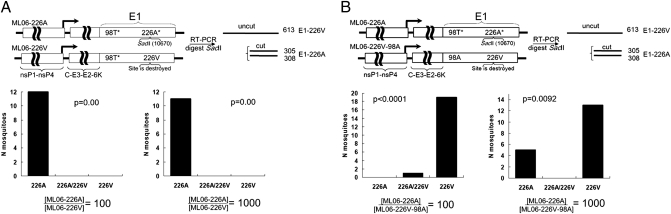
Effect of the E1-98T residue on positive selection of the E1-A226V mutation in CHIKV populations transmitted by Ae. albopictus (Thailand). CHIKV expressing the single E1-A226V mutation (A) or two mutations (E1-A226V, E1-T98A) (B) in the background of ML06 strain were passaged twice in Ae. albopictus in the presence of a 100- or 1,000-fold excess of wild-type ML06 virus with alanine at E1-226. Asterisks indicate authentic residues for the ML06 strain. At the bottom is the ratio of the viruses presented to Ae. albopictus in the starting blood meals. Graphs show number of mosquitoes after the second passage that contain only wild-type (226A), only mutant (226V), or both (226A/226V) strains in heads and legs. The differences in proportions of mosquitoes containing either 226A or 226V viruses were tested for significance with a one-tailed Fisher's exact test.
Fig. 4.
Fig. 4.
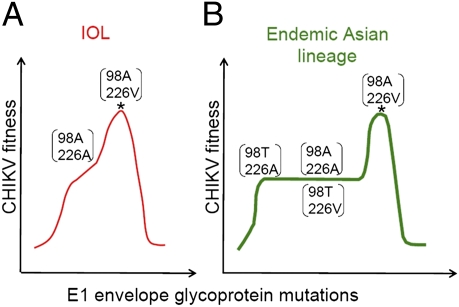
CHIKV strains of the IOL (A) and endemic Asian lineage (B) exhibit different fitness landscapes with regard to amino acid substitutions in the E1 glycoprotein. Asterisks indicate Ae. albopictus-adaptive peaks.

References

    1. Li W, et al. Receptor and viral determinants of SARS-coronavirus adaptation to human ACE2. EMBO J. 2005;24:1634–1643. - PMC - PubMed
    1. Tsetsarkin KA, Vanlandingham DL, McGee CE, Higgs S. A single mutation in Chikungunya virus affects vector specificity and epidemic potential. PLoS Pathog. 2007;3:e201. - PMC - PubMed
    1. Anishchenko M, et al. Venezuelan encephalitis emergence mediated by a phylogenetically predicted viral mutation. Proc Natl Acad Sci USA. 2006;103:4994–4999. - PMC - PubMed
    1. Brault AC, et al. A single positively selected West Nile viral mutation confers increased virogenesis in American crows. Nat Genet. 2007;39:1162–1166. - PMC - PubMed
    1. Hueffer K, Govindasamy L, Agbandje-McKenna M, Parrish CR. Combinations of two capsid regions controlling canine host range determine canine transferrin receptor binding by canine and feline parvoviruses. J Virol. 2003;77:10099–10105. - PMC - PubMed

Publication types

MeSH terms