. 2011 Jun;60(6):1779-88.
doi: 10.2337/db10-1110. Epub 2011 Apr 26.

Dedifferentiation of immortalized human podocytes in response to transforming growth factor-β: a model for diabetic podocytopathy

Affiliations

Dedifferentiation of immortalized human podocytes in response to transforming growth factor-β: a model for diabetic podocytopathy

Michal Herman-Edelstein et al. Diabetes. 2011 Jun.

Abstract

Objective: Diabetic nephropathy is associated with dedifferentiation of podocytes, losing the specialized features required for efficient glomerular function and acquiring a number of profibrotic, proinflammatory, and proliferative features. These result from tight junction and cytoskeletal rearrangement, augmented proliferation, and apoptosis.

Research design and methods: Experiments were performed in conditionally immortalized human podocytes developed by transfection with the temperature-sensitive SV40-T gene. Cells were then cultured in the presence of transforming growth factor (TGF)-β1 or angiotensin II in the presence or absence of a selective inhibitor of the TGF-β type I receptor kinase, SB-431542. Gene and protein expression were then examined by real-time RT-PCR and immunofluorescence, and correlated with changes observed in vivo in experimental diabetes.

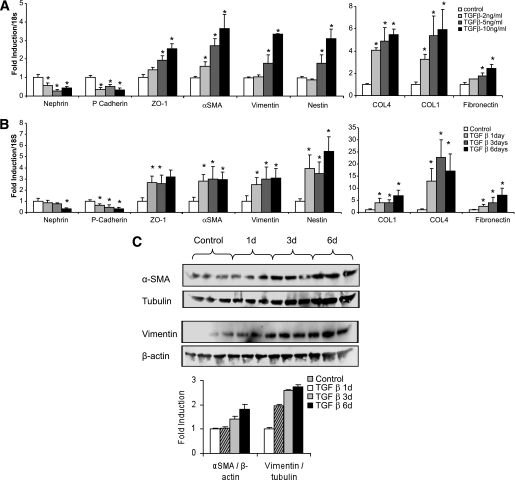
Results: Treatment of cells with TGF-β1 resulted in dynamic changes in their morphology, starting with retraction and shortening of foot processes and finishing with the formation of broad and complex tight junctions between adjacent podocytes. This dedifferentiation was also associated with dose- and time-dependent reduction in the expression of glomerular epithelial markers (nephrin, p-cadherin, zonnula occludens-1) and increased expression of mesenchymal markers (α-smooth muscle actin, vimentin, nestin), matrix components (fibronectin, collagen I, and collagen IV α3), cellular proliferation, and apoptosis. The induction of diabetes in mice was also associated with similar changes in morphology, protein expression, and proliferation in glomerular podocytes.

Conclusions: In response to TGF-β and other TGF-dependent stimuli, mature podocytes undergo dedifferentiation that leads to effacement of foot processes, morphologic flattening, and increased formation of intercellular tight junctions. This simplification of their phenotype to a more embryonic form is also associated with reentry of mature podocytes into the cell cycle, which results in enhanced proliferation and apoptosis. These "pathoadaptive" changes are seen early in the diabetic glomerulus and ultimately contribute to albuminuria, glomerulosclerosis, and podocytopenia.


Figures

FIG. 1.
FIG. 1.
Morphologic changes induced in immortalized human podocytes after treatment with TGF-β1 (10 ng/mL, right) for 3 days when compared with control cells (left), as shown by scanning electron microscopy (A and B, magnification 100×, insert showing microvilli), light microscopy (C and D, magnification 100×), immunofluorescence staining for β-actin (green) and nestin (red) (E and F), and immunofluorescence staining for F-actin (red) and ZO-1 (green) with a blue nuclear counterstain (DAPI) (G and H). (A high-quality color representation of this figure is available in the online issue.)
FIG. 2.
FIG. 2.
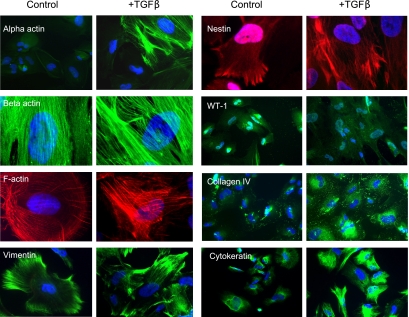
Changes in the expression of key markers of differentiation in immortalized human podocytes in response to treatment with TGF-β1 (10 ng/mL) for 3 days when compared with control cells. Immunofluorescence staining for α-actin, β-actin, F-actin, vimentin, nestin, WT1, collagen IV α3, and cytokeratin, with a blue nuclear counterstain (DAPI). (A high-quality color representation of this figure is available in the online issue.)
FIG. 3.
FIG. 3.
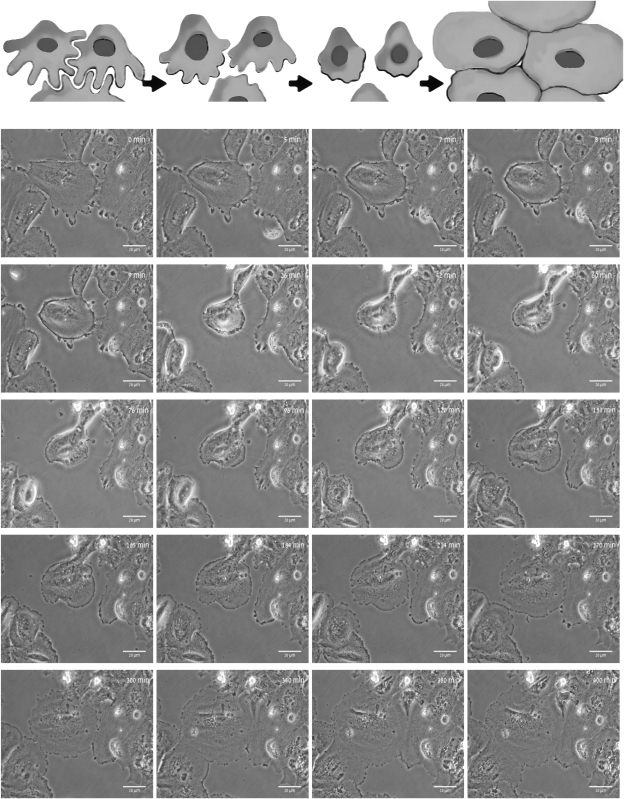
Dynamic changes in the morphology of immortalized human podocytes after treatment with TGF-β1 (10 mg/mL) over 6 h. A cartoon (top) illustrates changes observed in real-time video microscopy (bottom, Supplementary Video). Initial retraction and shortening of foot processes and contraction of the podocyte cell body are followed by flattening, broadening, and elongation of the cell and the formation of broad and complex tight junctions between adjacent podocytes. (A high-quality digital representation of this figure is available in the online issue.)
FIG. 4.
FIG. 4.
The induction of dose-dependent (A) and time-dependent changes (B) in the expression of key target genes in immortalized human podocytes after treatment with TGF-β1 (2–10 mg/mL) for 1–6 days, as measured by real-time RT-PCR (n = 6/group). C: Time-dependent changes in the expression of α-SMA and vimentin protein induced by TGF-β1 (10 mg/mL), as measured by Western blotting and adjusted for actin and tubulin expression, respectively. *P < 0.05 vs. control.
FIG. 5.
FIG. 5.
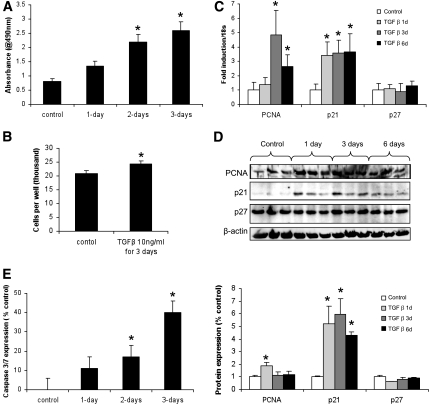
The induction of a time-dependent increase in cellular proliferation in immortalized human podocytes after treatment with TGF-β1 (10 ng/mL) for 1–6 days as measured by proliferation assay (A), cell counting (B), and the induction of PCNA and cell-cycle regulators p21 and p27 at a gene level (C) and protein level (D), as measured by real-time RT-PCR and quantified by Western blotting, respectively. At the same time, treatment with TGF-β1 (10 ng/mL) for 1–3 days also resulted in increased apoptosis, as denoted by the caspase 3/7 expression (E). *P < 0.05 vs. control.
FIG. 6.
FIG. 6.
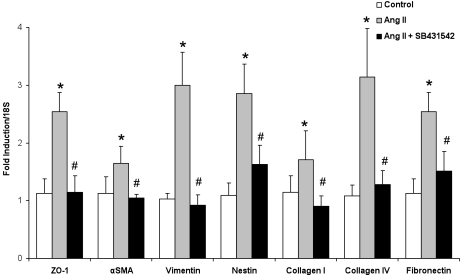
The induction in the expression of key target genes in cultured human podocytes after treatment with angiotensin II (1 nM) for 3 days in the presence and absence of a selective inhibitor of the TGF-β1 type I receptor kinase, SB-431542, as measured by real-time RT-PCR (n = 6/group). *P < 0.05 vs. control. #P < 0.05 vs. angiotensin II.
FIG. 7.
FIG. 7.
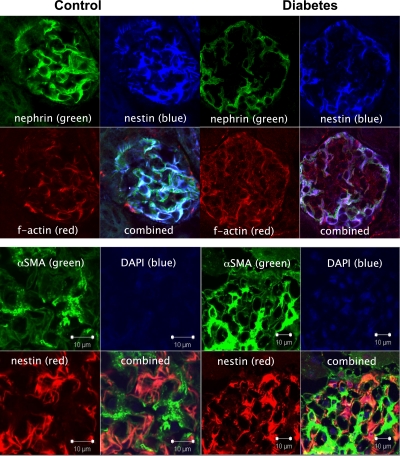
Immunofluorescent staining of cortical glomeruli showing expression of the podocyte marker, nephrin (green), f-actin (red), and the intermediate filament, nestin (blue); merged staining from control and diabetic apoE-KO mice (top); and immunostaining of cortical glomeruli showing expression of α-SMA (green), nestin (red), DAPI (blue), and merged (bottom). (A high-quality color representation of this figure is available in the online issue.)
FIG. 8.
FIG. 8.
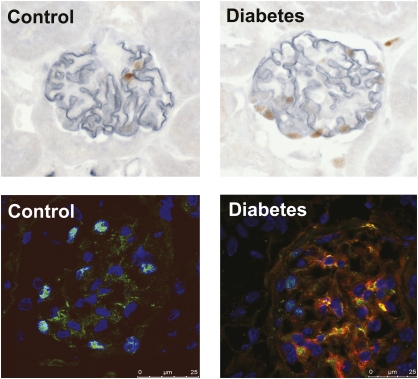
Immunostaining of cortical glomeruli from control and diabetic apoE-KO mice. Top: Costaining for the podocyte marker, nephrin, and PCNA. Bottom: Immunofluorescent staining for the proliferation marker, Ki67 (green), WT-1 (red) to denote podocytes, and a merged signal (yellow) to denote proliferating podocytes. DAPI (blue) is used as a nuclear counterstain. (A high-quality color representation of this figure is available in the online issue.)

References

    1. Ziyadeh FN, Wolf G. Pathogenesis of the podocytopathy and proteinuria in diabetic glomerulopathy. Curr Diabetes Rev 2008;4:39–45 - PubMed
    1. Wolf G, Chen S, Ziyadeh FN. From the periphery of the glomerular capillary wall toward the center of disease: podocyte injury comes of age in diabetic nephropathy. Diabetes 2005;54:1626–1634 - PubMed
    1. Li JJ, Kwak SJ, Jung DS, et al. Podocyte biology in diabetic nephropathy. Kidney Int Suppl 2007:S36–S42 - PubMed
    1. Salmon AH, Toma I, Sipos A, et al. Evidence for restriction of fluid and solute movement across the glomerular capillary wall by the subpodocyte space. Am J Physiol Renal Physiol 2007;293:F1777–F1786 - PubMed
    1. Reidy K, Susztak K. Epithelial-mesenchymal transition and podocyte loss in diabetic kidney disease. Am J Kidney Dis 2009;54:590–593 - PMC - PubMed

Publication types

MeSH terms