


Urinary tract stone occurrence in the Women's Health Initiative (WHI) randomized clinical trial of calcium and vitamin D supplements
- PMID: 21525191
- PMCID: PMC3127502
- DOI: 10.3945/ajcn.110.003350
Urinary tract stone occurrence in the Women's Health Initiative (WHI) randomized clinical trial of calcium and vitamin D supplements
Abstract
Background: The Women's Health Initiative (WHI) randomized clinical trial (RCT) of calcium plus vitamin D (CaD) supplements found a 17% excess in urinary tract stone incidence in the supplemented group. This study evaluated whether this risk is modified by participant characteristics.
Objective: We examined the correlates of urinary tract stone occurrence in the CaD arm of the WHI trial.
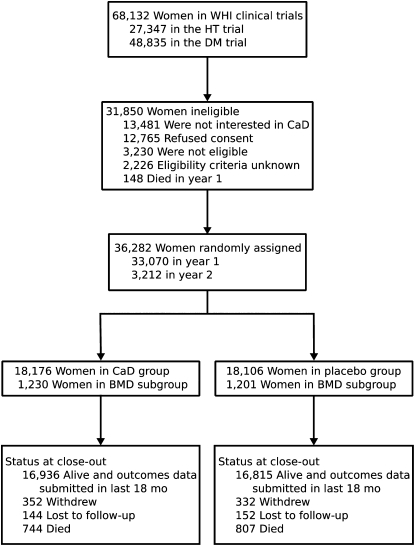
Design: We analyzed an RCT involving 36,282 postmenopausal women aged 50-79 y from 40 WHI centers: 18,176 women received 500 mg calcium carbonate plus 200 IU vitamin D(3) twice daily (1000 mg and 400 IU daily, respectively), and 18,106 women received a matching placebo for an average of 7.0 y. The incidence of urinary tract stones was determined.
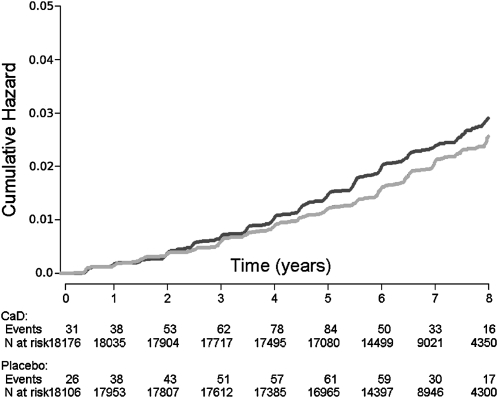
Results: The incidence of self-reported clinically diagnosed urinary tract stones was more common in the active CaD medication group than in the placebo group (hazard ratio: 1.17; 95% CI: 1.02, 1.34): 449 women in the CaD group and 381 women in the placebo group reported a stone during the trial. The rates of self-reported stones did not differ between various demographic, anthropomorphic, dietary, and other hypothesized risk factors according to randomization assignment. Neither the total calcium intake nor the use of calcium supplements at baseline was associated with the risk of stones. In sensitivity analyses that censored participants who were below 80% adherence, the findings were similar.
Conclusions: Daily supplementation with CaD for 7 y was associated with an increase in the number of self-reported urinary tract stones. These findings have implications for CaD supplement use. This trial was registered with the WHI at clinicaltrials.gov as NCT00000611.
Figures
Comment in
-
The risk of kidney stone formation: the form of calcium matters.Am J Clin Nutr. 2011 Jul;94(1):5-6. doi: 10.3945/ajcn.111.018481. Epub 2011 Jun 1. Am J Clin Nutr. 2011. PMID: 21633076 No abstract available.
References
-
- National Osteoporosis Foundation. Available from: http://www.nof.org/prevention (cited 17 June 2008)
-
- Jackson RD, LaCroix AZ, Gass M, et al. Calcium plus vitamin D supplementation and the risk of fractures. N Engl J Med 2006;354:669–83 - PubMed
-
- Anderson GL, Manson J, Wallace R, et al. Implementation of the Women's Health Initiative study design. Ann Epidemiol 2003;13(suppl):S5–17 - PubMed
-
- Curb JD, McTiernan A, Heckbert SR, et al. Outcomes ascertainment and adjudication methods in the Women's Health Initiative. Ann Epidemiol 2003;13(suppl):S122–8 - PubMed
-
- Hays J, Hunt JR, Hubbell FA, et al. The Women's Health Initiative recruitment methods and results. Ann Epidemiol 2003;13(suppl):S18–77 - PubMed
Publication types
MeSH terms
Substances
Associated data
Grants and funding
LinkOut - more resources
Full Text Sources
Medical
Miscellaneous
