


Climatic factors driving invasion of the tiger mosquito (Aedes albopictus) into new areas of Trentino, northern Italy
- PMID: 21525991
- PMCID: PMC3078124
- DOI: 10.1371/journal.pone.0014800
Climatic factors driving invasion of the tiger mosquito (Aedes albopictus) into new areas of Trentino, northern Italy
Abstract
Background: The tiger mosquito (Aedes albopictus), vector of several emerging diseases, is expanding into more northerly latitudes as well as into higher altitudes in northern Italy. Changes in the pattern of distribution of the tiger mosquito may affect the potential spread of infectious diseases transmitted by this species in Europe. Therefore, predicting suitable areas of future establishment and spread is essential for planning early prevention and control strategies.
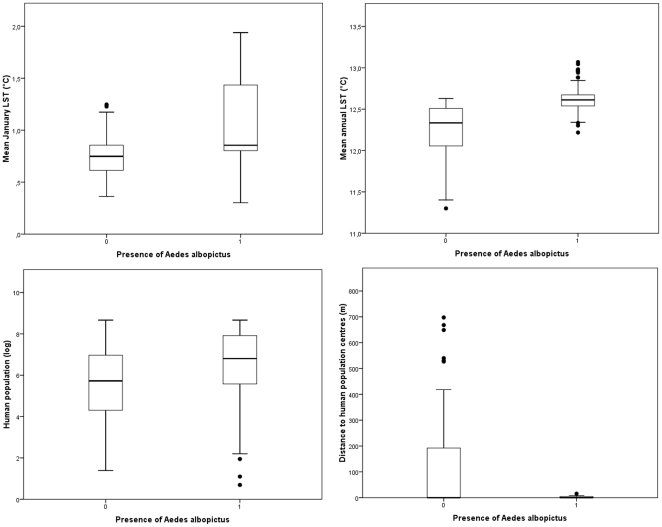
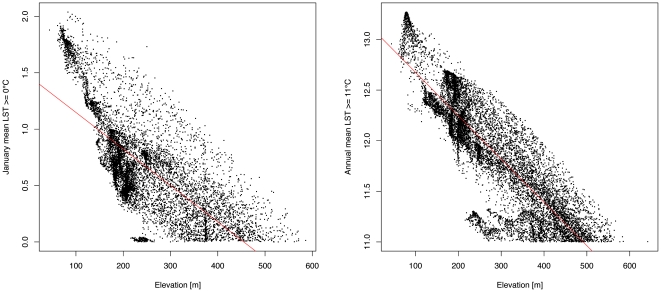
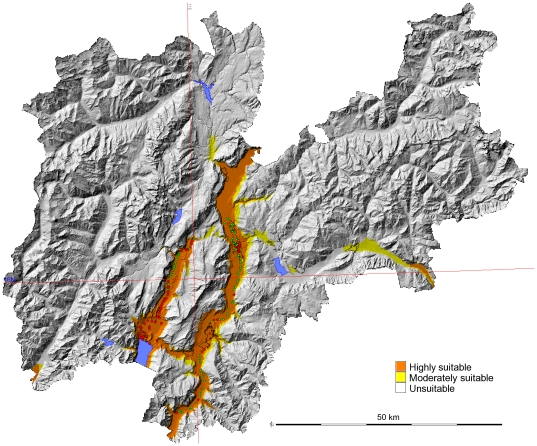
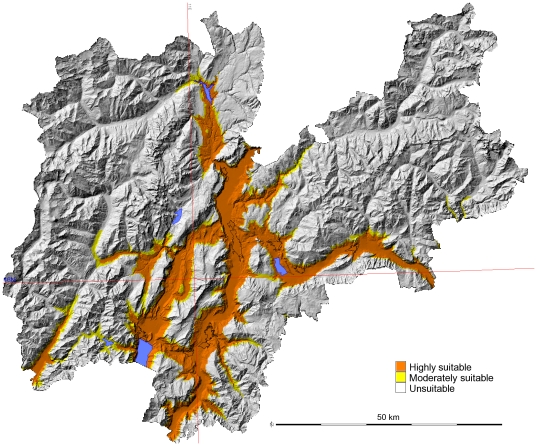
Methodology/principal findings: To identify the areas currently most suitable for the occurrence of the tiger mosquito in the Province of Trento, we combined field entomological observations with analyses of satellite temperature data (MODIS Land Surface Temperature: LST) and human population data. We determine threshold conditions for the survival of overwintering eggs and for adult survival using both January mean temperatures and annual mean temperatures. We show that the 0°C LST threshold for January mean temperatures and the 11°C threshold for annual mean temperatures provide the best predictors for identifying the areas that could potentially support populations of this mosquito. In fact, human population density and distance to human settlements appear to be less important variables affecting mosquito distribution in this area. Finally, we evaluated the future establishment and spread of this species in relation to predicted climate warming by considering the A2 scenario for 2050 statistically downscaled at regional level in which winter and annual temperatures increase by 1.5 and 1°C, respectively.
Conclusions/significance: MODIS satellite LST data are useful for accurately predicting potential areas of tiger mosquito distribution and for revealing the range limits of this species in mountainous areas, predictions which could be extended to an European scale. We show that the observed trend of increasing temperatures due to climate change could facilitate further invasion of Ae. albopictus into new areas.
Conflict of interest statement
Figures
References
-
- Hawley W. The biology of Aedes albopictus. J Am Mosq Control Assoc. 1988;1:1–39. - PubMed
-
- Romi R, Toma L, Severini F, Di Luca M. Twenty years of the presence of Aedes albopictus in Italy – From the annoying pest mosquito to the real disease vector. Eur Inf Dis. 2008;2:98–101.
-
- Sabatini A, Raineri V, Trovato G, Coluzzi M. Aedes albopictus in Italy and possible diffusion of the species into the Mediterranean area. Parassitologia. 1990;32:301–304. - PubMed
-
- Dalla Pozza G, Romi R, Severini C. Source and spread of Aedes albopictus in the Veneto region of Italy. J Am Mosq Control Assoc. 1994;10:589–592. - PubMed
-
- Ferrarese U. Monitoraggio di Aedes albopictus (Skuse) (Diptera, Culicidae) attorno a un focolaio nel comune di Rovereto (Trento). Ann Mus Civ Rov. 2003;19:281–295.
Publication types
MeSH terms
LinkOut - more resources
Full Text Sources
