


The Ying-Yang of the virus-host interaction: control of the DNA damage response
- PMID: 21526939
- PMCID: PMC3169440
- DOI: 10.2217/fmb.11.16
The Ying-Yang of the virus-host interaction: control of the DNA damage response
Abstract
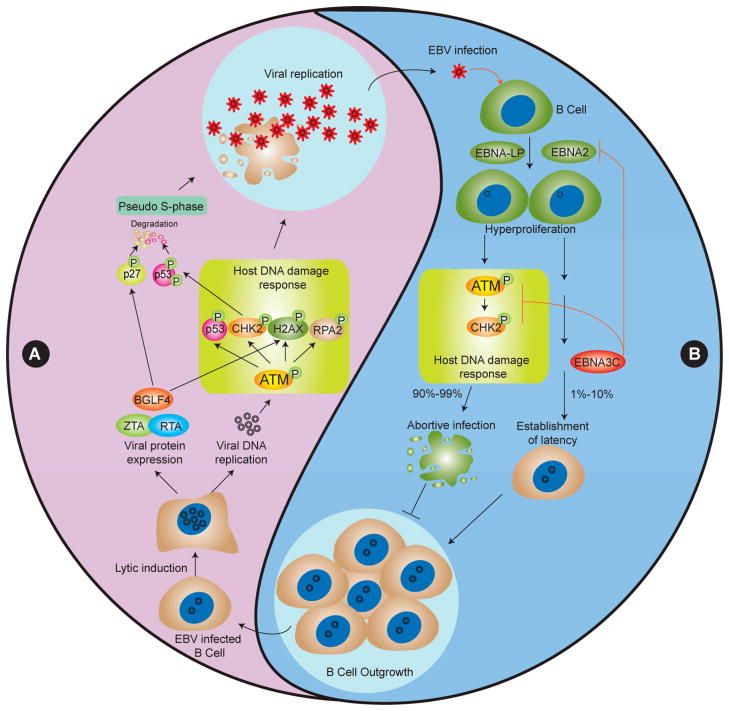
Evaluation of: Nikitin PA, Yan CM, Forte E et al.: An ATM/Chk2-mediated DNA damage-responsive signaling pathway suppresses Epstein-Barr virus transformation of primary human B cells. Cell. Host Microbe 8(6), 510-522 (2010). Viruses have evolved elegant strategies to manipulate the host while the host counters with defense systems including the interferon response, apoptosis and the DNA damage response (DDR). Viruses have multiple strategies for manipulating the DDR and the same virus can even activate or inhibit the DDR at different stages of infection. Epstein-Barr virus (EBV) is implicated in several human cancers, including Burkitt's lymphoma, nasopharyngeal carcinoma, post-transplant lymphoproliferative disease and HIV-associated lymphomas. Although multiple viral proteins have been implicated in EBV-associated malignancies, the cellular pathways that control EBV-induced transformation and tumorigenesis remain incompletely understood. In this study, Nikitin et al. demonstrate that early EBV infection induces a cellular DDR that restricts virus-mediated transformation. The EBV-encoded EBNA3C protein subsequently attenuates this response to favor transformation and immortalization of host cells.
Figures
Comment on
-
An ATM/Chk2-mediated DNA damage-responsive signaling pathway suppresses Epstein-Barr virus transformation of primary human B cells.Cell Host Microbe. 2010 Dec 16;8(6):510-22. doi: 10.1016/j.chom.2010.11.004. Cell Host Microbe. 2010. PMID: 21147465 Free PMC article.
References
-
- Epstein MA, Achong BG, Barr YM. Virus Particles in Cultured Lymphoblasts from Burkitt’s Lymphoma. Lancet. 1964;1(7335):702–703. Describes the discovery ofEpstein-Barr virus (EBV) - PubMed
-
- Young LS, Rickinson AB. Epstein-Barr virus: 40 years on. Nat Rev Cancer. 2004;4(10):757–768. Comprehensive overview on EBV and associated cancers. - PubMed
-
- Tsurumi T, Fujita M, Kudoh A. Latent and lytic Epstein-Barr virus replication strategies. Rev Med Virol. 2005;15(1):3–15. - PubMed
Publication types
Grants and funding
LinkOut - more resources
Full Text Sources
Research Materials
Miscellaneous
