


The use of microbead-based spoligotyping for Mycobacterium tuberculosis complex to evaluate the quality of the conventional method: providing guidelines for Quality Assurance when working on membranes
- PMID: 21527037
- PMCID: PMC3107175
- DOI: 10.1186/1471-2334-11-110
The use of microbead-based spoligotyping for Mycobacterium tuberculosis complex to evaluate the quality of the conventional method: providing guidelines for Quality Assurance when working on membranes
Abstract
Background: The classical spoligotyping technique, relying on membrane reverse line-blot hybridization of the spacers of the Mycobacterium tuberculosis CRISPR locus, is used world-wide (598 references in Pubmed on April 8th, 2011). However, until now no inter-laboratory quality control study had been undertaken to validate this technique. We analyzed the quality of membrane-based spoligotyping by comparing it to the recently introduced and highly robust microbead-based spoligotyping. Nine hundred and twenty-seven isolates were analyzed totaling 39,861 data points. Samples were received from 11 international laboratories with a worldwide distribution.
Methods: The high-throughput microbead-based Spoligotyping was performed on CTAB and thermolyzate DNA extracted from isolated Mycobacterium tuberculosis complex (MTC) strains coming from the genotyping participating centers. Information regarding how the classical Spoligotyping method was performed by center was available. Genotype discriminatory analyses were carried out by comparing the spoligotypes obtained by both methods. The non parametric U-Mann Whitney homogeneity test and the Spearman rank correlation test were performed to validate the observed results.
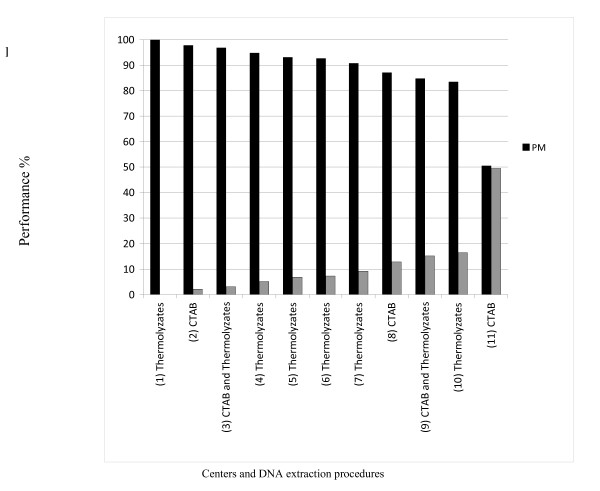
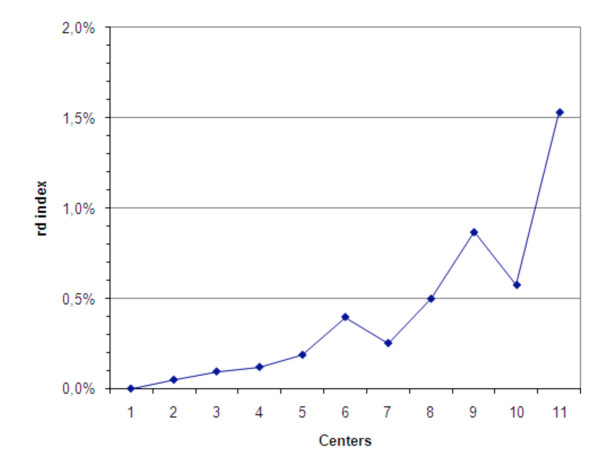
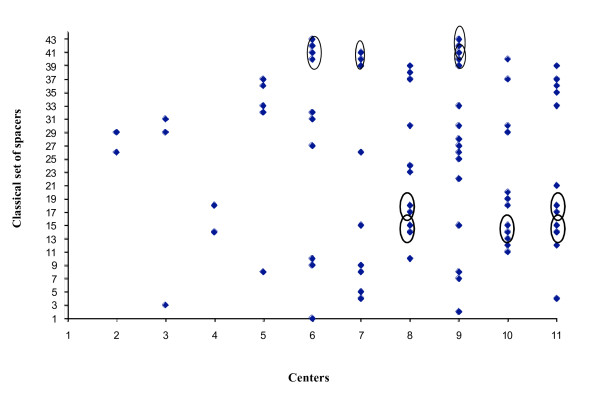
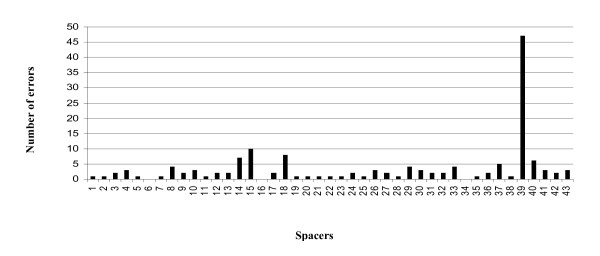
Results: Seven out of the 11 laboratories (63%), perfectly typed more than 90% of isolates, 3 scored between 80-90% and a single center was under 80% reaching 51% concordance only. However, this was mainly due to discordance in a single spacer, likely having a non-functional probe on the membrane used. The centers using thermolyzate DNA performed as well as centers using the more extended CTAB extraction procedure. Few centers shared the same problematic spacers and these problematic spacers were scattered over the whole CRISPR locus (Mostly spacers 15, 14, 18, 37, 39, 40).
Conclusions: We confirm that classical spoligotyping is a robust method with generally a high reliability in most centers. The applied DNA extraction procedure (CTAB or thermolyzate) did not affect the results in this study. However performance was center-dependent, suggesting that training is a key component in quality assurance of spoligotyping. Overall, no particular spacer yielded a higher degree of deviating results, suggesting that errors occur randomly either in the process of re-using membranes, or during the reading of the results and transferring of data from the film to a digital file. Last, the performance of the microbead-based method was excellent as previously shown by Cowan et al. (J. Clin. Microbiol. 2004) and Zhang et al. (J. Med. Microbiol. 2009) and demonstrated the proper detection of spacer 15 that is known to occasionally give weak signals in the classical spoligotyping.
Figures
References
-
- Makarova KS, Grishin NV, Shabalina SA, Wolf YI, Koonin EV. A putative RNA-interference-based immune system in prokaryotes: computational analysis of the predicted enzymatic machinery, functional analogies with eukaryotic RNAi, and hypothetical mechanisms of action. Biol Direct. 2006;1:7. doi: 10.1186/1745-6150-1-7. - DOI - PMC - PubMed
-
- Groenen PM, Bunschoten AE, van Soolingen D, van Embden JD. Nature of DNA polymorphism in the direct repeat cluster of Mycobacterium tuberculosis; application for strain differentiation by a novel typing method. Mol Microbiol. 1993;10(5):1057–1065. doi: 10.1111/j.1365-2958.1993.tb00976.x. - DOI - PubMed
Publication types
MeSH terms
Substances
Grants and funding
LinkOut - more resources
Full Text Sources
Medical
Miscellaneous
