


Alternative donor transplantation after reduced intensity conditioning: results of parallel phase 2 trials using partially HLA-mismatched related bone marrow or unrelated double umbilical cord blood grafts
- PMID: 21527516
- PMCID: PMC3138683
- DOI: 10.1182/blood-2011-03-344853
Alternative donor transplantation after reduced intensity conditioning: results of parallel phase 2 trials using partially HLA-mismatched related bone marrow or unrelated double umbilical cord blood grafts
Abstract
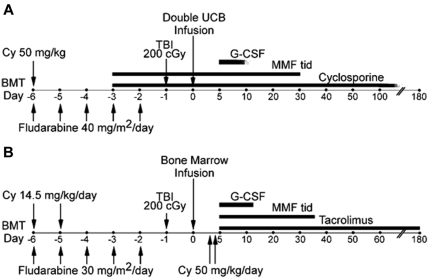
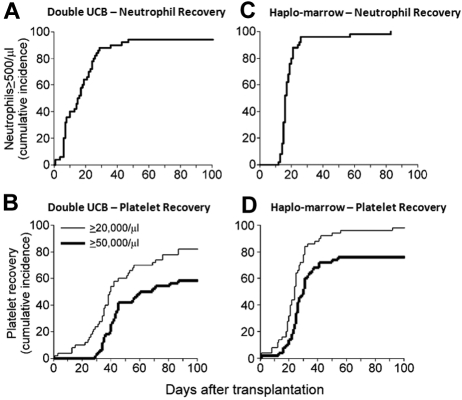
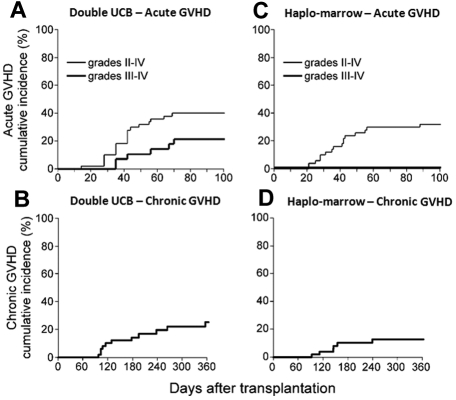
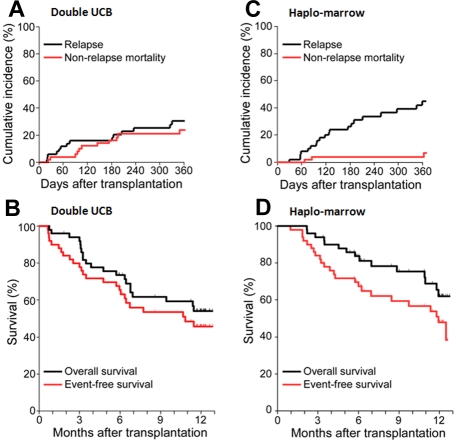
The Blood and Marrow Transplant Clinical Trials Network conducted 2 parallel multicenter phase 2 trials for individuals with leukemia or lymphoma and no suitable related donor. Reduced intensity conditioning (RIC) was used with either unrelated double umbilical cord blood (dUCB) or HLA-haploidentical related donor bone marrow (Haplo-marrow) transplantation. For both trials, the transplantation conditioning regimen incorporated cyclophosphamide, fludarabine, and 200 cGy of total body irradiation. The 1-year probabilities of overall and progression-free survival were 54% and 46%, respectively, after dUCB transplantation (n = 50) and 62% and 48%, respectively, after Haplo-marrow transplantation (n = 50). The day +56 cumulative incidence of neutrophil recovery was 94% after dUCB and 96% after Haplo-marrow transplantation. The 100-day cumulative incidence of grade II-IV acute GVHD was 40% after dUCB and 32% after Haplo-marrow transplantation. The 1-year cumulative incidences of nonrelapse mortality and relapse after dUCB transplantation were 24% and 31%, respectively, with corresponding results of 7% and 45%, respectively, after Haplo-marrow transplantation. These multicenter studies confirm the utility of dUCB and Haplo-marrow as alternative donor sources and set the stage for a multicenter randomized clinical trial to assess the relative efficacy of these 2 strategies. The trials are registered at www.clinicaltrials.gov under NCT00864227 (BMT CTN 0604) and NCT00849147 (BMT CTN 0603).
Figures
Comment in
-
Now everyone has a donor for HSCT.Blood. 2011 Jul 14;118(2):218. doi: 10.1182/blood-2011-05-352518. Blood. 2011. PMID: 21757626 No abstract available.
References
-
- Giralt S, Logan B, Rizzo D, et al. Reduced-intensity conditioning for unrelated donor progenitor cell transplantation: long-term follow-up of the first 285 reported to the national marrow donor program. Biol Blood Marrow Transplant. 2007;13(7):844–852. - PubMed
-
- Platzbecker U, Thiede C, Fussel M, et al. Reduced intensity conditioning allows for up-front allogeneic hematopoietic stem cell transplantation after cytoreductive induction therapy in newly-diagnosed high-risk acute myeloid leukemia. Leukemia. 2006;20(4):707–714. - PubMed
-
- Popat U, Heslop HE, Durett A, et al. Outcome of reduced-intensity allogeneic hematopoietic stem cell transplantation (RISCT) using antilymphocyte antibodies in patients with high-risk acute myeloid leukemia (AML). Bone Marrow Transplant. 2006;37(6):547–552. - PubMed
-
- Grigg AP, Gibson J, Bardy PG, et al. A prospective multicenter trial of peripheral blood stem cell sibling allografts for acute myeloid leukemia in first complete remission using fludarabine-cyclophosphamide reduced intensity conditioning. Biol Blood Marrow Transplant. 2007;13(5):560–567. - PubMed
-
- Oran B, Giralt S, Saliba R, et al. Allogeneic hematopoietic stem cell transplantation for the treatment of high-risk acute myelogenous leukemia and myelodysplastic syndrome using reduced-intensity conditioning with fludarabine andmelphalan. Biol Blood Marrow Transplant. 2007;13(4):454–462. - PMC - PubMed
Publication types
MeSH terms
Substances
Associated data
Grants and funding
LinkOut - more resources
Full Text Sources
Other Literature Sources
Medical
Research Materials
