


Predictors of long-term weight loss in adults with modest initial weight loss, by sex and race
- PMID: 21527896
- PMCID: PMC3830958
- DOI: 10.1038/oby.2011.88
Predictors of long-term weight loss in adults with modest initial weight loss, by sex and race
Abstract
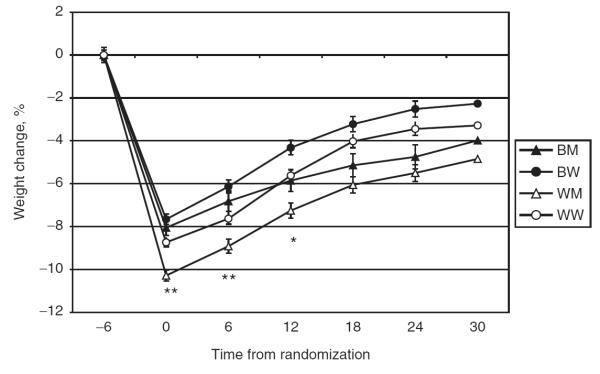
Effective weight management interventions could reduce race-sex disparities in cardiovascular disease (CVD), yet little is known about factors associated with successful weight loss maintenance in race-sex subgroups. In the Weight Loss Maintenance trial (WLM), overweight/obese (BMI 25-45 kg/m(2)) adults who lost ≥4 kg in a 6-month behavioral weight loss intervention (phase I) were randomized into one of three 30-month maintenance interventions (phase II). To investigate predictors in subgroups, randomized groups were combined for this analysis. Of 1,685 phase I participants, 1,032 (61%) entered phase II, including 12% black men (BM), 26% black women (BW), 25% white men (WM), and 37% white women (WW). Weight change over the 36-month study ranged from -2.3% (95% confidence interval = -3.1 to -1.5%) in BW to -4.5% (95% confidence interval = -5.7 to -4.0%) in WM, the result of differential weight loss during phase I. Within race, men lost significantly more weight than women, but within sex group, weight loss did not differ significantly between races. Although participants regained weight during phase II, regain did not differ by race-sex group, and mean weight at the end of the study was significantly lower than phase I entry weight for each subgroup. In regression models, phase I weight loss predicted overall 36-month weight loss in all race-sex groups. Healthy dietary pattern at entry, improvement in dietary pattern, or both were predictive in three of four race-sex groups. Few other variables other than initial weight loss and dietary pattern were predictive. Future research should identify additional modifiable influences on long-term maintenance after a modest weight loss.
Figures
References
-
- Flegal KM, Carroll MD, Ogden CL, Curtin LR. Prevalence and trends in obesity among US adults, 1999-2008. JAMA. 2010;303:235–241. - PubMed
-
- Lloyd-Jones D, Adams R, Carnethon M, et al. American Heart Association Statistics Committee and Stroke Statistics Subcommittee Heart disease and stroke statistics–2009 update: a report from the American Heart Association Statistics Committee and Stroke Statistics Subcommittee. Circulation. 2009;119:480–486. - PubMed
-
- Wadden TA, Butryn ML, Wilson C. Lifestyle modification for the management of obesity. Gastroenterology. 2007;132:2226–2238. - PubMed
-
- Appel LJ, Champagne CM, Harsha DW, et al. Writing Group of the PREMIER Collaborative Research Group Effects of comprehensive lifestyle modification on blood pressure control: main results of the PREMIER clinical trial. JAMA. 2003;289:2083–2093. - PubMed
Publication types
MeSH terms
Grants and funding
LinkOut - more resources
Full Text Sources
Other Literature Sources
Medical
