


Influenza immunization with trehalose-stabilized virus-like particle vaccine using microneedles
- PMID: 21528098
- PMCID: PMC3082143
- DOI: 10.1016/j.provac.2010.03.004
Influenza immunization with trehalose-stabilized virus-like particle vaccine using microneedles
Abstract
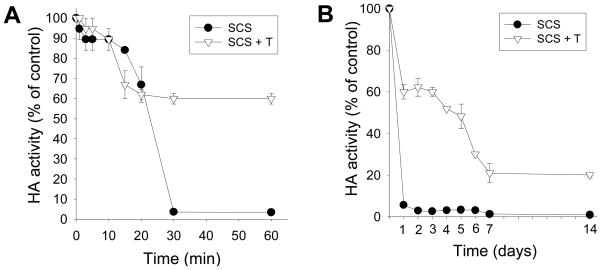
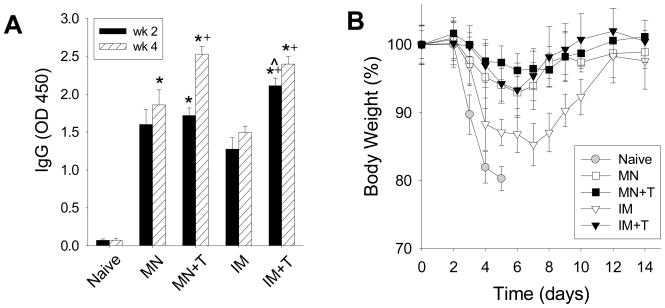
Morbidity and mortality due to seasonal and pandemic influenza could be reduced by simpler vaccination methods that enable improved vaccination coverage. In this study, solid metal microneedles coated with influenza virus-like particle (VLP) vaccine were inserted into skin for intradermal immunization. Microneedles were applied to the skin by hand and designed for simple administration with little or no training. Inclusion of trehalose in the coating formulation significantly increased vaccine stability during coating by maintaining hemagglutination activity. Mice vaccinated with stabilized microneedles developed strong antibody responses comparable to conventional intramuscular vaccination and were fully protected against subsequent viral challenge. Whereas, coating microneedles with a coating solution lacking trehalose led to only partial protection against lethal viral challenge. Therefore, our results show that microneedles coated with trehalose-stabilized VLP vaccine can be a promising tool for improving influenza vaccination.
Figures
References
-
- Monto AS, Ohmit SE. Seasonal influenza vaccines: evolutions and future trends. Expert Rev Vaccines. 2009;8:383–389. - PubMed
-
- Partidos CD, Beignon AS, Mawas F, Belliard G, Briand JP, Muller S. Immunity under the skin: potential application for topical delivery of vaccines. Vaccine. 2003;21:776–780. - PubMed
Grants and funding
LinkOut - more resources
Full Text Sources